
Home › Research › WhatsApp Statistics: How Many People Use WhatsApp? (2026)
Research data
WhatsApp Statistics: Users, Countries, Groups and Channels
More than 3 billion people use WhatsApp each month. Verified figures on users by country, the US, groups, channels, revenue and the numbers with no source.
What these numbers measure. Every figure on this page was published by someone else: Meta and WhatsApp, regulators, statistics offices, audience panels, surveys and peer-reviewed studies, each named with its source. None of them is WHAMetrics data, and none counts groups or channels that WHAMetrics manages.
Key WhatsApp statistics
Figures published by Meta, regulators, surveys and studies; none is WHAMetrics data.
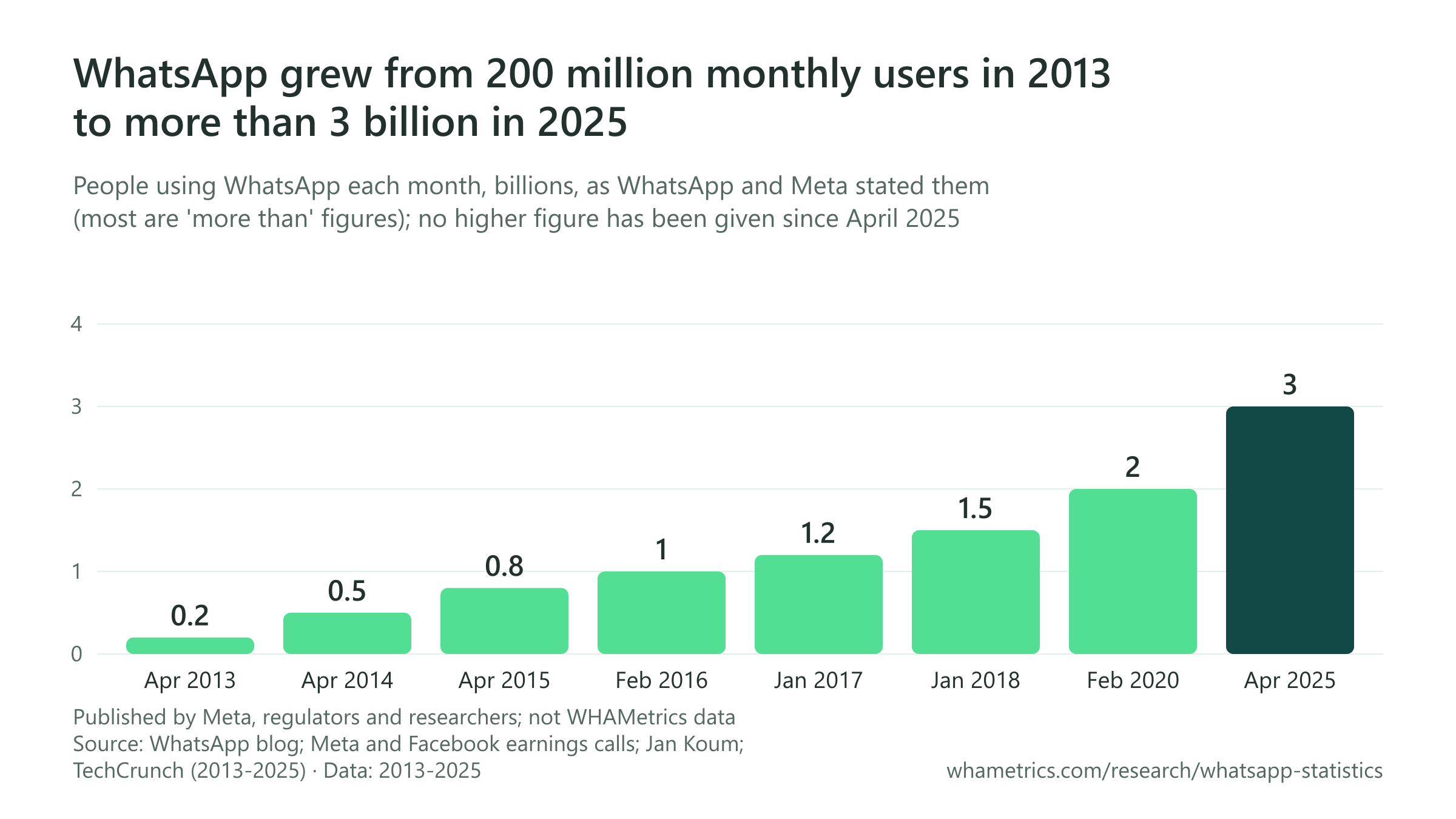
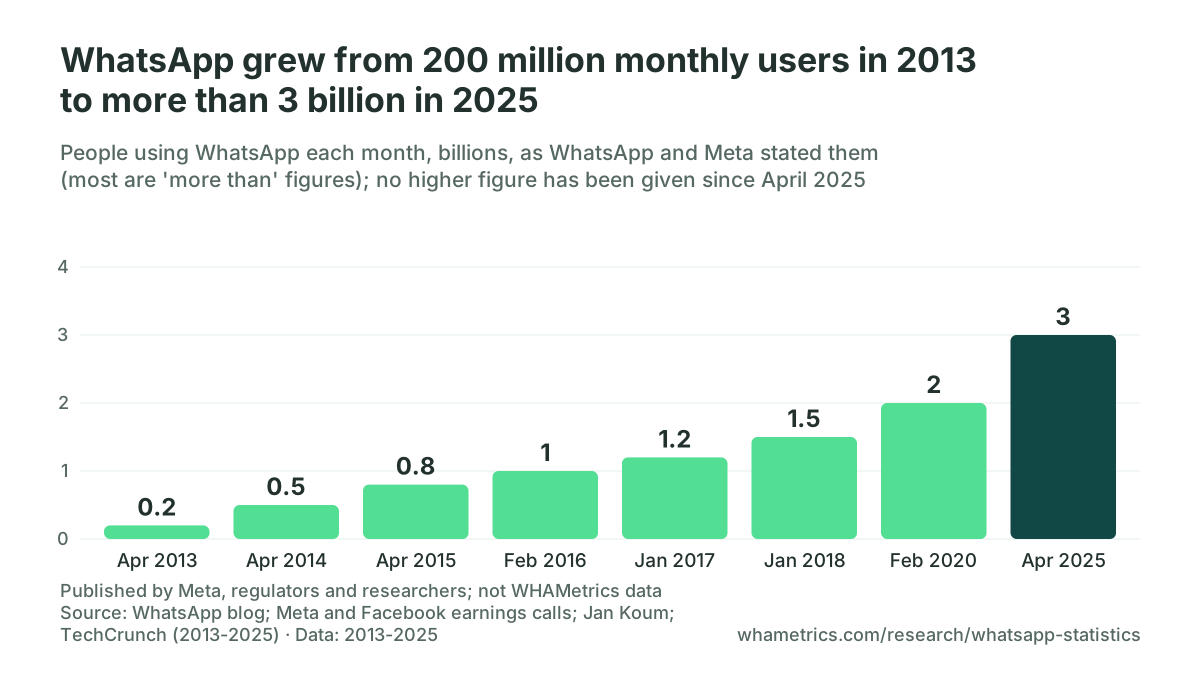
- More than 3 billion people used WhatsApp each month in April 2025, a figure its owner has not raised since.
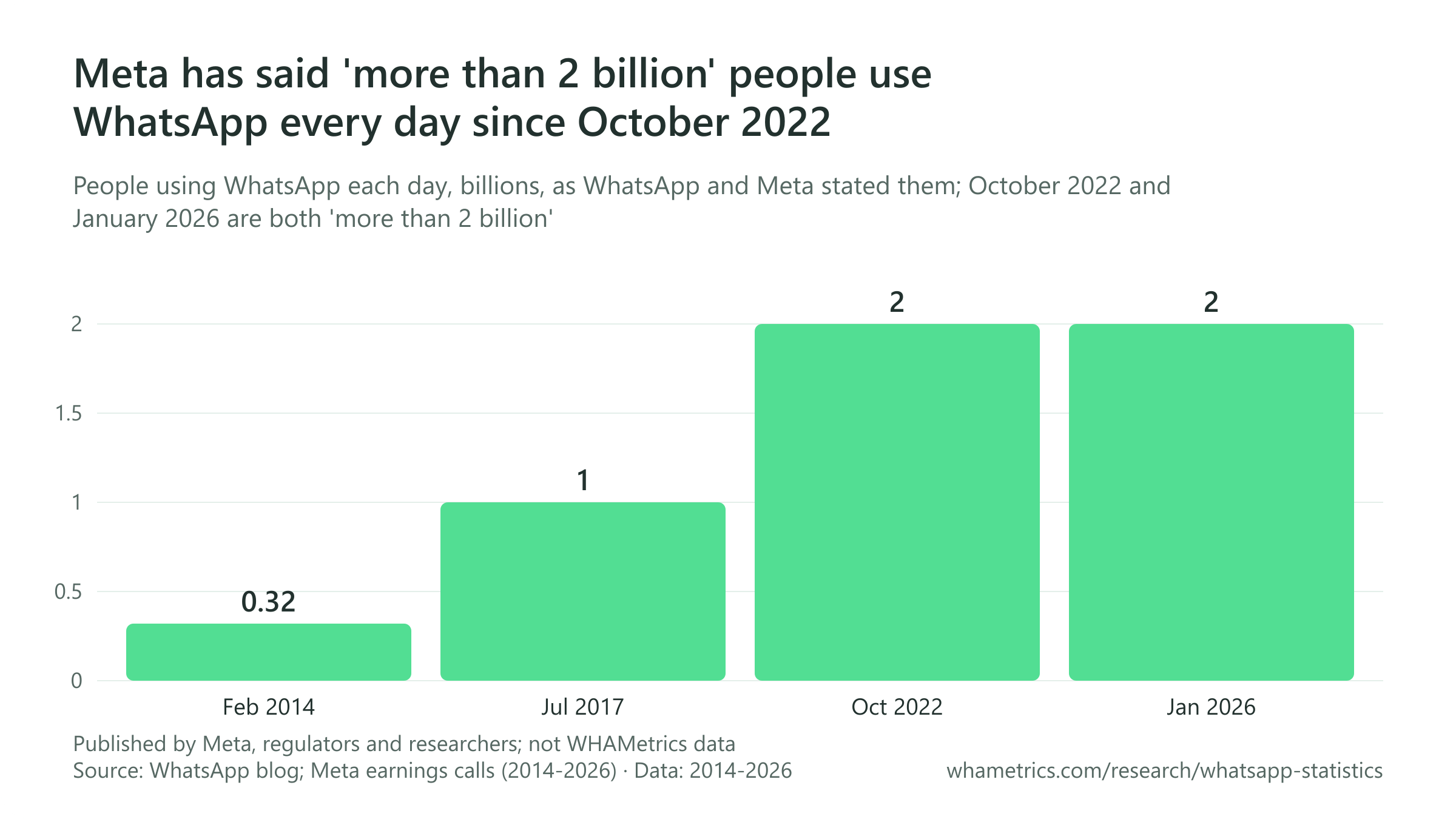
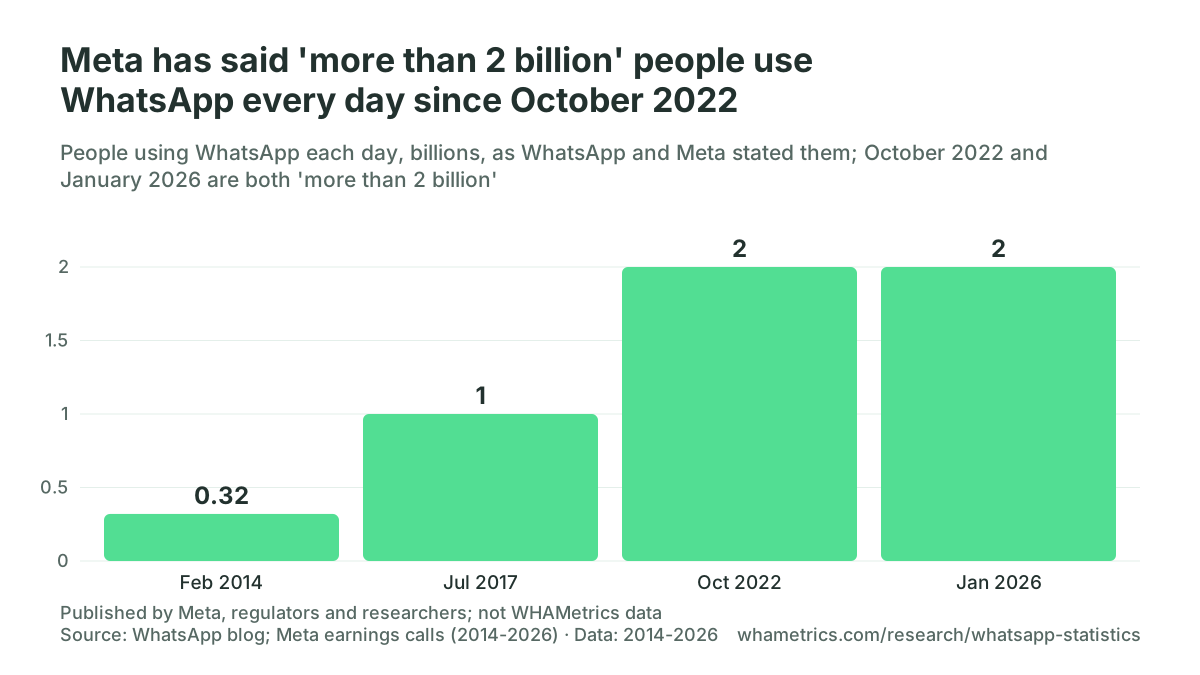
- More than 2 billion people use WhatsApp daily, a figure first given in October 2022 and repeated in January 2026.
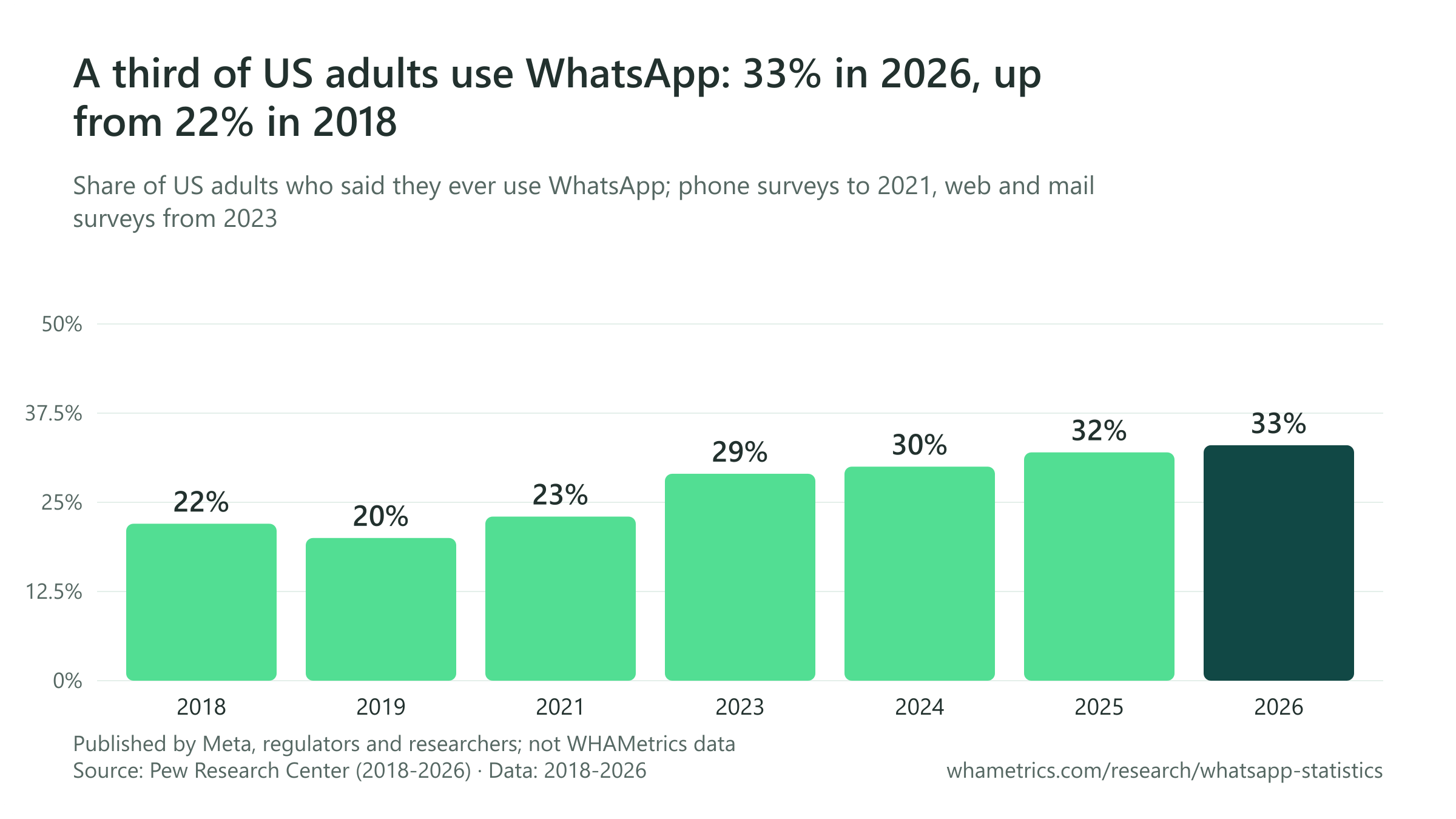
- 33% of US adults said they use WhatsApp in 2026, up from 22% in 2018.
- 90% of adults in Brazil said they use WhatsApp in 2023, the most of eight middle-income countries.
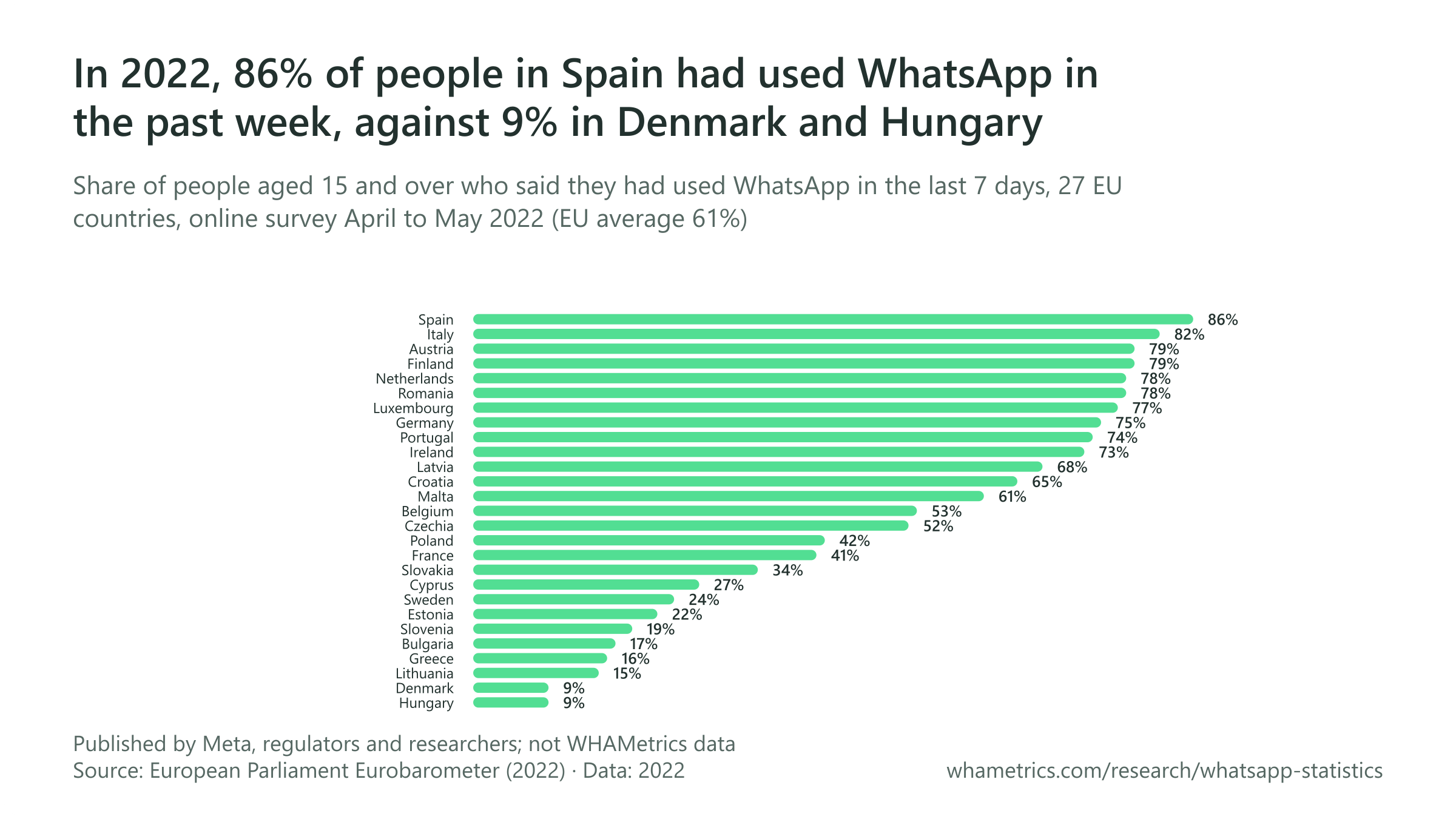
- 61% of people in the EU aged 15 and over had used WhatsApp in the past seven days in 2022.
- 74% of UK online adults used WhatsApp on an average day in May 2025, up from 48% in 2022.
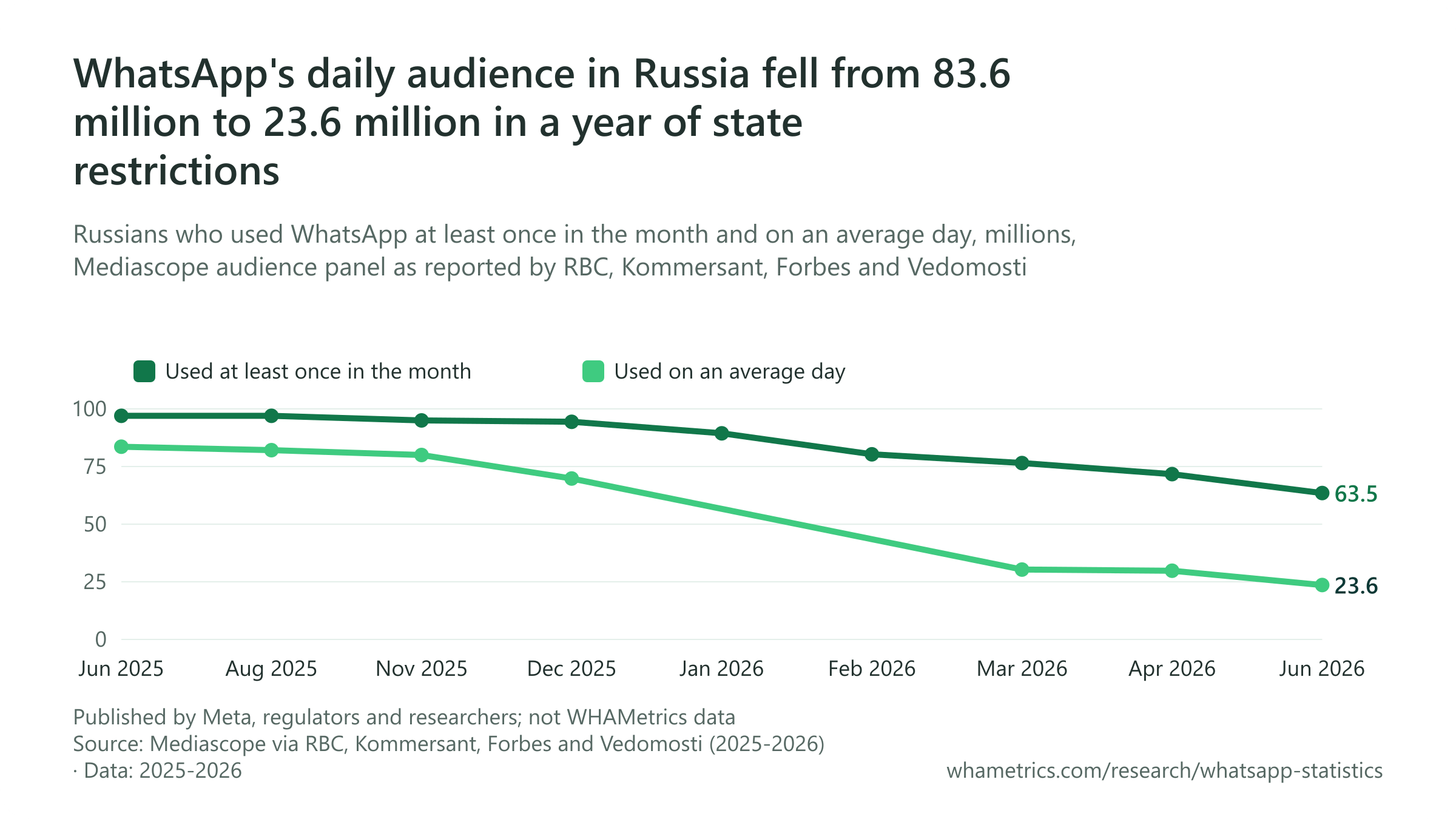
- 63.5 million Russians aged 12 and over used WhatsApp in June 2026, down from 97 million a year earlier.
- WhatsApp's owner booked $1.1 billion of 'other revenue' in the third quarter of 2026, mostly WhatsApp paid messaging and subscriptions.
Sources: Meta Platforms, Inc. (2026a, 2026b, 2025); Pew Research Center (2026, 2024); European Parliament; Ofcom; Vedomosti
WhatsApp is how much of the world talks: family groups in Brazil, traders in Nigeria, school classes in Germany, voters in India. Yet its owner publishes no regular count of its users, and most numbers repeated about it trace back to a vendor's estimate or to nothing at all. This page gathers what has actually been published: Meta's and WhatsApp's own statements, each with its date and wording; national regulators', statistics offices' and audience panels' measurements, each with its measure and population; studies of groups, messages and accounts; the EU's official count of Channels users; and Meta's filings on how WhatsApp makes money. Where a popular number has no source, the page says where it came from.
How many people use WhatsApp?
Figures published by Meta, regulators, surveys and studies; none is WHAMetrics data.
More than 3 billion people used WhatsApp each month in April 2025, a figure its owner has not raised since (Meta, 2025).

- More than 2 billion people use WhatsApp daily, a figure first given in October 2022 and repeated in January 2026.
- 1 billion people were using WhatsApp in February 2016, nearly one in seven people on Earth.
- Researchers counted 3.46 billion active WhatsApp accounts in early 2025: registered phone numbers, not people.
- 3.64 billion people used at least one of Meta's apps, WhatsApp included, each day in the third quarter of 2026.
- 70% of WhatsApp's monthly users used it on a given day in February 2014, when Facebook agreed to buy it.
| Date and source | Daily users |
|---|---|
| February 2014, WhatsApp blog | more than 320 million |
| July 2017, WhatsApp blog | 1 billion |
| October 2022, Meta earnings call | more than 2 billion |
Sources: Meta Platforms, Inc. (2026a, 2026b, 2025, 2022); WhatsApp LLC (2014-2020); University of Vienna and SBA Research; Facebook, Inc. (2018, 2017, 2014); TechCrunch; Jan Koum
More statistics (37)
WhatsApp has never published a regular user count. What exists is a string of milestones: a number given on an earnings call, in a blog post or in an executive's post, each worded its own way and dated. Monthly users and daily users are different measures, and so are people and accounts; each figure below keeps the wording it was given in. Meta's company-wide counts cover all of its apps together.
Monthly users, statement by statement
- 400 million people used WhatsApp each month in December 2013, with 100 million active users added in the previous four months, WhatsApp said (WhatsApp, 2013).
- 700 million people used WhatsApp each month at the start of January 2015, Facebook said on its fourth-quarter 2014 earnings call (Facebook, 2015).
- More than 800 million people used WhatsApp each month in April 2015, Facebook said on its first-quarter 2015 earnings call (Facebook, 2015).
- 900 million people used WhatsApp each month in the third quarter of 2015, Facebook said on its third-quarter 2015 earnings call (Facebook, 2015).
- Nearly 1 billion people relied on WhatsApp in January 2016, WhatsApp said when it dropped its subscription fee (WhatsApp, 2016).
- Nearly 1 billion people used WhatsApp each month at the end of 2015, Facebook said on its fourth-quarter 2015 earnings call (Facebook, 2016).
- 1.3 billion people used WhatsApp in January 2018, WhatsApp said when it launched the WhatsApp Business app (WhatsApp, 2018).
- More than 3 billion people in over 180 countries used WhatsApp in September 2025, WhatsApp said (WhatsApp, 2025).
- More than 3 billion people were on WhatsApp in June 2026, WhatsApp said when it opened username reservations (WhatsApp, 2026).
- More than 3 billion people globally, including more than 100 million in the US, were on WhatsApp in August 2026, WhatsApp said (WhatsApp, 2026).
- 300 million people used WhatsApp each month in August 2013, WhatsApp told AllThingsD (AllThingsD, 2013).
- 350 million people used WhatsApp each month in October 2013, its chief executive announced at Nokia World, The Next Web reported (The Next Web, 2013).
- 600 million people used WhatsApp each month in August 2014, WhatsApp's chief executive said (Jan Koum, 2014).
- More than 700 million people used WhatsApp each month in January 2015, WhatsApp's chief executive said (Jan Koum, 2015).
- 900 million people used WhatsApp each month in September 2015, WhatsApp's chief executive said (Jan Koum, 2015).
- 1.3 billion people used WhatsApp each month in July 2017, alongside 1 billion daily users, TechCrunch reported from Facebook's stats update (TechCrunch, 2017).
Daily users

- 450 million people used WhatsApp each month and more than 320 million used it each day in February 2014, WhatsApp said when it agreed to join Facebook (WhatsApp, 2014).
- More than 450 million people used WhatsApp each month in February 2014, 70% of them on a given day, Facebook said when it agreed to buy WhatsApp (Facebook, 2014).
- WhatsApp was adding more than 1 million new registered users a day in February 2014, Facebook said (Facebook, 2014).
- 465 million people used WhatsApp each month and 330 million each day in February 2014, its chief executive said at Mobile World Congress, TechCrunch reported (TechCrunch, 2014).
- 330 million people used WhatsApp each day in February 2014, its chief executive said at Mobile World Congress, TechCrunch reported (TechCrunch, 2014).
- 72% of WhatsApp's monthly users were active daily in February 2014, said Sequoia Capital, its investor (Sequoia Capital, 2014).
WhatsApp's About page
- More than 3 billion people in over 180 countries use WhatsApp, its About page has said since October 2025 (WhatsApp, 2025).
- More than 1 billion people in over 180 countries used WhatsApp, its About page said from September 2016 to February 2020 (WhatsApp, 2016).
- More than 2 billion people in over 180 countries used WhatsApp, its About page said from March 2020 to September 2025 (WhatsApp, 2020).
Accounts are not people
- 2.2 billion people remained offline in 2025, while almost three-quarters of the world's population used the internet (ITU estimates; ITU, 2025).
- 81% of the active WhatsApp accounts researchers found ran on Android and 19% on iOS, December 2024 to April 2025 (account enumeration; Gegenhuber et al., 2025).
- 9.0% of the active WhatsApp accounts researchers found were business accounts, December 2024 to April 2025 (account enumeration; Gegenhuber et al., 2025).
Meta's apps as a family

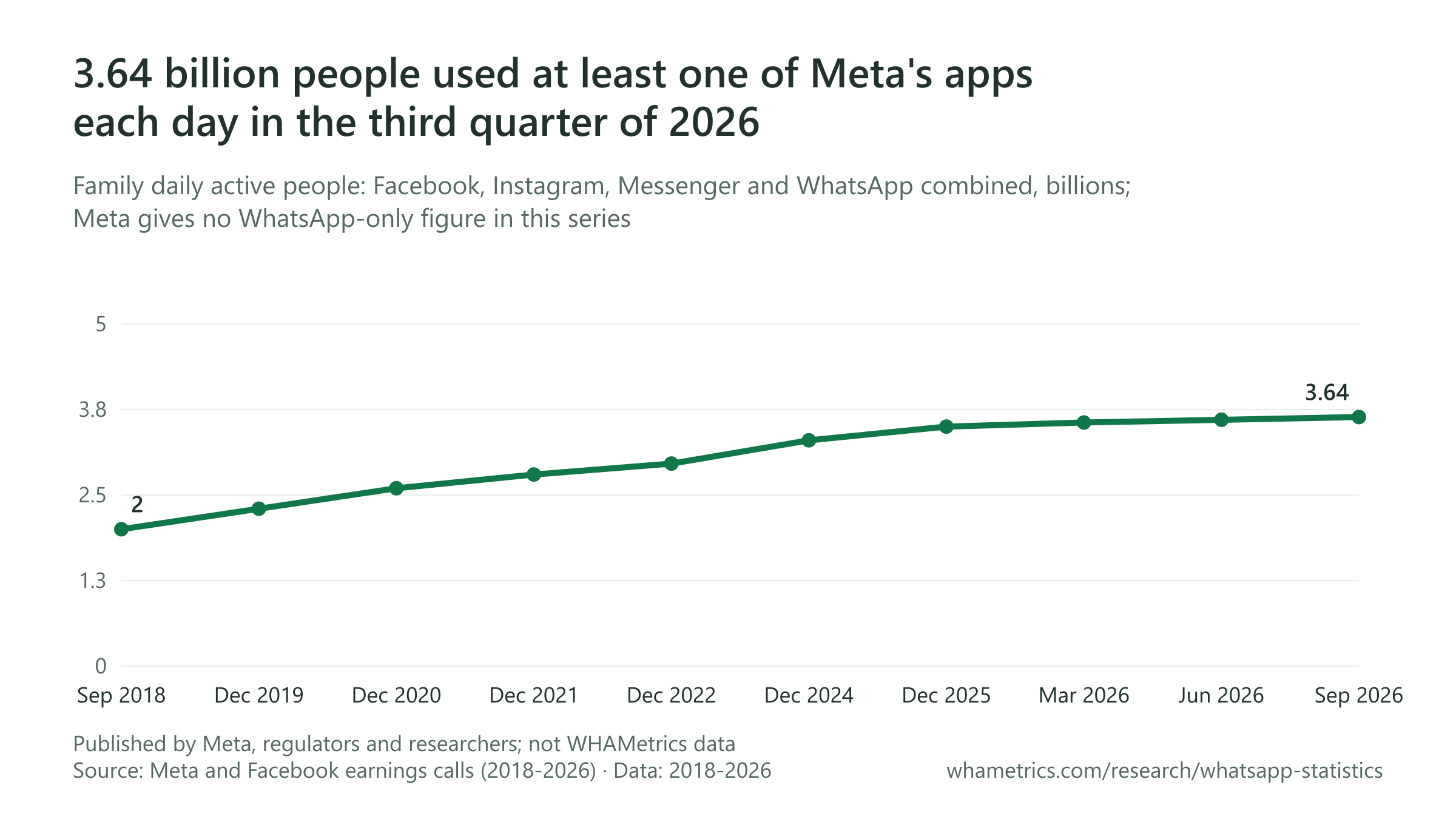
- 2.5 billion people used at least one of Facebook, WhatsApp, Instagram or Messenger each month in mid-2018, the first time Facebook published a family-wide count (Facebook, 2018).
- About 3 billion people used at least one of Facebook's apps each month in March 2020, the first time the family count reached 3 billion (Facebook, 2020).
- About 3.96 billion people used at least one of Meta's apps each month in September 2023, the last monthly family figure Meta gave on a call (Meta, 2023).
What Meta stopped reporting
- WhatsApp had 50 employees when it reached 400 million monthly active users in December 2013, WhatsApp said (WhatsApp, 2013).
- Facebook's reported daily and monthly users do not include WhatsApp users, its 2014 annual report on Form 10-K said in January 2015 (Facebook, 2015).
- Meta stopped reporting Facebook daily and monthly users and family monthly active people from 2024, keeping only family daily active people, it said in February 2024 (Meta, 2024).
- About 65 million WhatsApp users, around 2%, were expected to still be on old app versions on February 1, 2022, Meta's WhatsApp Business pricing documentation said (Meta, 2022).
- 65 million users being 'around 2%' of WhatsApp's users implies a base of roughly 3.25 billion in early 2022, a derivation from Meta's pricing documentation, not a figure Meta stated (Meta, 2022; derived).
Sources: WhatsApp LLC (2013-2026); Facebook, Inc. (2014-2021); AllThingsD; The Next Web; Jan Koum (2014, 2015); TechCrunch (2014, 2017); Sequoia Capital; WhatsApp Inc.; International Telecommunication Union; University of Vienna and SBA Research; Meta Platforms, Inc. (2022-2026)
WhatsApp users by country: where is WhatsApp used most?
Figures published by Meta, regulators, surveys and studies; none is WHAMetrics data.
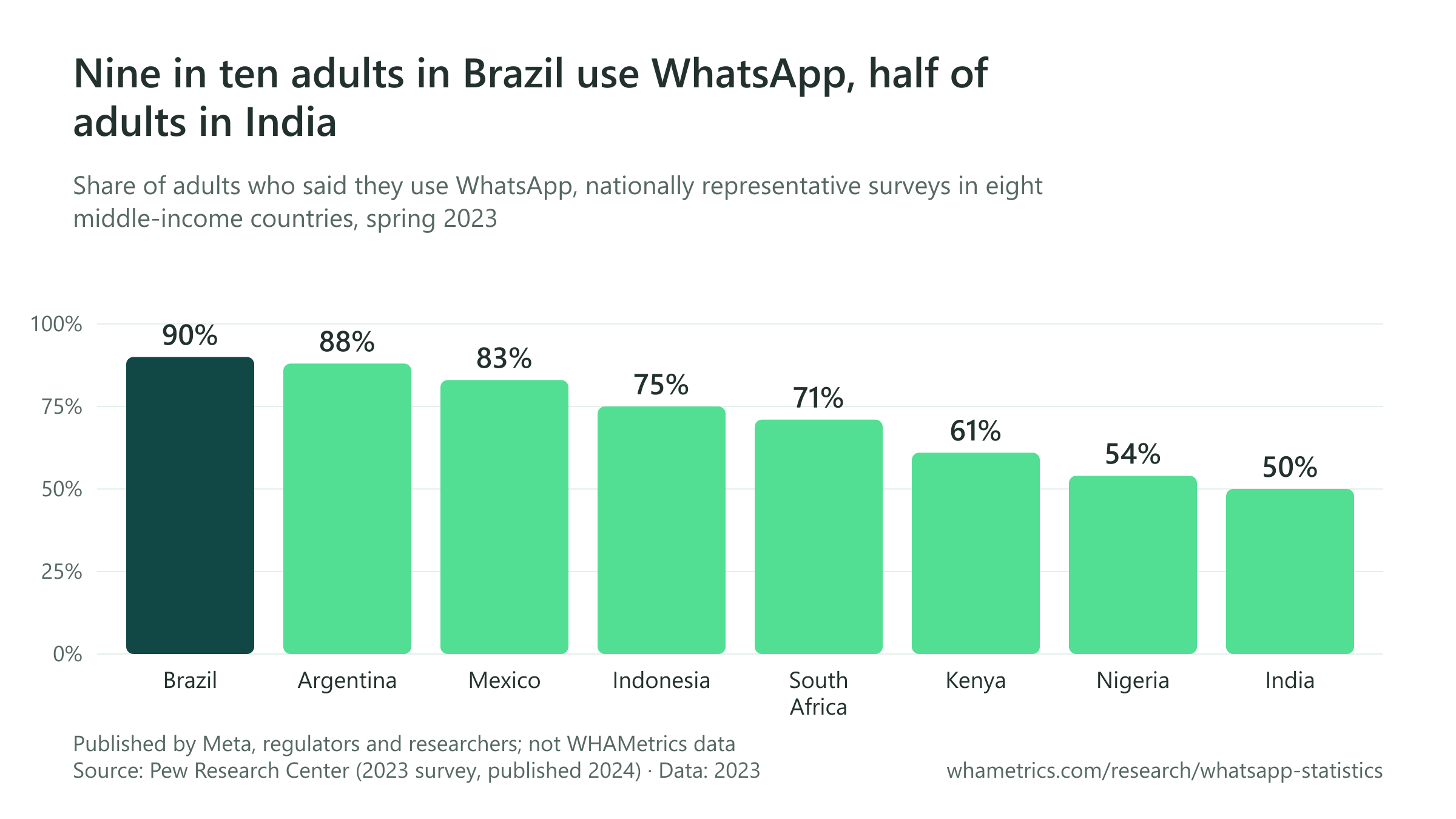
90% of adults in Brazil said they use WhatsApp in 2023, the most of eight middle-income countries (Pew Research Center, 2023).

- 61% of people in the EU aged 15 and over had used WhatsApp in the past seven days in 2022.
- 64% of adults across 18 Latin American countries used WhatsApp in 2018, more than the 60% who used Facebook.
- 67% of nationals in seven Arab countries used WhatsApp in 2017, the most used platform, ahead of Facebook.
- 99% of adults in Israel used WhatsApp in May 2026, the country's most used digital platform.
- 90.6% of people in Kyrgyzstan named WhatsApp as the messenger they use most often, in a 2023 survey.
| Market | Used WhatsApp in the past week |
|---|---|
| Singapore | 91% |
| Italy | 89% |
| Spain | 89% |
| Nigeria (younger, English-speaking sample) | 89% |
| South Africa (younger, English-speaking sample) | 89% |
| Czech Republic | 70% |
| France | 64% |
| Slovakia | 54% |
| Poland | 51% |
| Australia | 46% |
Sources: Pew Research Center; European Parliament; Corporación Latinobarómetro; Northwestern University in Qatar; Israel Internet Association; Central Asia Barometer; Reuters Institute for the Study of Journalism
More statistics (57)
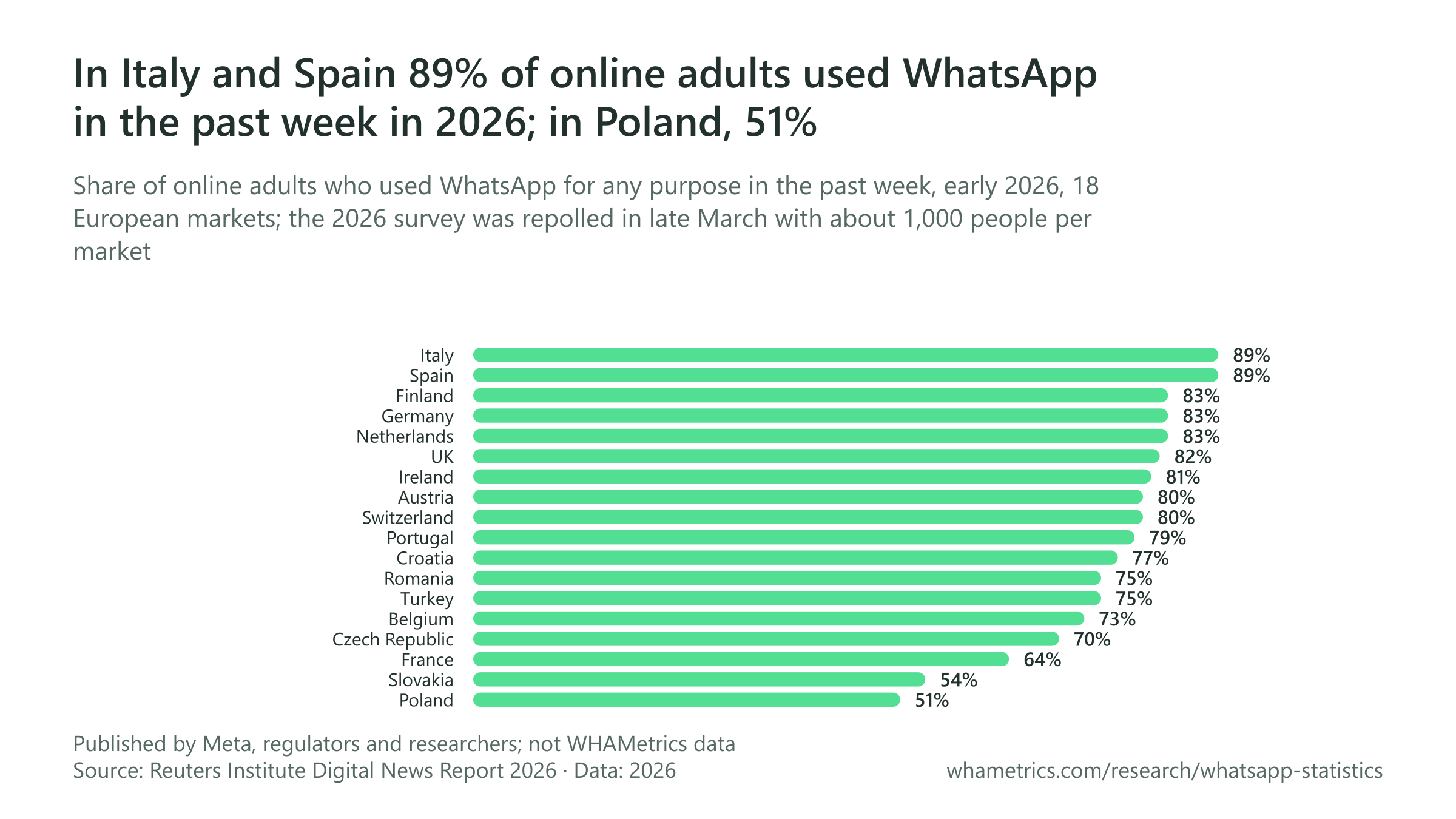
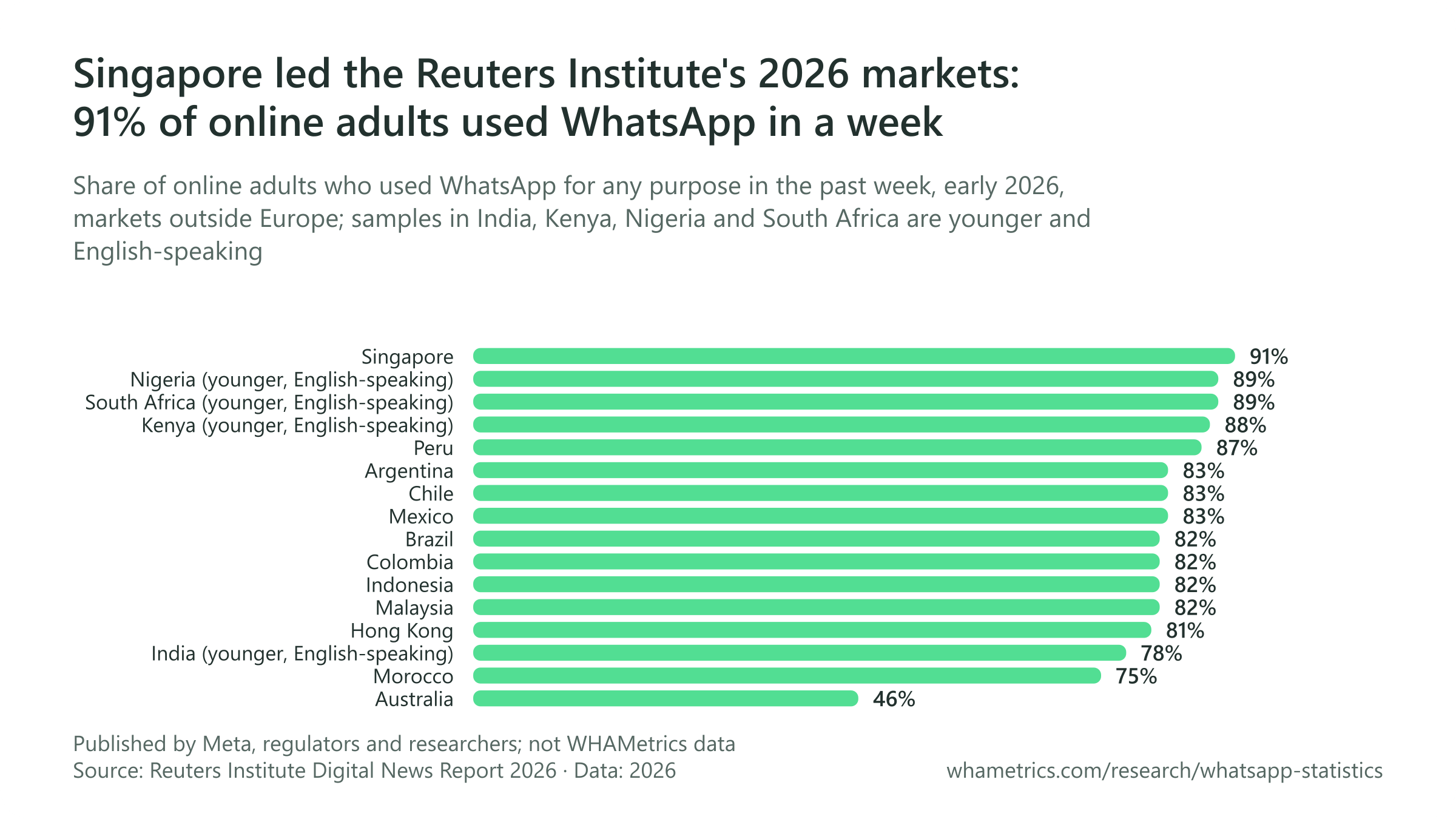
No one counts WhatsApp's users country by country except WhatsApp, and it rarely says. What exists are surveys and audience panels, each with its own measure: the share of all adults, of online adults or of internet users, used in the past week, month, three months or year. Comparisons hold only within one survey. The biggest markets have their own section below; this one gathers the cross-country surveys and the smaller countries.
The Reuters Institute's markets


- 55% of online adults across all markets surveyed in 2021 said they used WhatsApp for any purpose in the past week (online survey average; Reuters Institute, 2021).
- 54% of online adults across all markets surveyed in 2022 said they used WhatsApp for any purpose in the past week (online survey average; Reuters Institute, 2022).
- 53% of online adults across all markets surveyed in 2023 said they used WhatsApp for any purpose in the past week (online survey average; Reuters Institute, 2023).
- 51% of online adults across all markets surveyed in 2024 said they used WhatsApp for any purpose in the past week (online survey average; Reuters Institute, 2024).
- 53% of online adults across all markets surveyed in 2025 said they used WhatsApp for any purpose in the past week (online survey average; Reuters Institute, 2025).
- 62% of online adults across all markets surveyed in 2026 said they used WhatsApp for any purpose in the past week (online survey average; Reuters Institute, 2026).
- 40% of online adults across 36 markets surveyed in early 2017 said they used WhatsApp for any purpose in the past week (online survey average; Reuters Institute, 2017).
- 44% of online adults across 37 markets surveyed in early 2018 said they used WhatsApp for any purpose in the past week (online survey average; Reuters Institute, 2018).
- 4% of online adults in Greece said they used WhatsApp for news in the past week (online survey, late January to early February 2018; Reuters Institute, 2018).
- 2% of online adults in Norway said they used WhatsApp for news in the past week (online survey, late January to early February 2018; Reuters Institute, 2018).
- 17% of online adults on average across the long-tracked markets (ten in 2014, twelve from 2015) said in 2014 that they used WhatsApp for any purpose in the past week (online survey; Reuters Institute, 2014).
- 45% of online adults on average across 12 long-tracked markets said in 2019 that they used WhatsApp for any purpose in the past week (online survey; Reuters Institute, 2019).
- 52% of online adults on average across 12 long-tracked markets said in 2021 that they used WhatsApp for any purpose in the past week (online survey; Reuters Institute, 2021).
Pew Research Center's international surveys
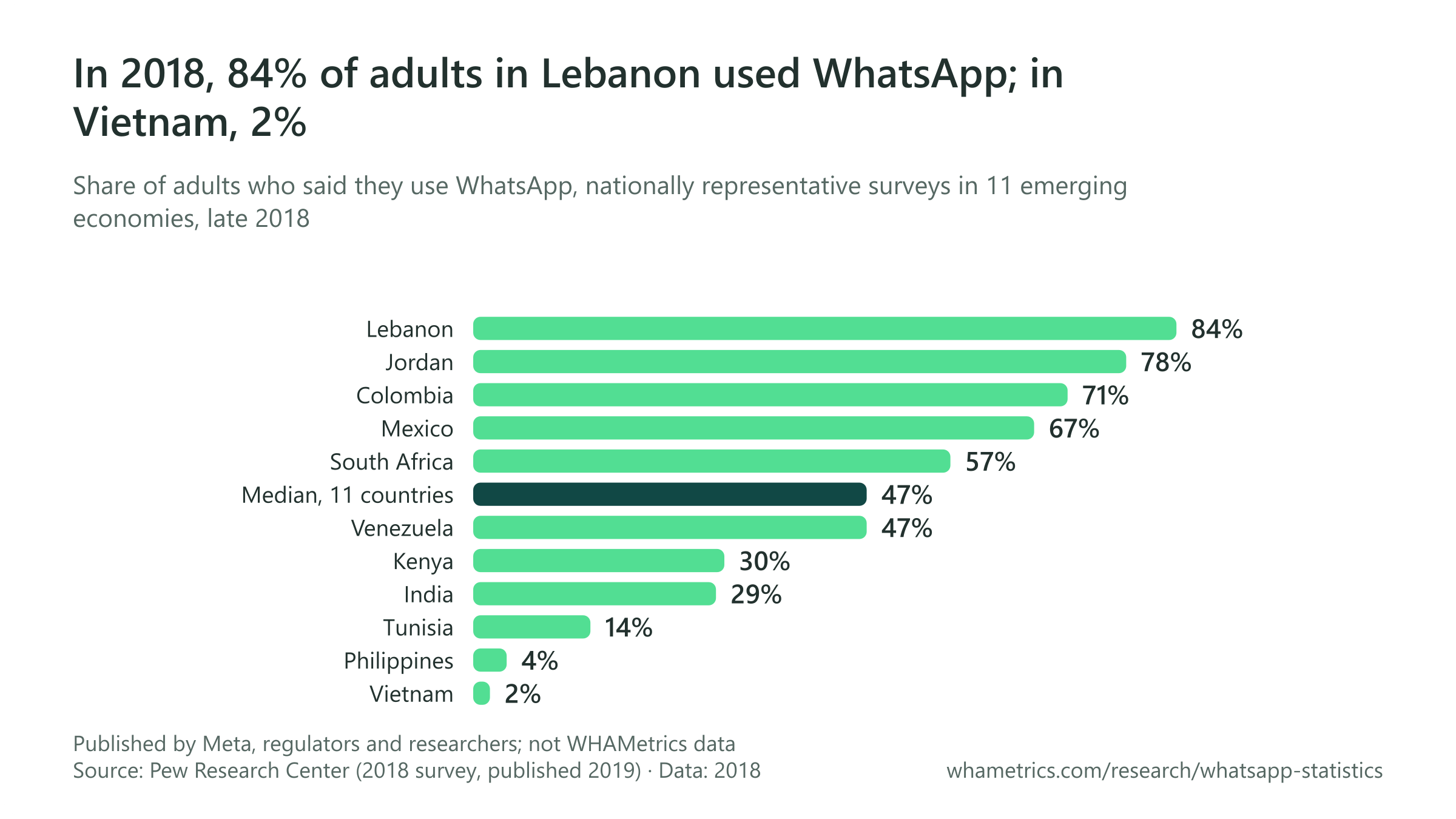
- WhatsApp use ranged from 50% of adults in India to 90% in Brazil across eight middle-income countries surveyed in 2023 (Pew Research Center, 2024).

Europe: Eurobarometer, Eurostat and CEDMO

- 58% used WhatsApp, on average, in an online survey of people aged 15 and over in nine Central and Western European countries in January and February 2026, second only to Facebook at 85%; CEDMO does not say whether the shares are of all respondents or of social media users (CEDMO, 2026).
Latin America

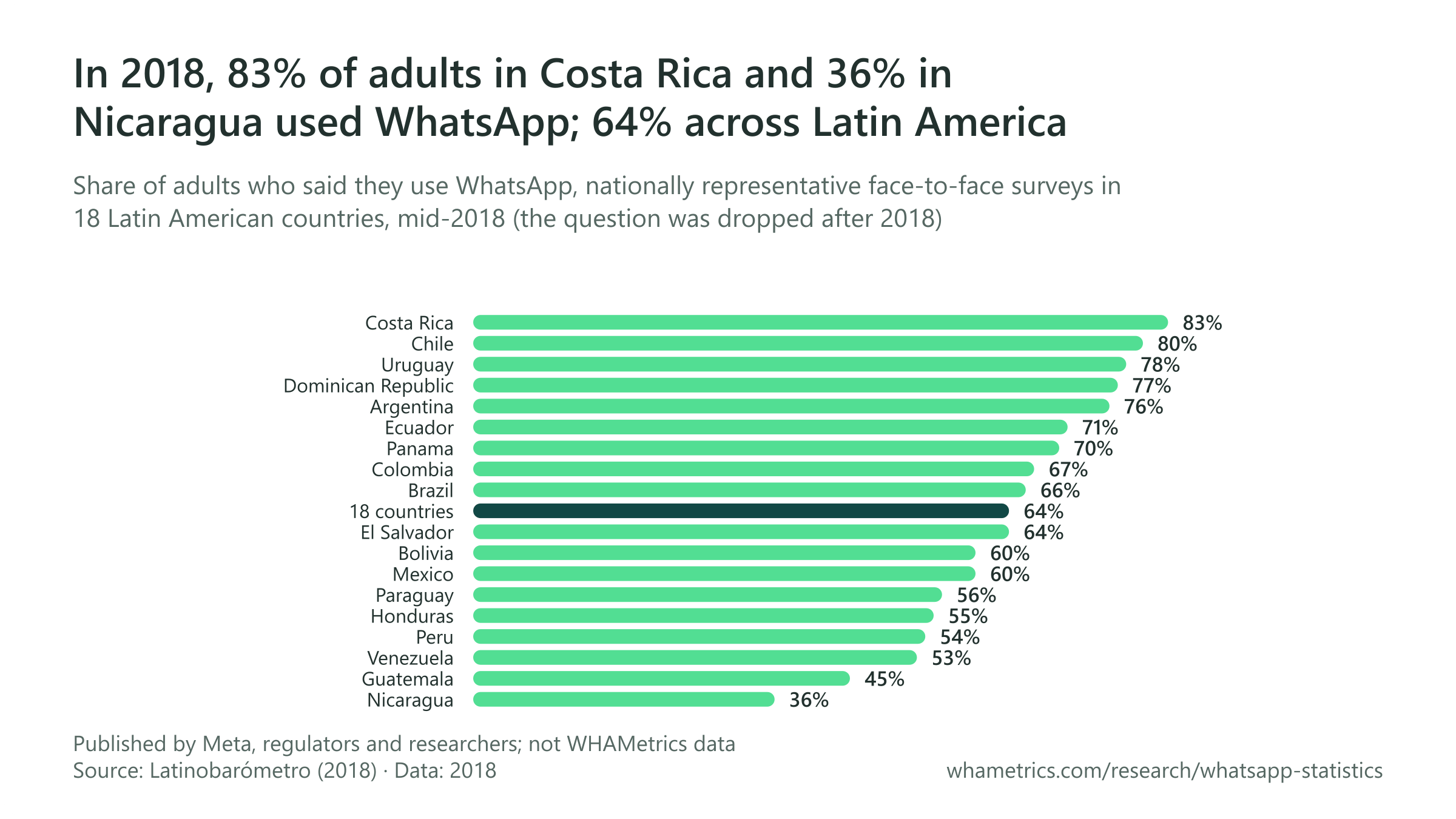
- 49% of adults across 18 Latin American countries said they use WhatsApp in 2016 (face-to-face survey; Latinobarómetro, 2017).
- 68.6% of Peruvians used instant messaging platforms in 2025, the most used digital service measured, rising to 80.7% in Metropolitan Lima; a category, not WhatsApp alone (OSIPTEL Erestel household survey, 2026).
- About two in three Peruvians (67.6%) used WhatsApp in 2025 (OSIPTEL Erestel household survey, 2026; derived).
- 79.4% of Chileans aged 16 and over said they habitually used WhatsApp in 2017, the most used social platform, ahead of Facebook at 65.5% (Subtel national internet access and use survey, 2018).
The Arab world

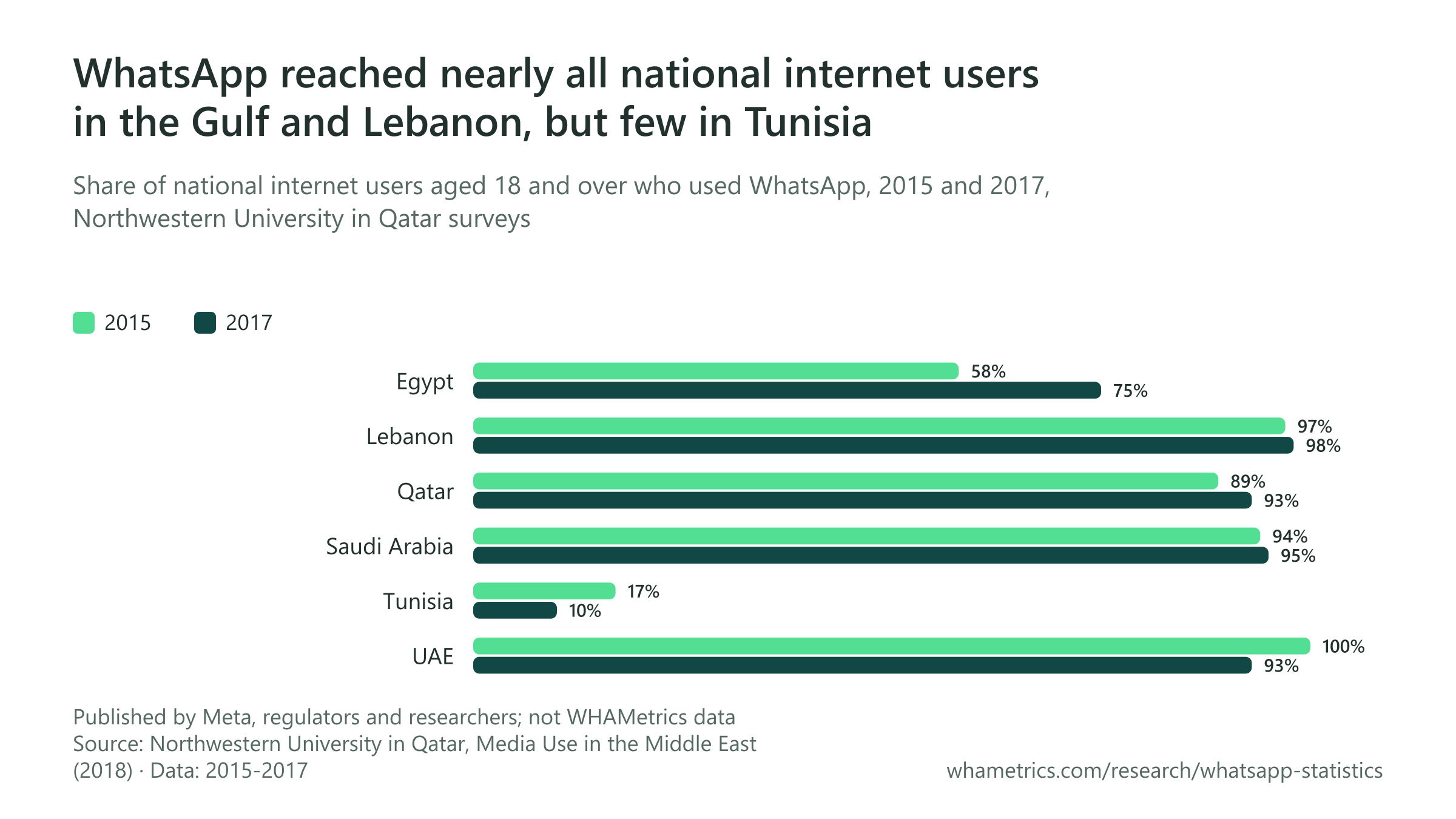
- About two-thirds of Arab nationals in seven Arab countries used WhatsApp, level with Facebook as the most used platforms (survey, mid-2019; Northwestern University in Qatar, 2019).
- Only 7% of Tunisian nationals used WhatsApp in 2017, against 57% for Facebook (survey; Northwestern University in Qatar, 2017).
- 77% of national internet users aged 18 and over in six Arab countries (Egypt, Lebanon, Qatar, Saudi Arabia, Tunisia, the UAE) used WhatsApp in early 2016 (Northwestern University in Qatar survey, 2016).
- 3% of Tunisian national internet users used WhatsApp in early 2016, while all used Facebook (Northwestern University in Qatar survey, 2016).
- 93% of WhatsApp users among nationals in six Arab countries used it daily in early 2016 (Northwestern University in Qatar survey, 2016).
- 80% of national internet users in six Arab countries used WhatsApp in 2017, ahead of Facebook at 74% and YouTube at 60% (Northwestern University in Qatar survey, 2017).
- 96% of WhatsApp users among nationals in six Arab countries used it to communicate with others in 2017, against 46% for news and 51% for entertainment (Northwestern University in Qatar survey, 2017).
- About seven in ten Qataris used WhatsApp in 2019, still the most popular platform in Qatar but down 16 percentage points since 2017 (Northwestern University in Qatar survey, 2019).
- WhatsApp use among Arab national internet users fell by seven percentage points between 2015 and 2018 (Northwestern University in Qatar survey, 2018).
- Nearly 27 million people in Morocco (26,902,330) used WhatsApp in 2020, more than any other social platform, according to the telecoms regulator's household survey (ANRT, 2021).
- 99% of adults in Israel used WhatsApp in July 2025, up from 98% in 2024 (Israel Internet Association, 2026).
- 98% of adults in Israel used WhatsApp in 2024 (Israel Internet Association, 2026).
- 100% of Arab adults in Israel surveyed in May 2026 used WhatsApp (Israel Internet Association, 2026).
Central Asia
- 18.2% of respondents in Uzbekistan named WhatsApp as the messenger they use most often (survey; Central Asia Barometer, 2023).
- 87.0% of respondents in Kazakhstan named WhatsApp as the messenger they use most often (survey; Central Asia Barometer, 2023).
- 58% of respondents in Kazakhstan, Kyrgyzstan, Tajikistan and Uzbekistan said they use WhatsApp as a messenger (telephone survey of 2,400; European Neighbourhood Council, 2023).
- 90% of respondents in Kyrgyzstan said they use WhatsApp as a messenger (telephone survey, 600 respondents; European Neighbourhood Council, 2023).
- 82% of respondents in Kazakhstan said they use WhatsApp as a messenger (telephone survey, 600 respondents; European Neighbourhood Council, 2023).
- 46% of respondents in Tajikistan said they use WhatsApp as a messenger (telephone survey, 600 respondents; European Neighbourhood Council, 2023).
Europe, country by country

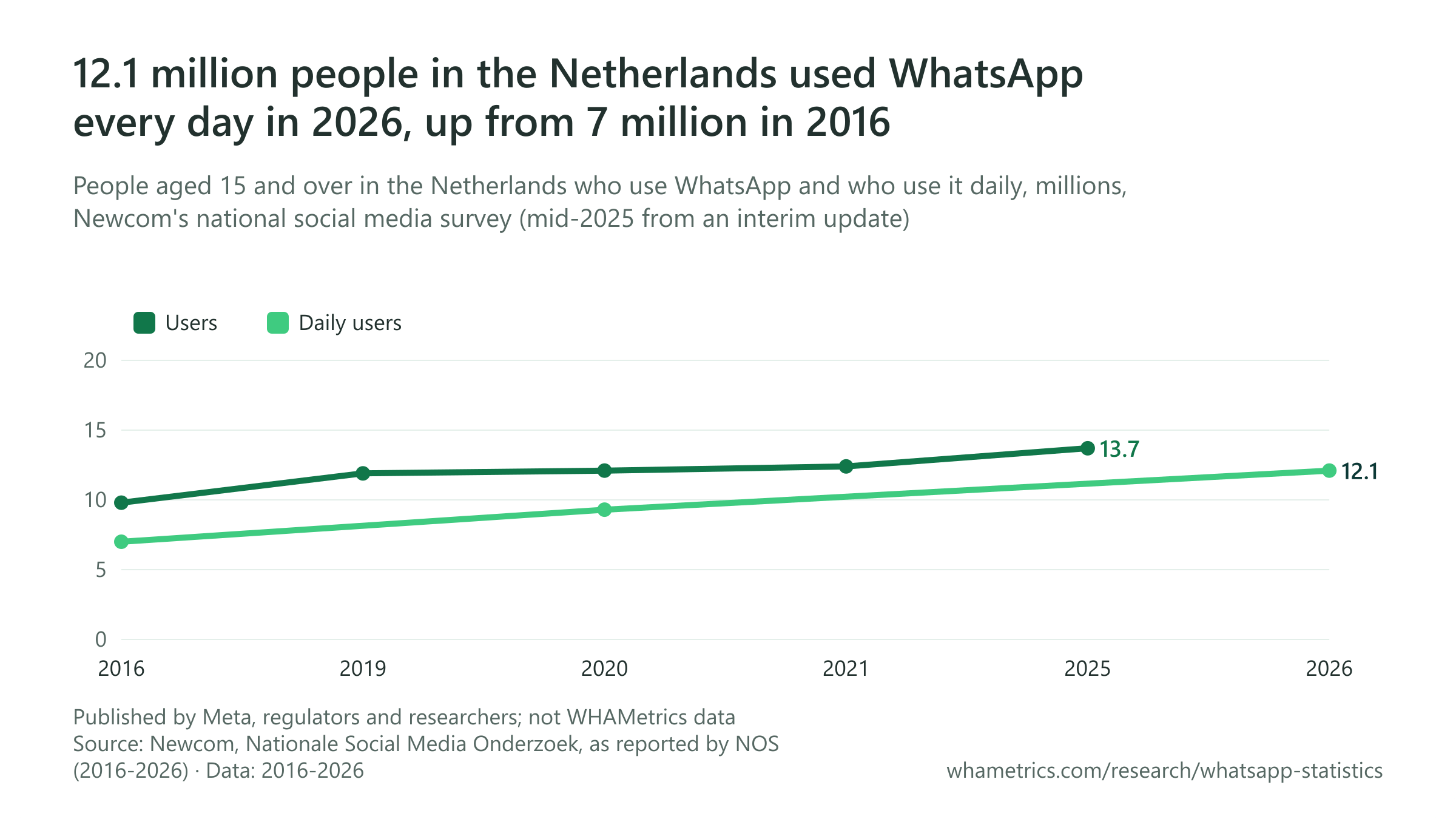

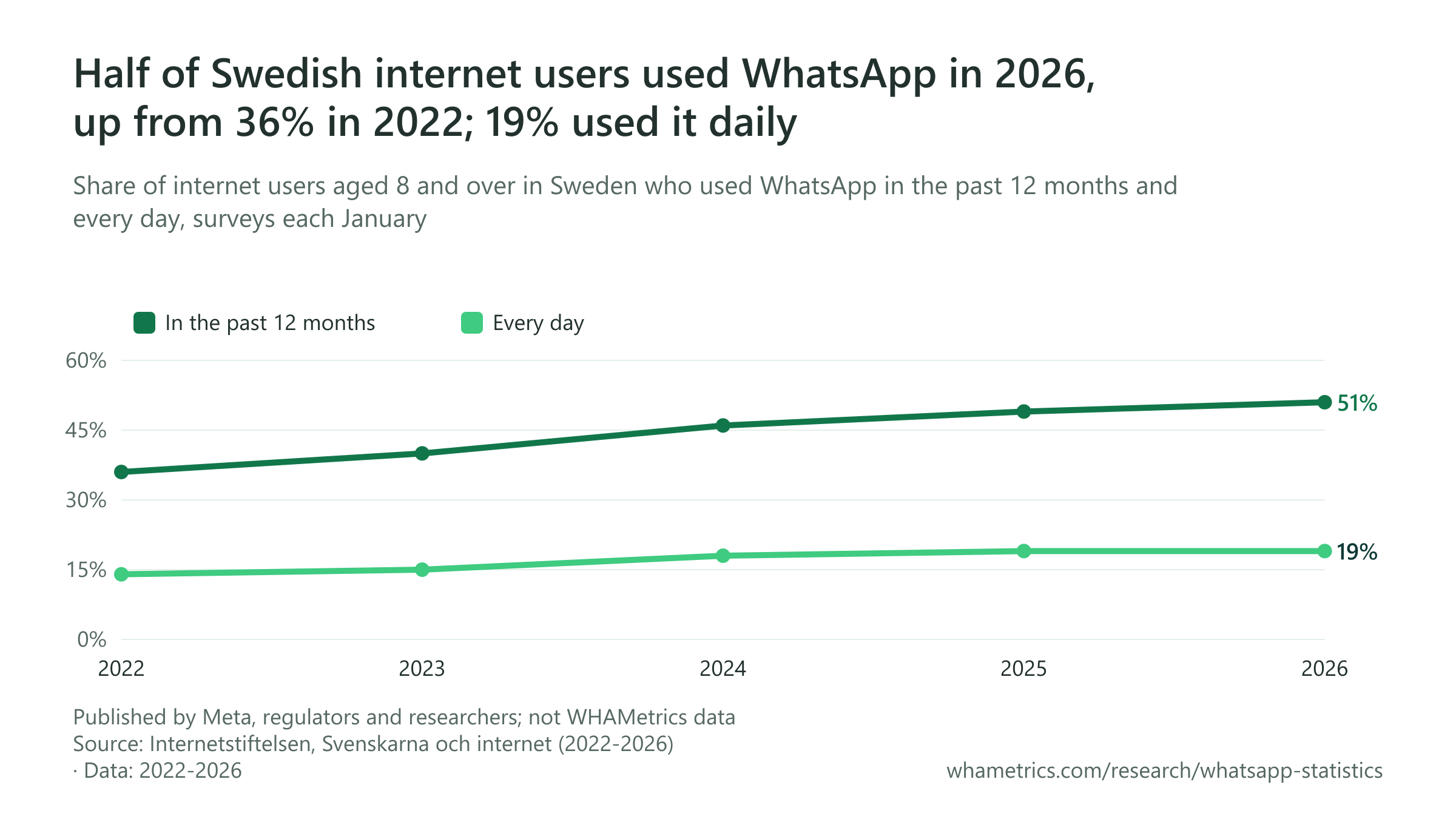
- Fewer than 10% of people aged 15 to 65 in the Netherlands did not use WhatsApp in January 2020, and WhatsApp users were in about 7 WhatsApp groups on average (Newcom, Nationale Social Media Onderzoek, 2020).
- 85% of adults in Flanders (Belgium) were active WhatsApp users in autumn 2023, the most used platform, ahead of Facebook at 69% and Facebook Messenger at 59% (imec.digimeter, 2024).
- 19.3 million internet users aged 7 to 75 in Poland used WhatsApp (app or web) in an average month of the fourth quarter of 2025, up from 17.8 million a year earlier (PBI Mediapanel, 2026).
- 17.8 million internet users aged 7 to 75 in Poland used WhatsApp (app or web) in an average month of the fourth quarter of 2024 (PBI Mediapanel, 2025).
- 16.9 million people in Poland used the WhatsApp Messenger app in an average month of the fourth quarter of 2024, fewer than the 20.6 million who used Facebook's Messenger app (PBI Mediapanel, 2025).
- 81% of adults in Finland used WhatsApp weekly to send messages at the end of 2023, and 34% used it weekly for calls, the most used service for both (Traficom consumer survey, 2024).
- 56% of people in Norway used messaging services such as Messenger, WhatsApp or Viber on an average day in 2025 (category: messaging apps, not WhatsApp alone), against 63% for Facebook and 58% for Snapchat (Statistics Norway, Norsk mediebarometer 2025, 2026).
Asia-Pacific and Canada

- WhatsApp reached 70% of Brunei's entire population in August 2013, WhatsApp told AllThingsD (AllThingsD, 2013).
- WhatsApp reached 50% of Hong Kong's population in August 2013, WhatsApp told AllThingsD (AllThingsD, 2013).
- 45% of Canadian adults said they use WhatsApp in June 2022, including 68% of those aged 18 to 34 (Research Co. online poll, 2022).
- 76% of Canadians aged 15 and over used instant messaging apps to communicate in 2020 (category: instant messaging, not WhatsApp alone; Statistics Canada Canadian Internet Use Survey, 2021).
- 98.1% of Malaysia's communication app users owned a WhatsApp account in 2018, ahead of Facebook Messenger at 55.6%, WeChat at 36.8% and Telegram at 25.0% (MCMC Internet Users Survey, 2019).
- 98.7% of Malaysia's communication app users owned a WhatsApp account in 2020, up from 98.1% in 2018, while Telegram rose from 25.0% to 40.1% (MCMC Internet Users Survey, 2020).
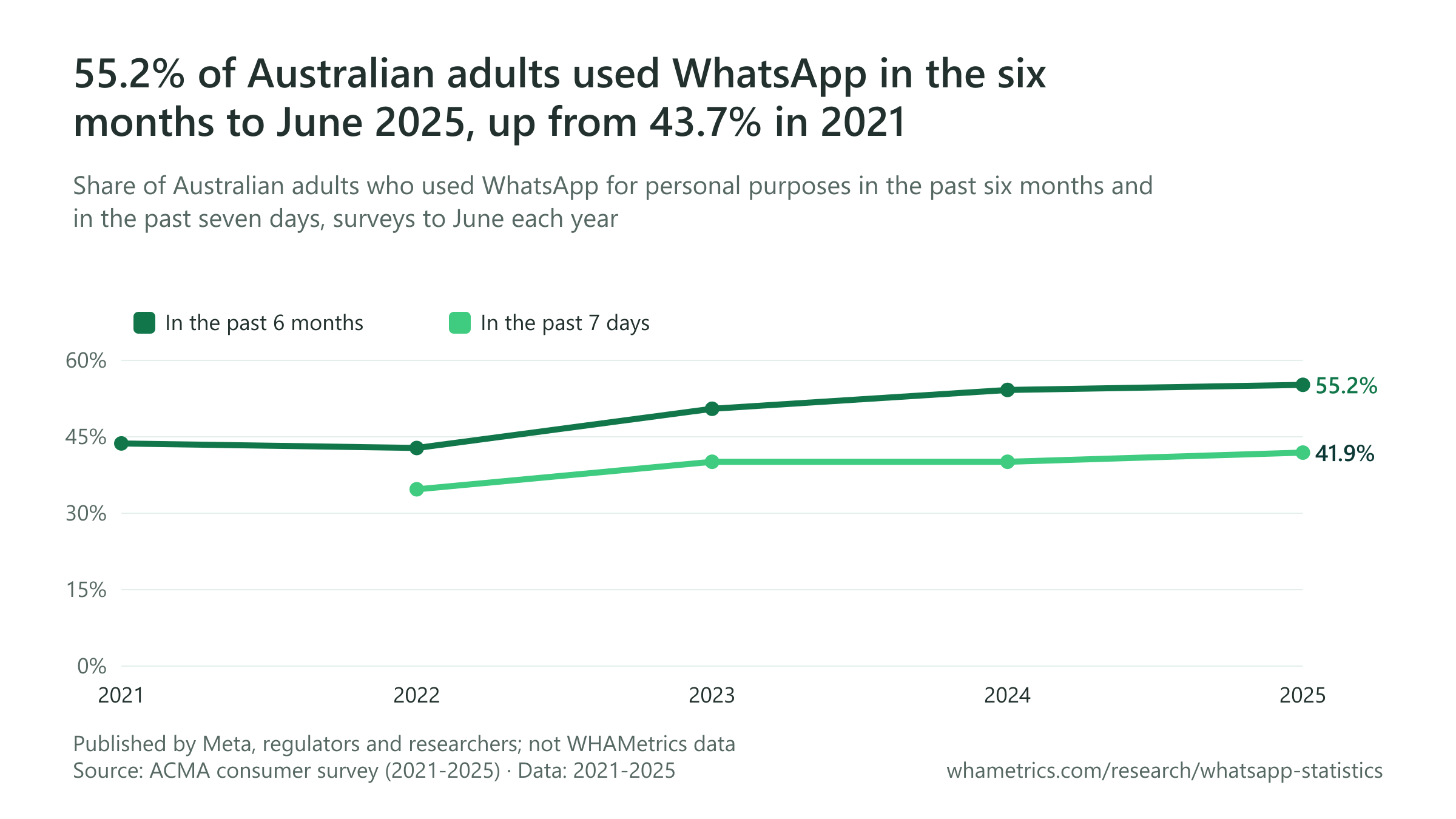
- 37.1% of Australian adults used WhatsApp to send messages in the past seven days, in the survey to June 2025, up from 31% in 2022 (ACMA consumer survey, 2026).
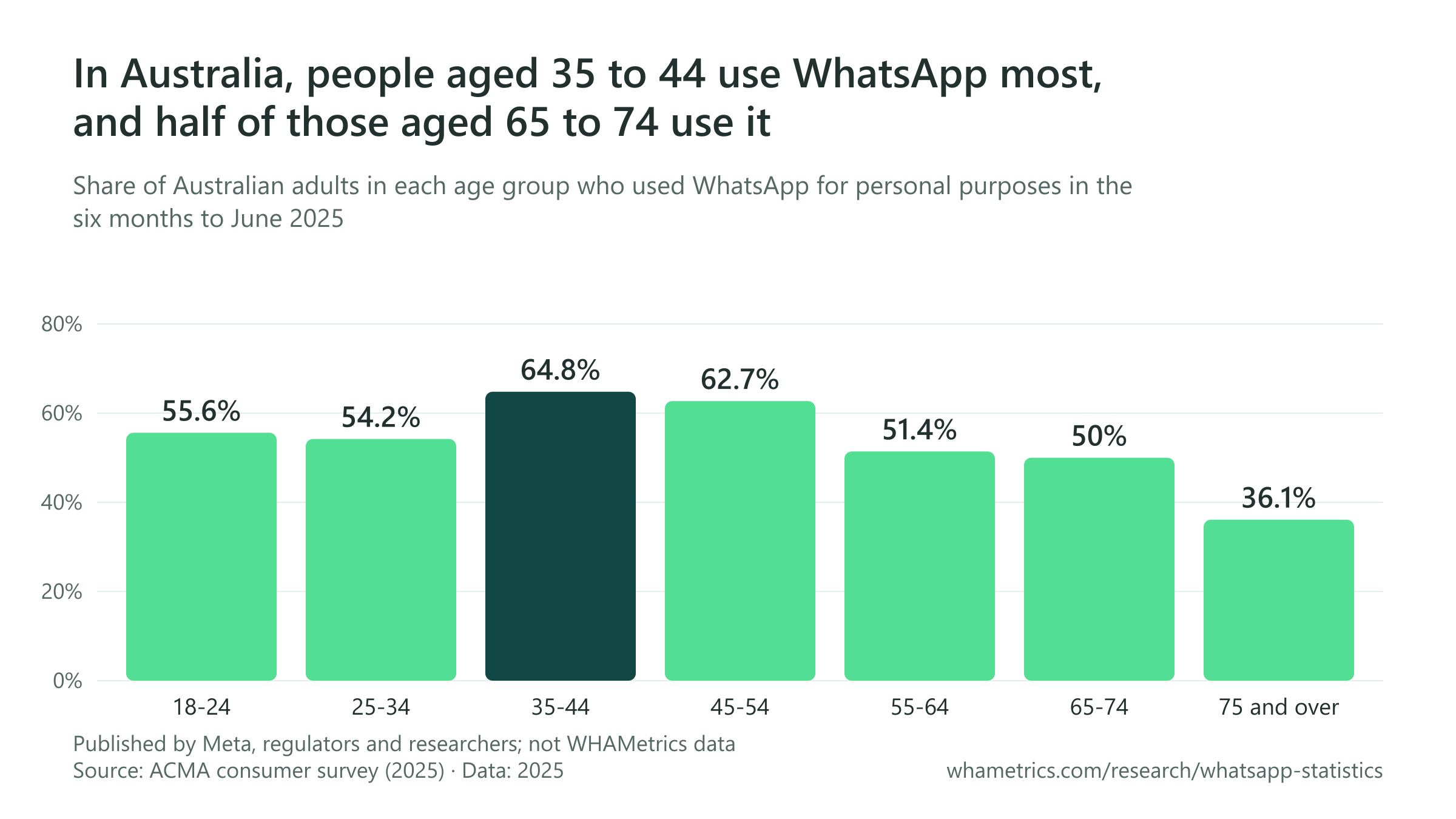
- 28% of Australian adults who used WhatsApp in the past six months used it multiple times a day in 2025, up from 24% in 2024; 42% of users aged 35-44 did (ACMA, 2026).
- 62% of New Zealand adults surveyed for the Commerce Commission had WhatsApp on their smartphone in March 2025, behind Facebook Messenger at 73% (Commerce Commission, 2025).
- 44% of New Zealand adults with WhatsApp on their smartphone used it to make a call at least once a week in March 2025 (Commerce Commission, 2025).
Sources: Reuters Institute for the Study of Journalism (2017-2026); Pew Research Center (2019, 2024); Central European Digital Media Observatory, with Ipsos; Corporación Latinobarómetro (2017, 2018); Organismo Supervisor de Inversión Privada en Telecomunicaciones, Peru; Subsecretaría de Telecomunicaciones de Chile, fieldwork by Brújula; Northwestern University in Qatar (2016-2019); Communications, Space and Technology Commission, Saudi Arabia; Agence Nationale de Réglementation des Télécommunications, Morocco; Israel Internet Association (2026); Central Asia Barometer; European Neighbourhood Council; Newcom Research & Consultancy (2020, 2026); imec; Polskie Badania Internetu, Mediapanel (2025, 2026); Traficom; Statistisk sentralbyrå, Norsk mediebarometer; AllThingsD; Research Co.; Statistics Canada; Malaysian Communications and Multimedia Commission (2019, 2020); Australian Communications and Media Authority (2026); Commerce Commission New Zealand; European Parliament; NOS (2016, 2021, 2025); Internetstiftelsen, Svenskarna och internet
How many Americans use WhatsApp?
Figures published by Meta, regulators, surveys and studies; none is WHAMetrics data.
33% of US adults said they use WhatsApp in 2026, up from 22% in 2018 (Pew Research Center, 2026).

- More than 100 million people in the US were on WhatsApp in August 2026, WhatsApp said.
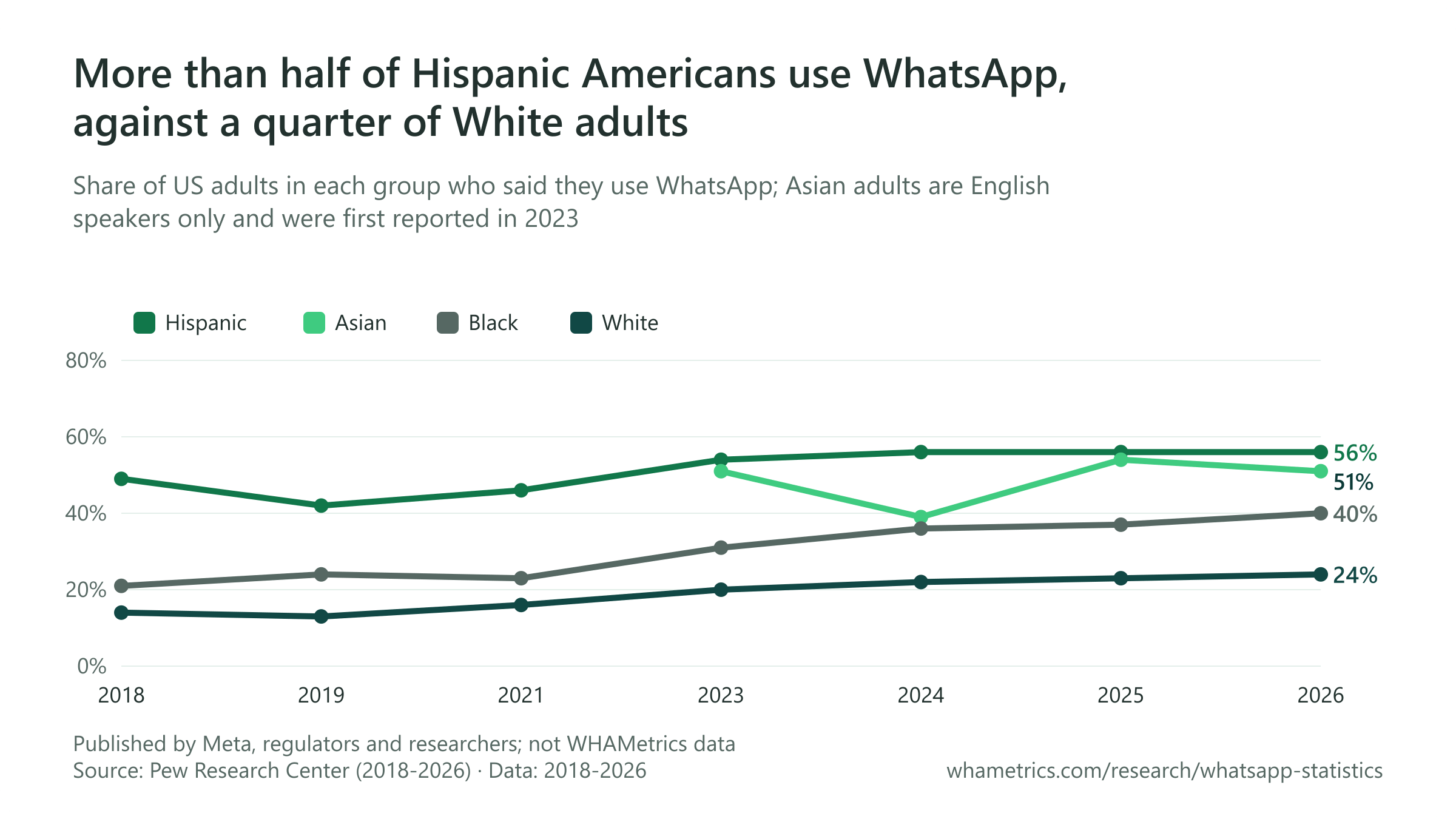
- 56% of Hispanic adults in the US use WhatsApp, against 24% of White adults, in 2026.
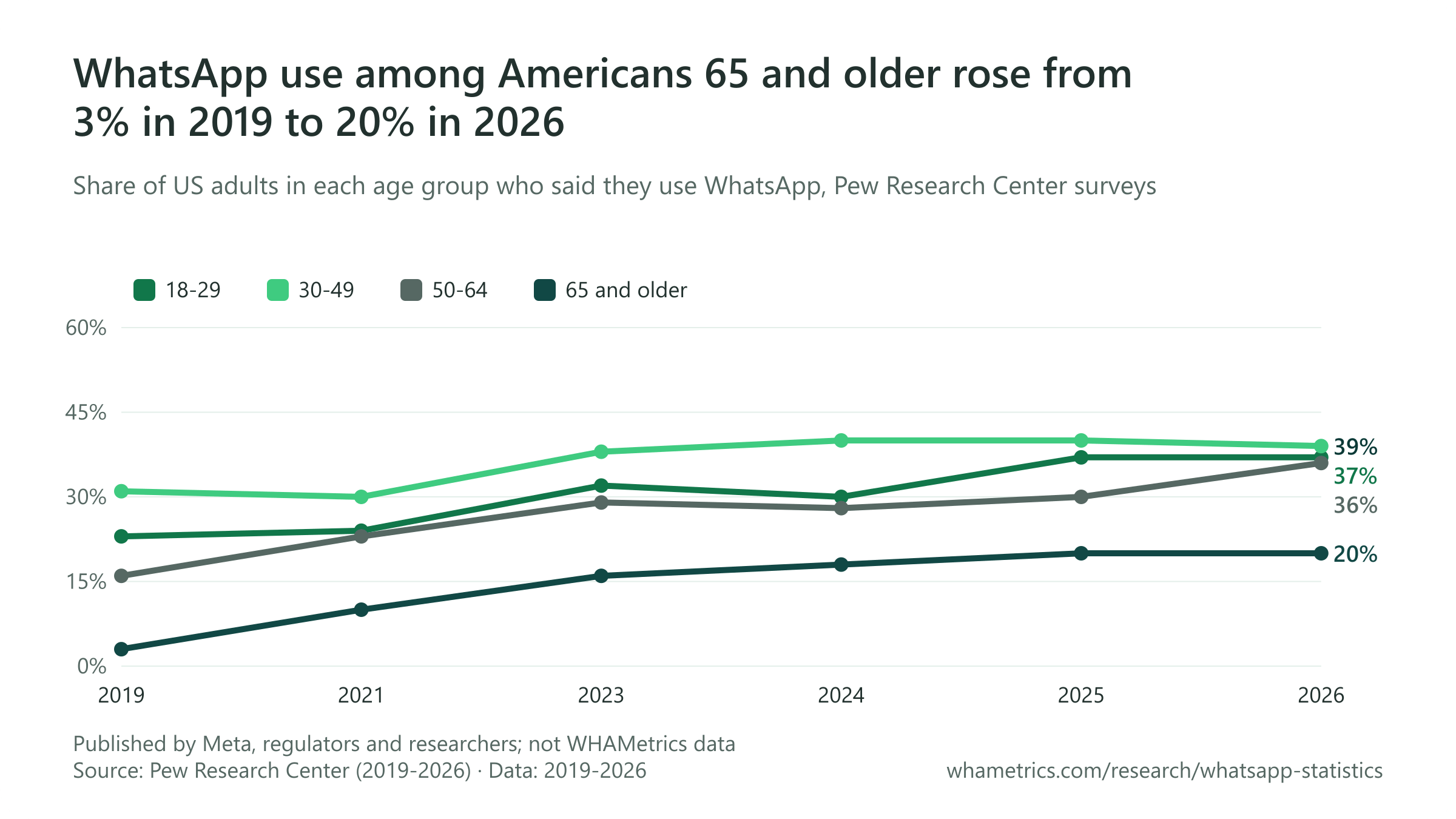
- 20% of Americans aged 65 and older use WhatsApp, up from 3% in 2019.
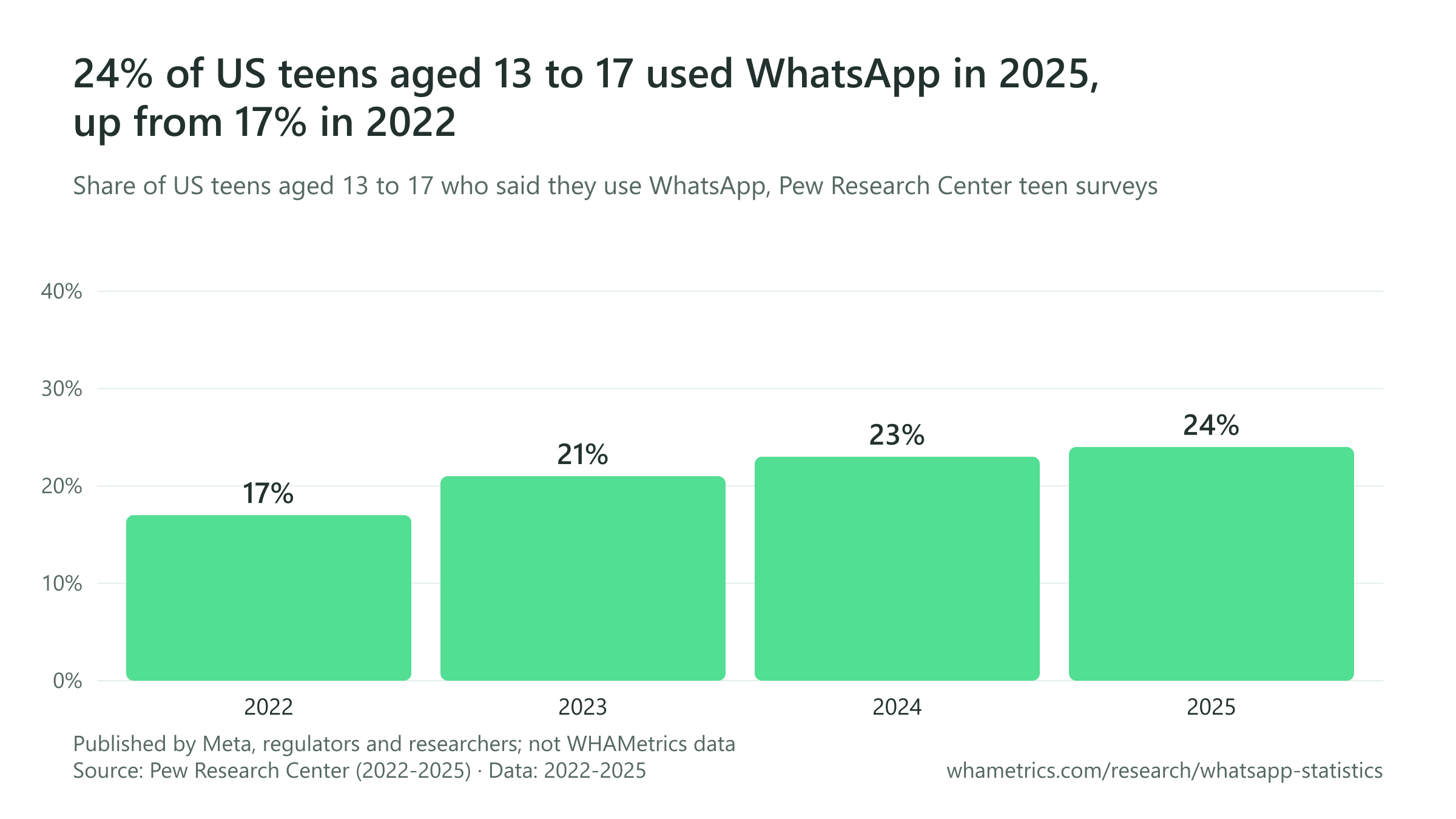
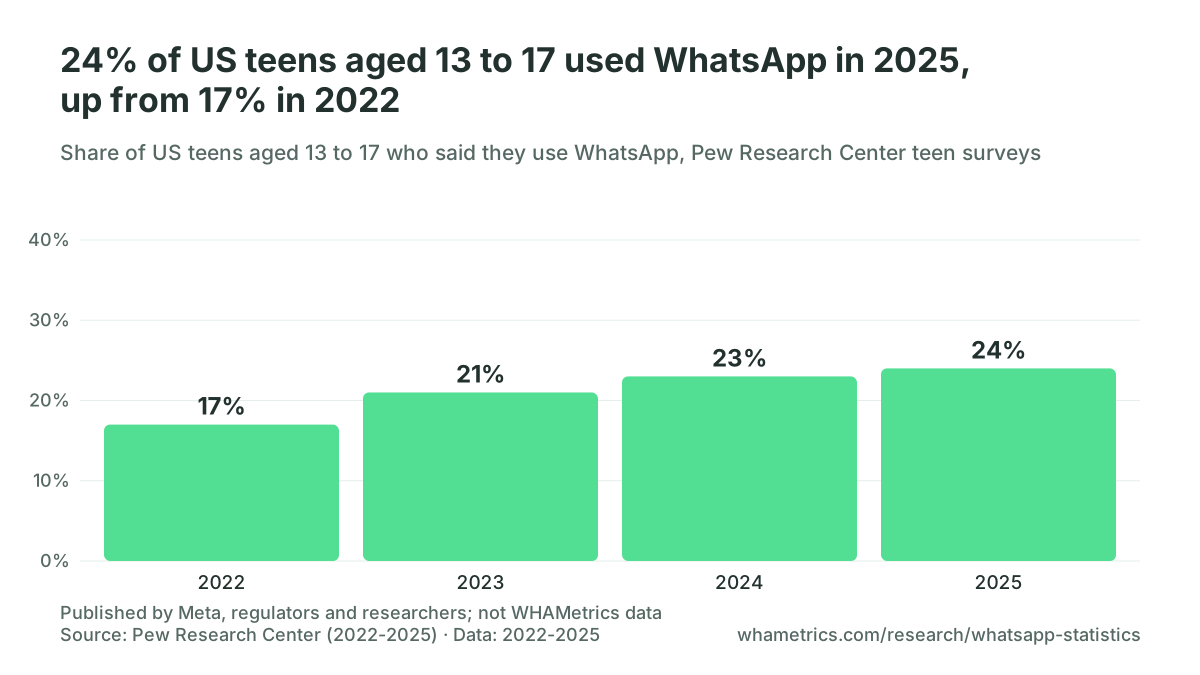
- 24% of US teens aged 13 to 17 used WhatsApp in autumn 2025, up from 17% in 2022.
- More than half of WhatsApp's users in the US use iPhones, the company said in 2024.
| Group | Use WhatsApp |
|---|---|
| Ages 18 to 29 | 37% |
| Ages 30 to 49 | 39% |
| Ages 50 to 64 | 36% |
| Black adults | 40% |
| Asian adults (English speakers) | 51% |
| Urban adults | 44% |
| Suburban adults | 33% |
| Rural adults | 22% |
| College graduates | 43% |
| Household income of $100,000 or more | 40% |
Sources: Pew Research Center (2026, 2025); WhatsApp LLC; TechCrunch
More statistics (25)
WhatsApp is a minority app in the United States, where most phones message by text or iMessage, but its American audience has grown every year Pew Research Center has asked. It is used most by Hispanic and Asian Americans and by people with family abroad, and its oldest users are its fastest-growing group. WhatsApp's own American count is a round number it has repeated since 2024.
Pew Research Center's surveys of US adults


- 34% of US men said they ever use WhatsApp in a survey conducted January to June 2026 (Pew Research Center, 2026).
- 33% of US women said they ever use WhatsApp in a survey conducted January to June 2026 (Pew Research Center, 2026).
- 25% of US adults with household income under $30,000 said they ever use WhatsApp in a survey conducted January to June 2026 (Pew Research Center, 2026).
- 33% of US adults with household income of $30,000 to $69,999 said they ever use WhatsApp in a survey conducted January to June 2026 (Pew Research Center, 2026).
- 32% of US adults with household income of $70,000 to $99,999 said they ever use WhatsApp in a survey conducted January to June 2026 (Pew Research Center, 2026).
- 26% of US adults with a high school education or less said they ever use WhatsApp in a survey conducted January to June 2026 (Pew Research Center, 2026).
- 30% of US adults with some college education said they ever use WhatsApp in a survey conducted January to June 2026 (Pew Research Center, 2026).
- 26% of Republicans and Republican leaners said they ever use WhatsApp in a survey conducted January to June 2026 (Pew Research Center, 2026).
- 39% of Democrats and Democratic leaners said they ever use WhatsApp in a survey conducted January to June 2026 (Pew Research Center, 2026).
What WhatsApp and Meta say about the US
- North America was WhatsApp's fastest-growing region in October 2022, Meta said on its third-quarter 2022 earnings call (Meta, 2022).
- 100 million people used WhatsApp in the United States in July 2024, WhatsApp said (WhatsApp, 2024).
- More than 100 million people used WhatsApp each month in the US in July 2024, Meta said on its second-quarter 2024 earnings call (Meta, 2024).
- More than 100 million people used WhatsApp each month in the US in January 2025, Meta said on its fourth-quarter 2024 earnings call (Meta, 2025).
- More than 100 million people used WhatsApp in the US in April 2025, and the number was growing quickly, Meta said on its first-quarter 2025 earnings call (Meta, 2025).
- WhatsApp is not the primary messaging app in the United States, iMessage is, Meta's chief executive said in April 2025 (Meta, 2025).
- More than 10 million people in Texas used WhatsApp actively in July 2024, WhatsApp said, MediaPost reported (MediaPost, 2024).
News on WhatsApp

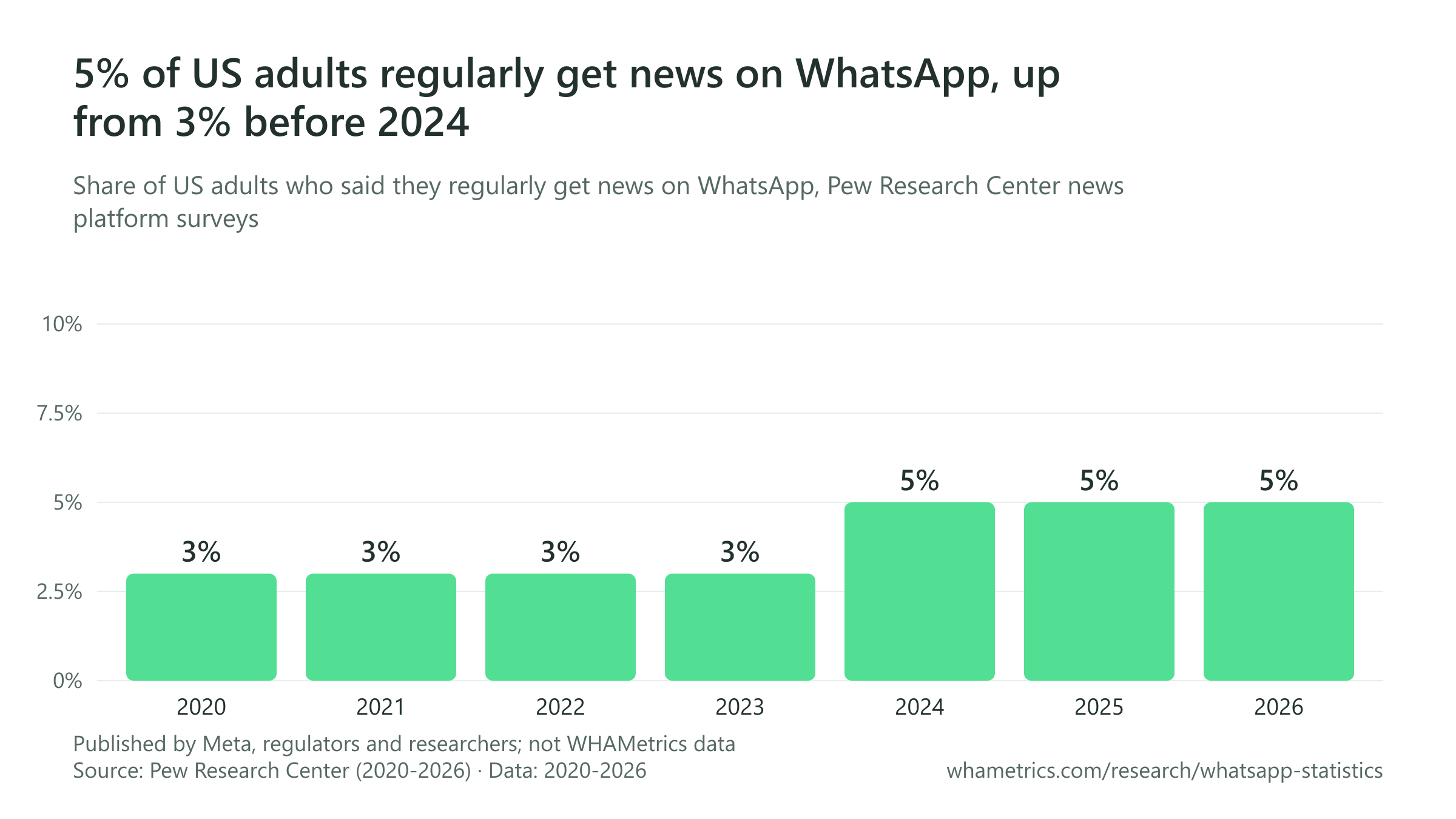
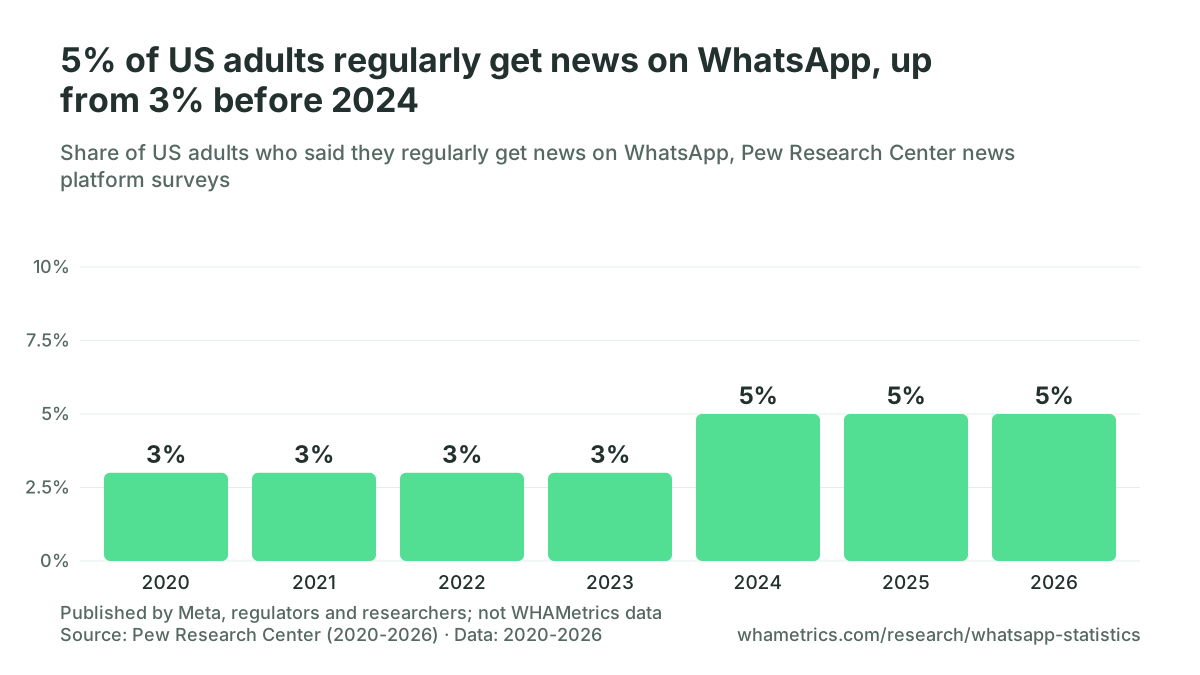
- 16% of US WhatsApp users said they regularly get news on WhatsApp in August 2026, against 57% of Facebook users and 57% of X users (Pew Research Center, 2026).
- 16% of Hispanic adults in the US said they regularly get news on WhatsApp in August 2026, against 1% of White adults (Pew Research Center, 2026).
Teenagers

App trackers' estimates for the US
- Meta's apps (WhatsApp and Messenger) took 78% of mobile usage among the 10 most used messaging apps in the United States in the first quarter of 2022, down from 86% in the first quarter of 2020 (Sensor Tower estimate, 2022).
- US WhatsApp users opened the app 116 times a week on average in the first quarter of 2023 (Sensor Tower estimate, 2023).
- WhatsApp was the seventh most downloaded app in the United States in the fourth quarter of 2022 (Sensor Tower estimate, 2023).
- WhatsApp was the eighth most downloaded app in the United States in the fourth quarter of 2023 (Sensor Tower estimate, 2024).
- 59% of WhatsApp's monthly active users in the United States used it daily in the fourth quarter of 2023, below Google Messages at 72% (Sensor Tower estimate, 2024).
- In the US, Facebook Messenger beat WhatsApp on Android store downloads, monthly active users and daily stickiness, although WhatsApp was first in Similarweb's one-day rank of Android communication apps, by Similarweb's estimate (modelled app panel; Similarweb, 2025).
- WhatsApp was installed on 43.37% of Android devices in the United States in 2022, by Similarweb's estimate (modelled app panel; Similarweb, 2023).
Sources: Pew Research Center (2018-2026); Meta Platforms, Inc. (2022, 2024, 2025); WhatsApp LLC; MediaPost; Sensor Tower (2022, 2023, 2024); Similarweb (2023, 2025)
WhatsApp users in India, Brazil, the UK and other big markets
Figures published by Meta, regulators, surveys and studies; none is WHAMetrics data.
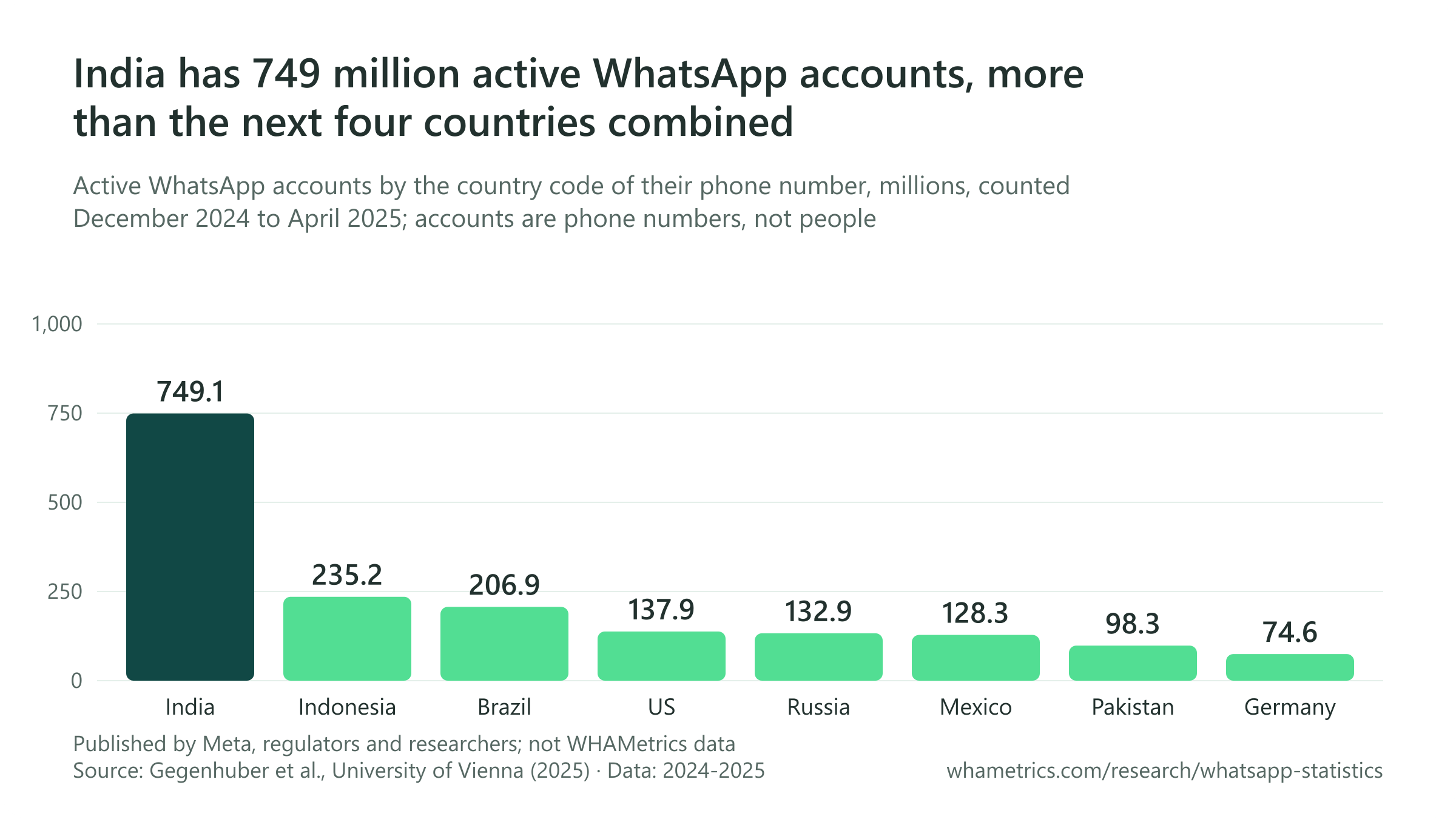
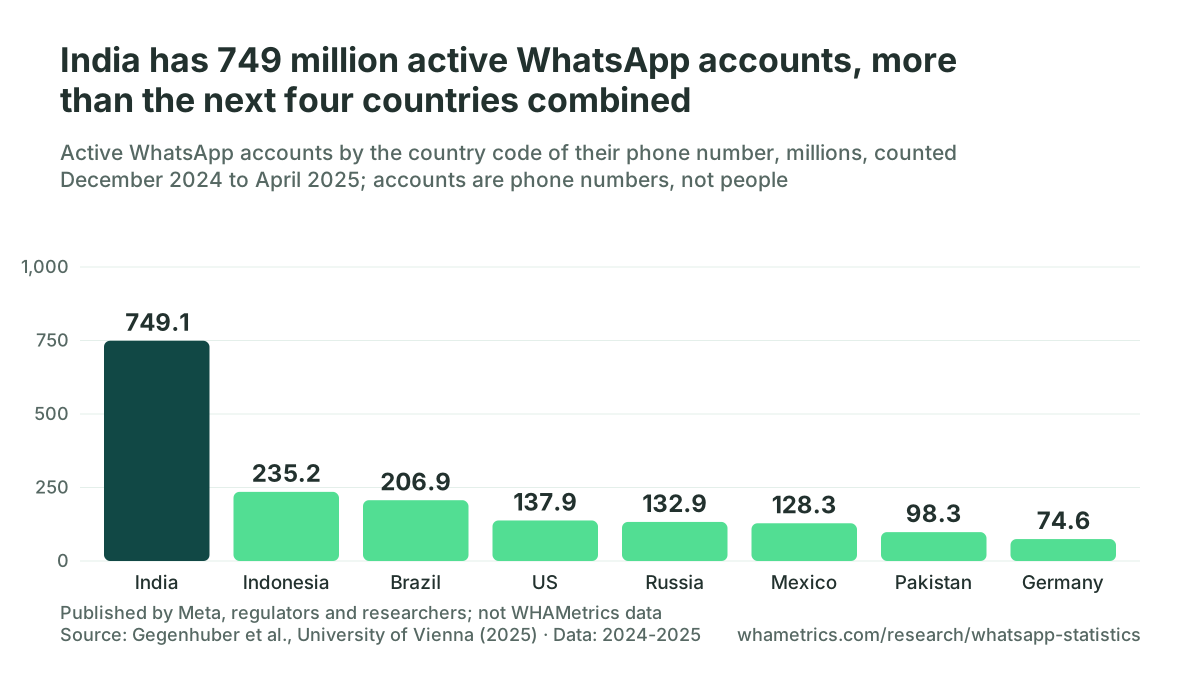
749 million active WhatsApp accounts had Indian phone numbers in early 2025, the most of any country (Gegenhuber et al., 2025).

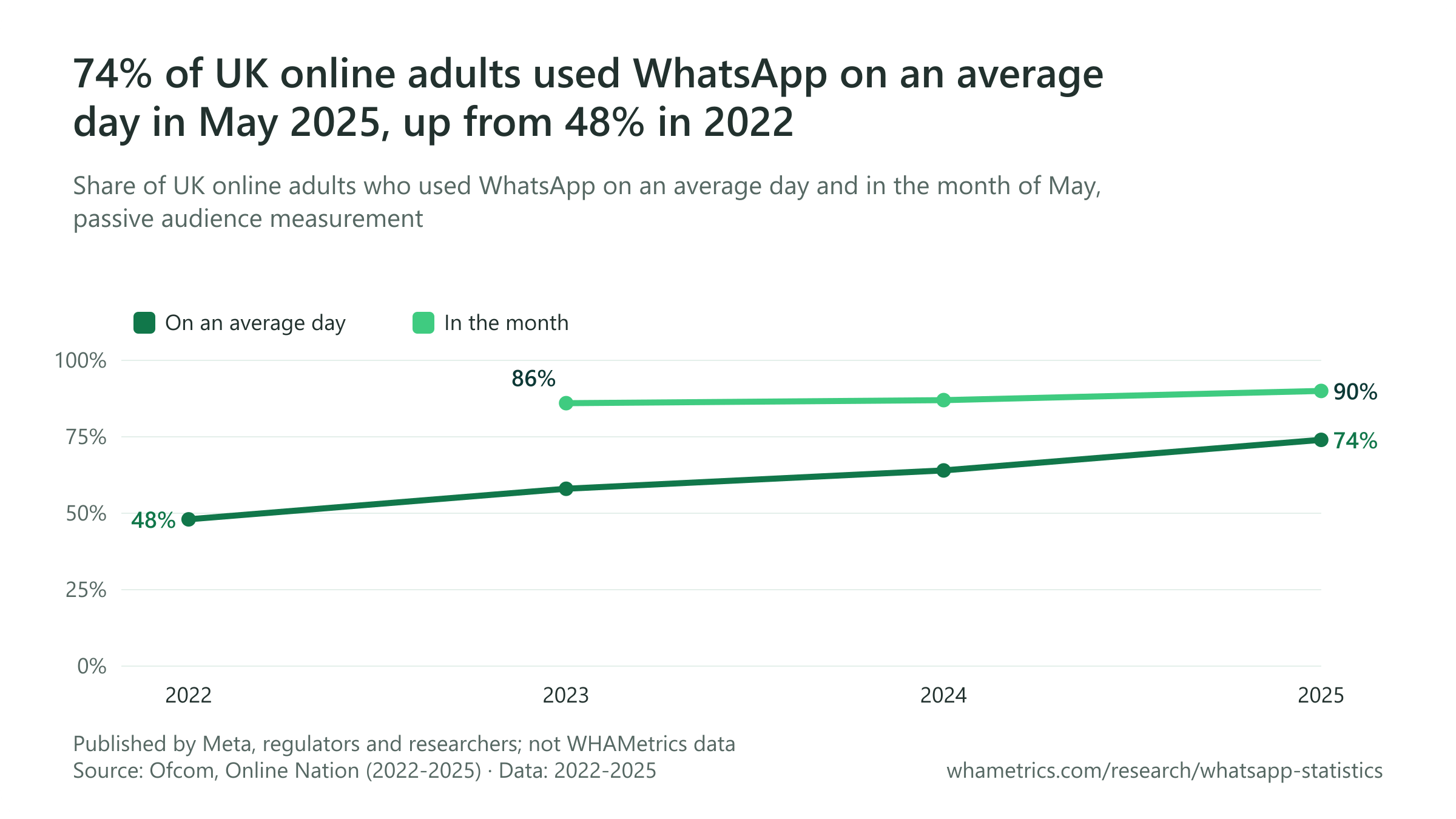
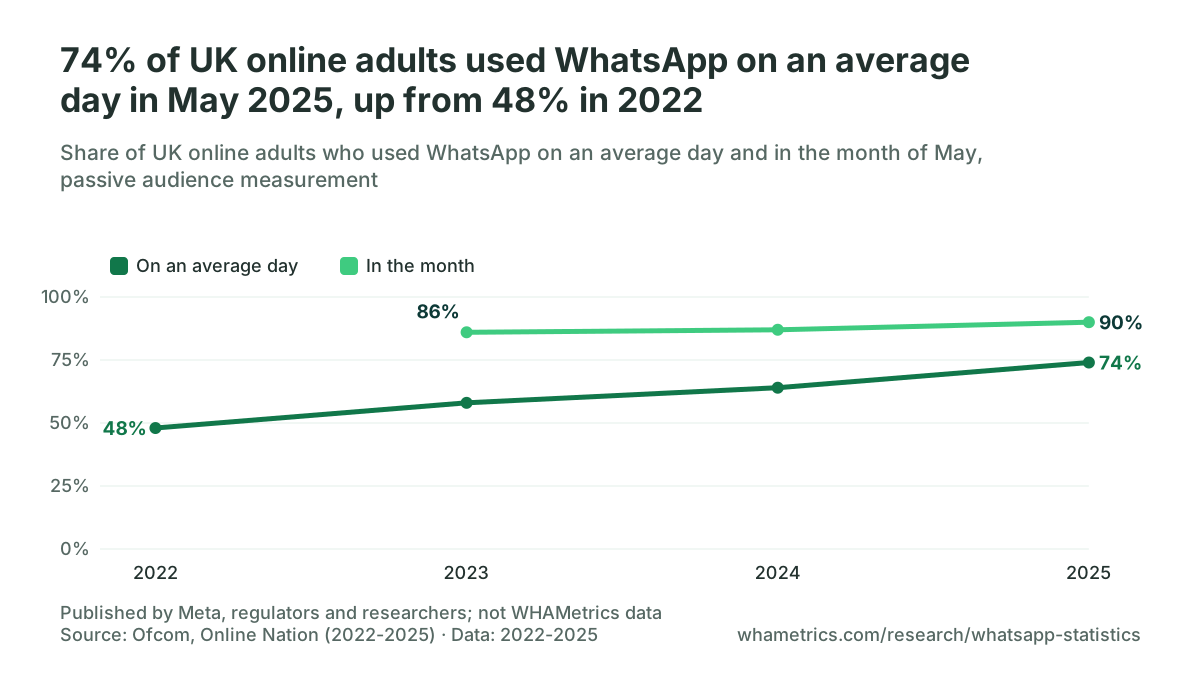
- 74% of UK online adults used WhatsApp on an average day in May 2025, up from 48% in 2022.
- 63.5 million Russians aged 12 and over used WhatsApp in June 2026, down from 97 million a year earlier.
- 50% of adults in India said they use WhatsApp in 2023, up from 29% in 2018.
- 40.5% of Iranians aged 15 and over used WhatsApp in June 2026, behind the domestic apps Rubika and Eitaa.
- WhatsApp was installed on 99% of Brazilian smartphone owners' phones in January 2025, in a commercial survey.
| Country, date and measure | Users, as stated |
|---|---|
| India, July 2019 (monthly users) | more than 400 million |
| India, February 2017 (monthly users) | 200 million |
| India, November 2014 (monthly users) | 70 million |
| Brazil, May 2017 (users) | 120 million |
| Russia, December 2025 (users, as the restrictions began) | more than 100 million |
| Russia, February 2014 (monthly users) | more than 10 million |
| Germany, January 2014 (monthly users) | more than 30 million |
Sources: University of Vienna and SBA Research; Ofcom; Vedomosti; Pew Research Center; Iranian Students Polling Agency; Mobile Time and Opinion Box; TechCrunch; Jan Koum (2017, 2014a, 2014b); Press Trust of India; Convergência Digital; Reuters
More statistics (75)
India, Indonesia and Brazil have the most WhatsApp accounts, and in much of Latin America, Africa, Europe and South Asia WhatsApp is the default way to message. WhatsApp itself has given country counts only now and then, years apart. The rest comes from each country's regulator, statistics office or audience panel, each with its own measure, and from Russia, where the state has been pushing people off WhatsApp.
India
- Brazil, India, Mexico and Russia were among WhatsApp's fastest-growing countries in early 2014, WhatsApp said (WhatsApp, 2014).
- India, Mexico, Brazil and Indonesia are among WhatsApp's biggest countries, Facebook's chief executive said in January 2020 (Facebook, 2020).
- India has the largest WhatsApp community in the world, Facebook said in April 2020 (Facebook, 2020).
- More than 20 million people each in Germany, Mexico, India and Spain used WhatsApp actively in August 2013, WhatsApp told AllThingsD (AllThingsD, 2013).
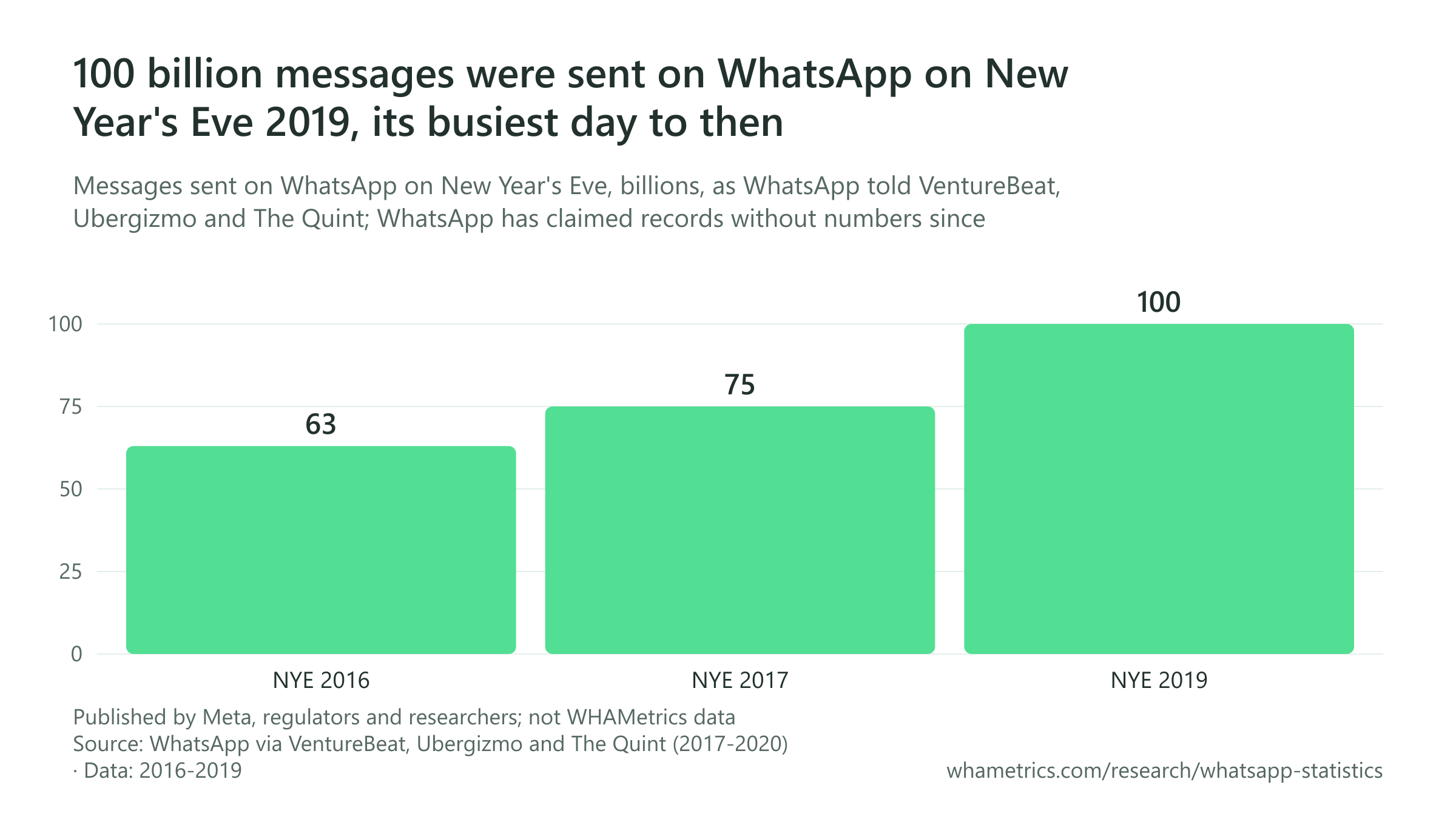
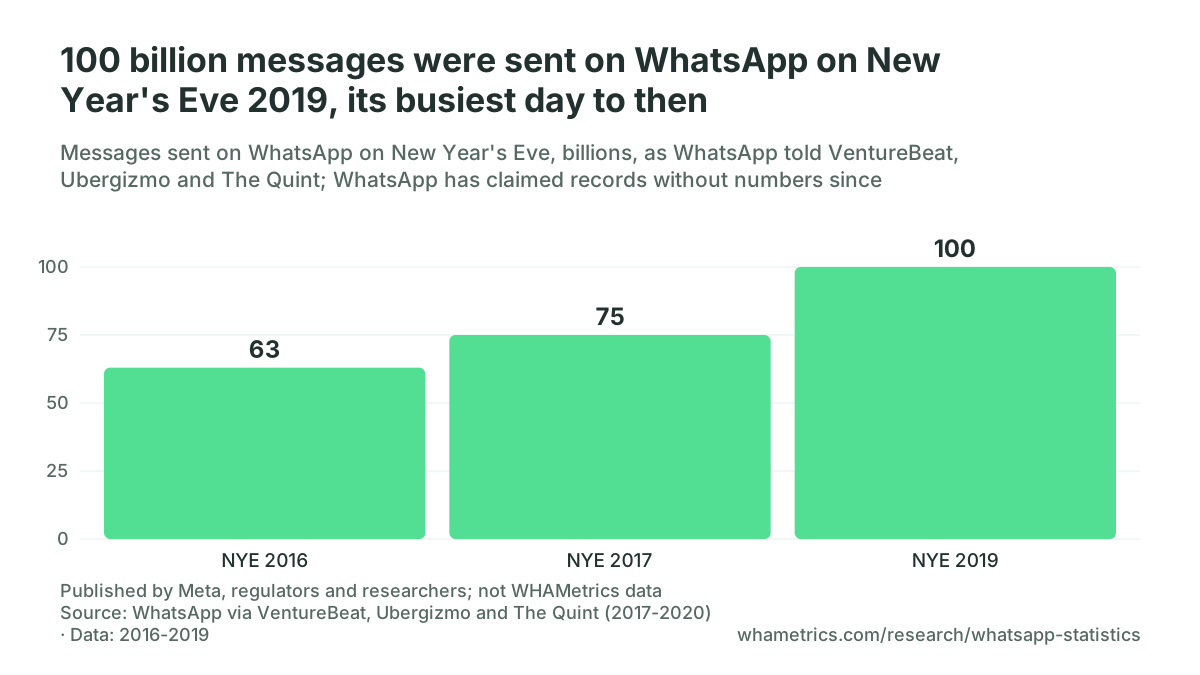
- 14 billion WhatsApp messages were sent in India on New Year's Eve 2016, Facebook revealed, Ubergizmo reported (Ubergizmo, 2017).
- More than 20 billion WhatsApp messages were sent in India on New Year's Eve 2019, about a fifth of the global total, WhatsApp said (The Quint, 2020).
- India led WhatsApp video calling with 50 million minutes a day in May 2017, WhatsApp said, GSMArena reported (GSMArena, 2017).
- Brazil ranks third among WhatsApp's markets by number of users, behind India and Indonesia, Olhar Digital reported from WhatsApp head Will Cathcart's interview with Folha de S.Paulo in November 2023 (Olhar Digital, 2023).
- WhatsApp had 53 crore (530 million) users in India, India's Ministry of Electronics and IT said in February 2021, citing figures 'reported' by unnamed portals rather than a government measurement (MeitY, 2021).
- 34% of Indian voters used WhatsApp at the time of the 2019 Lok Sabha election, up from 22% in 2017 (Lokniti-CSDS, 2019).
- 33% of Indian voters used WhatsApp in May 2018 (Lokniti-CSDS, 2019).
- 22% of Indian voters used WhatsApp in May 2017 (Lokniti-CSDS, 2019).
- 29% of Indian voters used WhatsApp daily in 2019, more than Facebook at 23% or YouTube at 25% (Lokniti-CSDS, 2019).
- 97% of small retail businesses surveyed by PayNearby in India used WhatsApp or WhatsApp Business in 2024, the most used messaging apps (PayNearby vendor survey, 2024).
Brazil
- People in Brazil send four times more voice messages on WhatsApp than people in any other country, Meta's chief executive said in June 2024, Canaltech reported (Canaltech, 2024).
- Brazil sends four times more voice messages on WhatsApp than any other country and also leads in text and disappearing messages, WhatsApp's head said in November 2023, Olhar Digital reported (Olhar Digital, 2023).
- 92% of Brazil's 157 million internet users aged 10 and over sent instant messages in 2025, the most common online activity (category: instant messaging, not WhatsApp alone; Cetic.br TIC Domicílios, 2026).
- 73% of Brazilian internet users aged 10 to 15 sent instant messages in 2025, against 92% of all internet users (category: instant messaging, not WhatsApp alone; Cetic.br TIC Domicílios, 2026).
- 85% of Brazilian internet users in rural areas sent instant messages in 2025, against 92% of all internet users (category: instant messaging, not WhatsApp alone; Cetic.br TIC Domicílios, 2026).
- 84% of Brazilian internet users in social classes D and E sent instant messages in 2025, against 92% of all internet users (category: instant messaging, not WhatsApp alone; Cetic.br TIC Domicílios, 2026).
- 64% of Brazilian internet users with no schooling or only pre-school education sent instant messages in 2025, against 92% of all internet users (category: instant messaging, not WhatsApp alone; Cetic.br TIC Domicílios, 2026).
- 90.2% of Brazil's 168.7 million internet users aged 10 and over used the internet to send or receive text, voice or image messages through apps other than e-mail in 2025 (category: messaging apps, not WhatsApp alone; IBGE PNAD Contínua TIC, 2026).
- WhatsApp was on the home screen of 64.8% of Brazilian smartphones in March 2026, up from 53% a year earlier, the most of any app (Mobile Time and Opinion Box commercial online survey, 2026).
- 97% of Brazilian adult WhatsApp users with a smartphone open WhatsApp at least once a day, and 37% say it stays open all day, in July 2026 (Opinion Box commercial online survey, 2026).
- 93% of Brazilian WhatsApp users said they open the app every day in January 2020, when it was installed on 99% of Brazilian smartphones (Mobile Time/Opinion Box, 2020).
The UK

- WhatsApp was installed on almost 88% of Android devices in the UK, and 88% of its UK users opened it daily, by Similarweb's estimate (modelled app panel, 2025; Similarweb, 2025).
- WhatsApp was installed on 87.83% of Android devices in the UK in 2022, by Similarweb's estimate (modelled app panel; Similarweb, 2023).
- 98% of WhatsApp's users are outside the UK, so about 2% are in it, WhatsApp's head said in March 2023 while opposing the Online Safety Bill (PA Media, 2023).
- 44.2 million UK online adults used WhatsApp in May 2025, up 2.7 million on a year earlier (Ofcom, 2025).
- 82.4% of UK online adults aged 15 and over (41.1 million) used WhatsApp in September 2021 (Ofcom, 2022).
- 67% of UK online adults (30.4 million) used WhatsApp in September 2020, as measured by Comscore (Ofcom, 2021).
- 75% of UK online people aged 15 and over said they used WhatsApp during the spring 2020 lockdown (Ofcom, 2021).
- UK adults who used WhatsApp spent an average of 15 minutes a day on it in May 2024 (Ofcom, 2025).
- UK adults who used WhatsApp spent an average of 13 minutes a day on it in May 2023 (Ofcom, 2025).
- 62% of UK children aged 13 to 17 had a WhatsApp profile in 2024, against 23% of those aged 3 to 12 (Ofcom, 2025).
- 86% of UK internet users aged 16 and over said they had used WhatsApp in June 2024 (Ofcom online research panel, 2024).
Germany

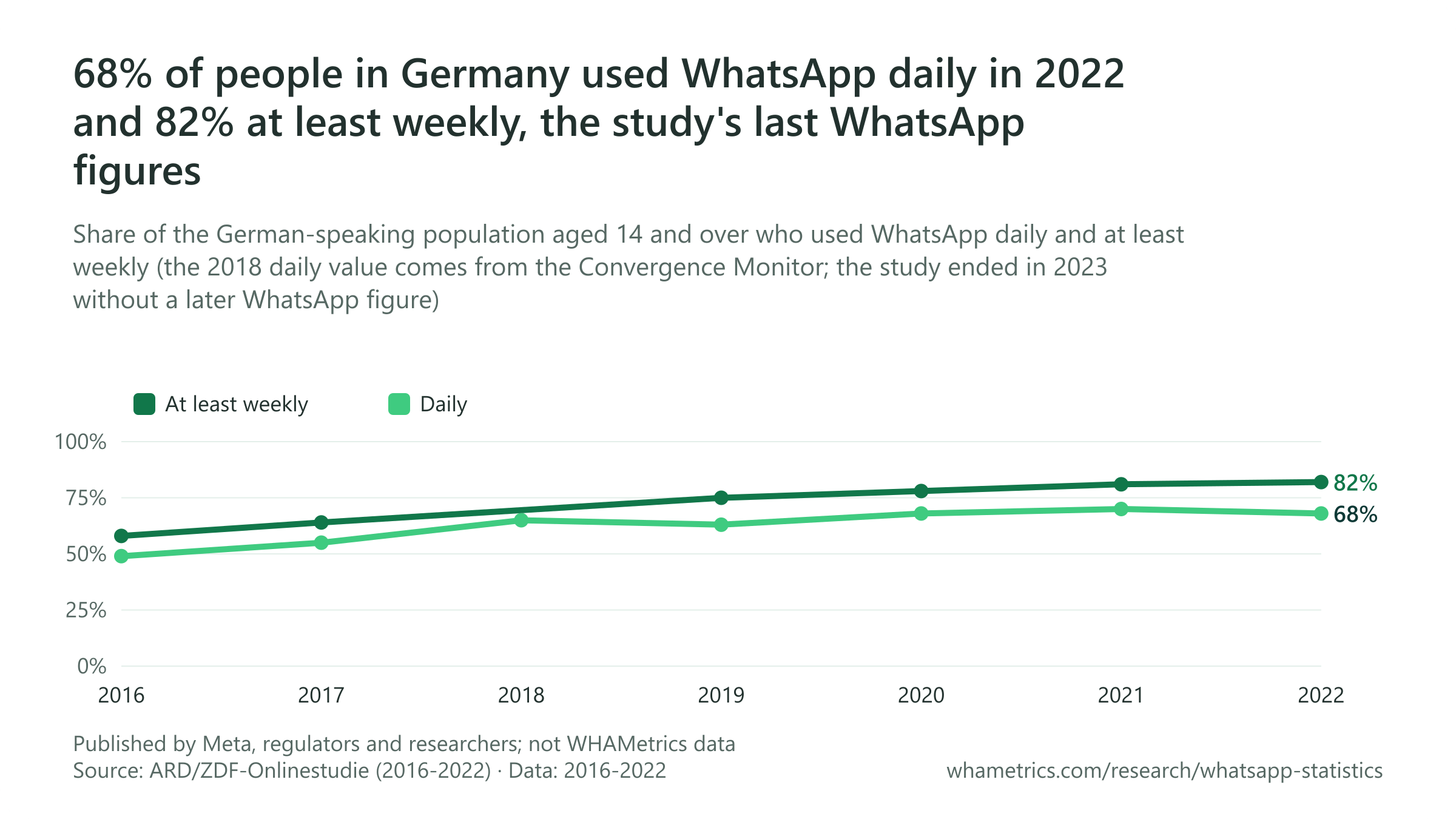
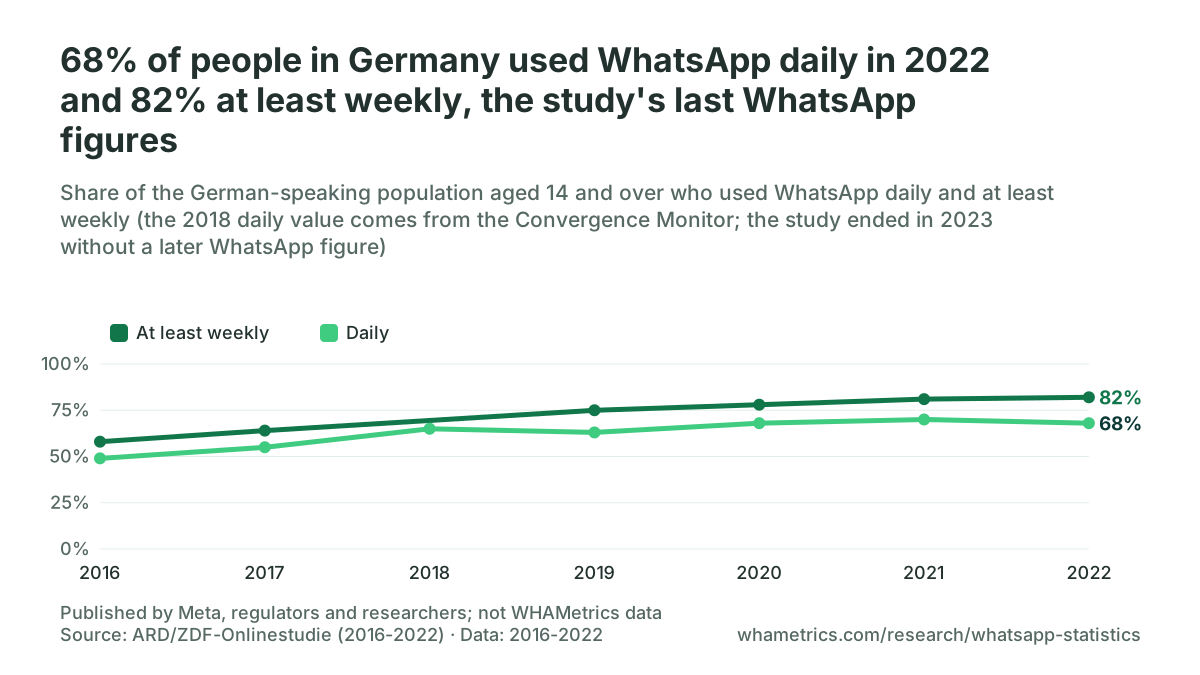
- 34% of people aged 14 and over in Germany said WhatsApp had become more important to them during the Covid-19 crisis of the previous 12 months, and 3% said less important (ARD/ZDF-Onlinestudie, 2021).
- 79% of people in Germany said they had WhatsApp on their smartphone and used it in June 2021, after the privacy-policy controversy, and 13% planned to delete it (YouGov poll for the Deutsche Presse-Agentur, 2021).
France, Italy and Spain

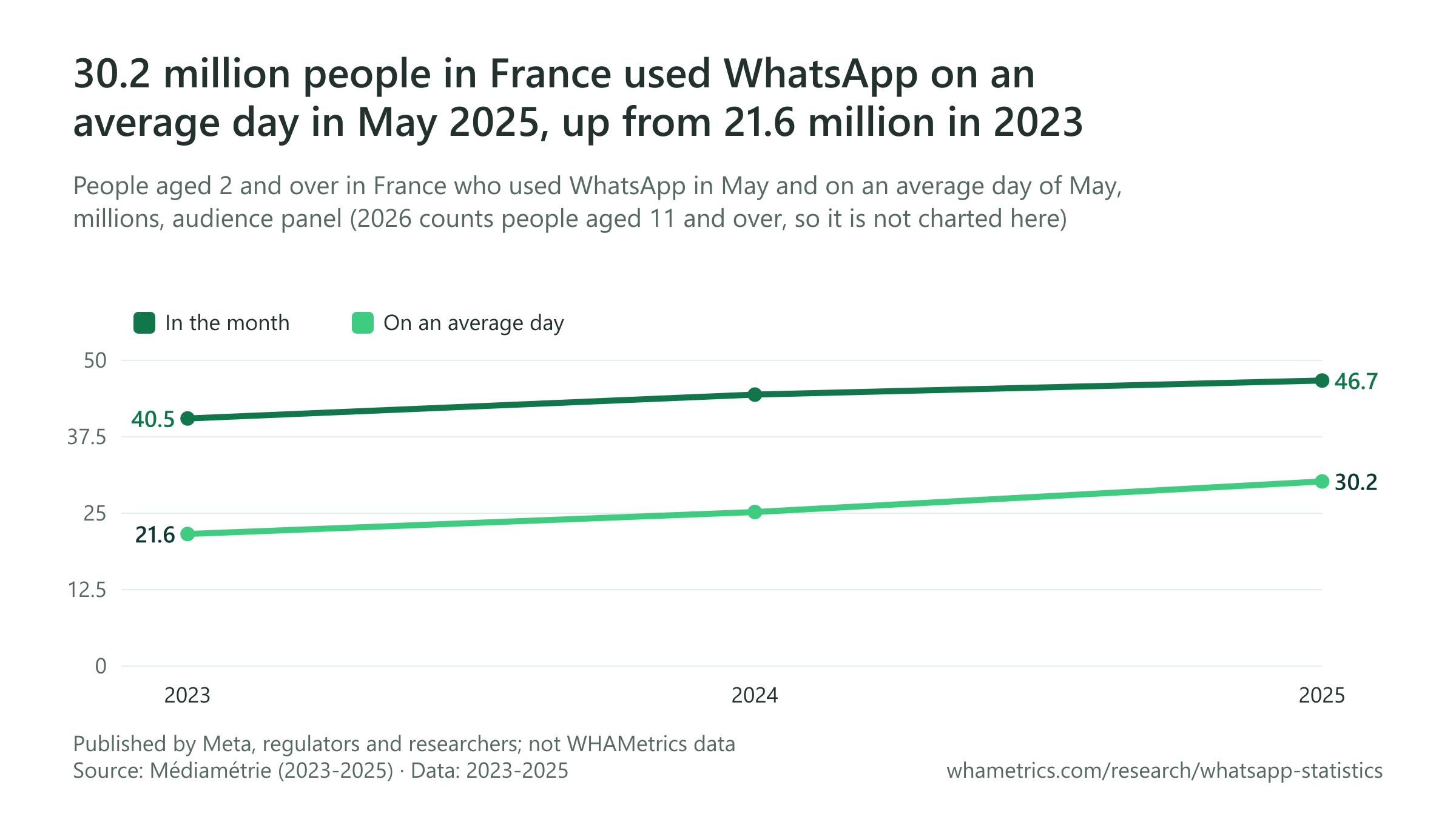
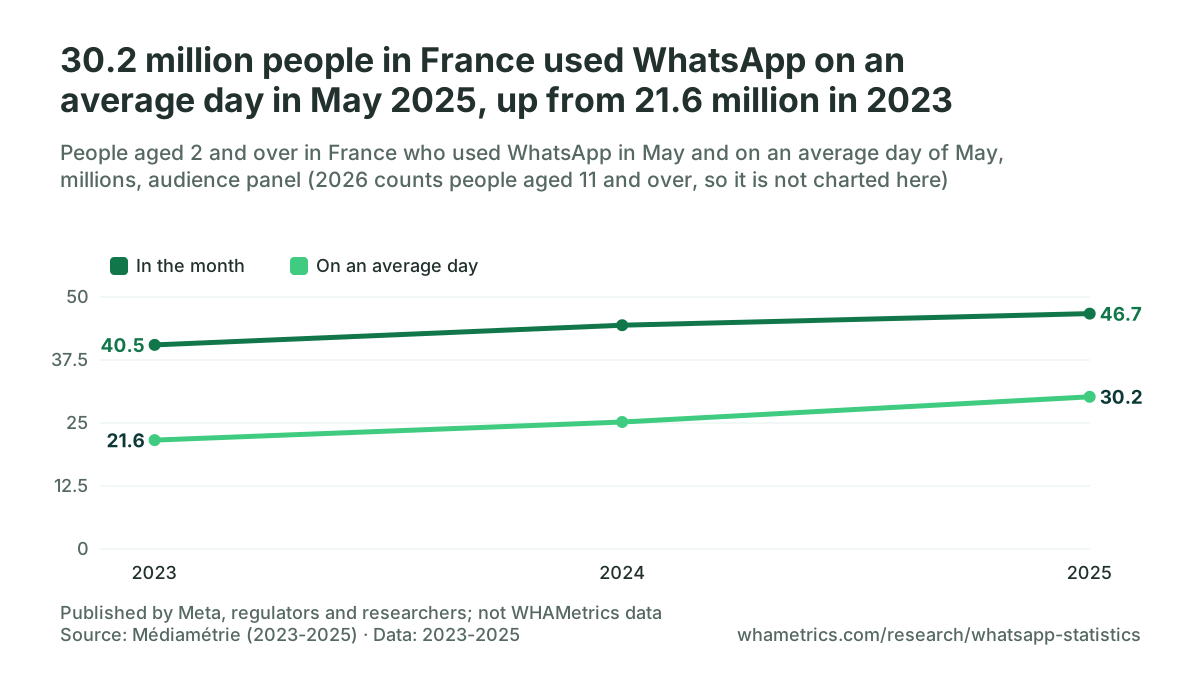

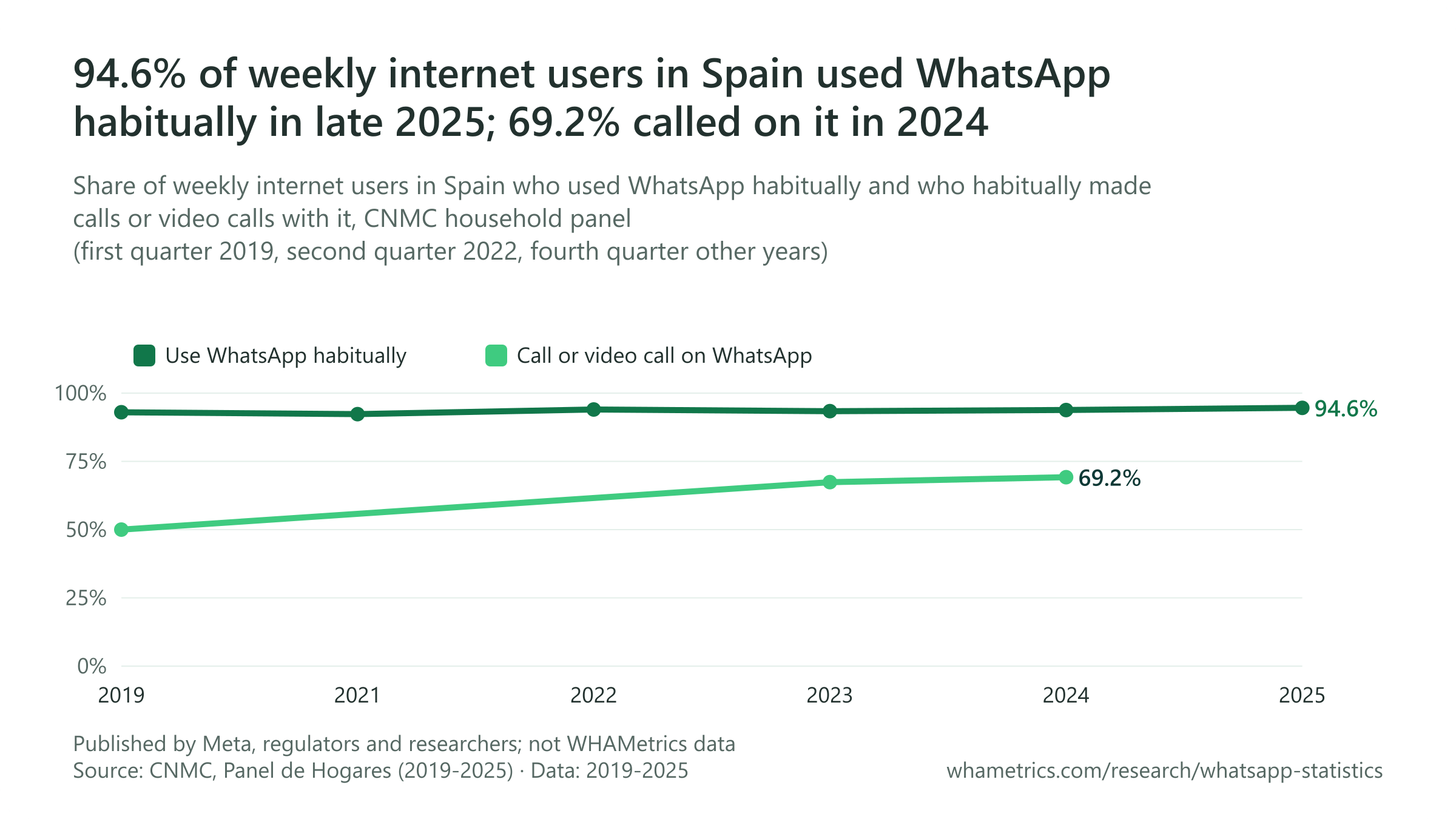
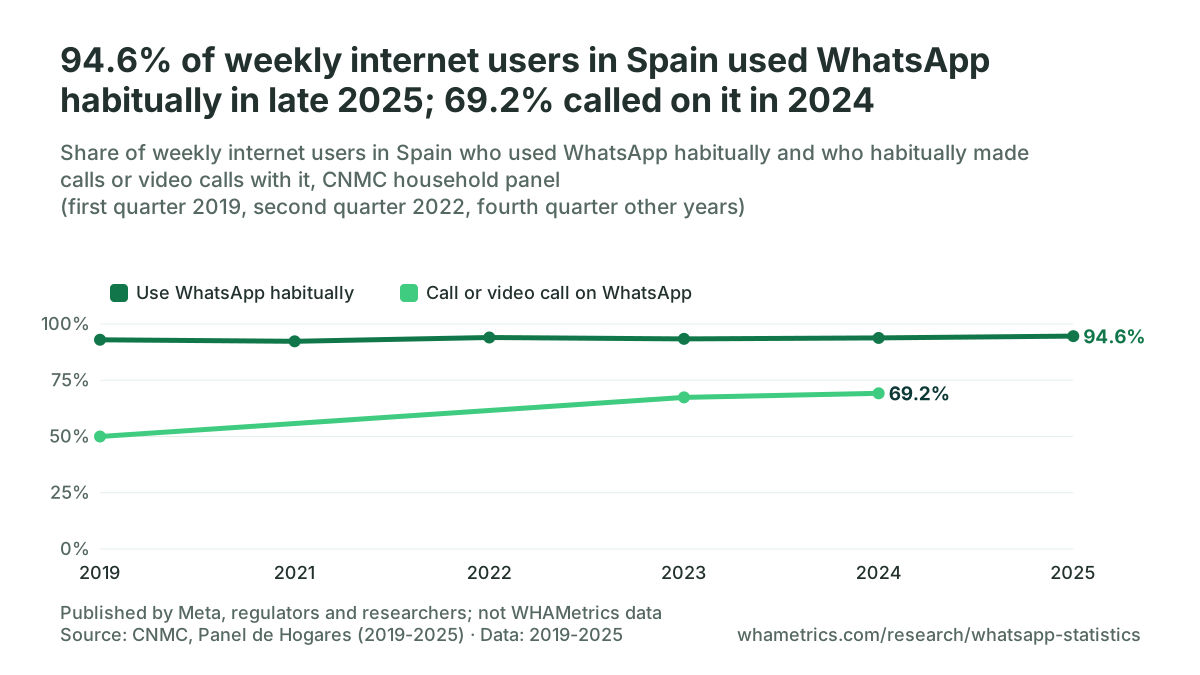
- 50.3 million people aged 11 and over in France used WhatsApp at least once in May 2026, measured by audience panel (Médiamétrie, 2026).
- 35.5 million people aged 11 and over in France used WhatsApp on an average day in May 2026, measured by audience panel (Médiamétrie, 2026).
- 86% of people aged 12 and over in France used instant-messaging services in June 2025, and 64% used them daily (category: instant messaging, not WhatsApp alone; Baromètre du numérique, Arcep and Credoc, 2026).
- About 75% of people aged 12 and over in France used WhatsApp in June 2025, combining the 86% who use instant messaging with the 87% of them who use WhatsApp (derived from the Baromètre du numérique, Arcep and Credoc, 2026).
- 38.3 million people in Italy used instant-messaging sites and apps in December 2025 (category: instant messaging, not WhatsApp alone; Audicom, Sistema Audiweb, 2026).
Turkey

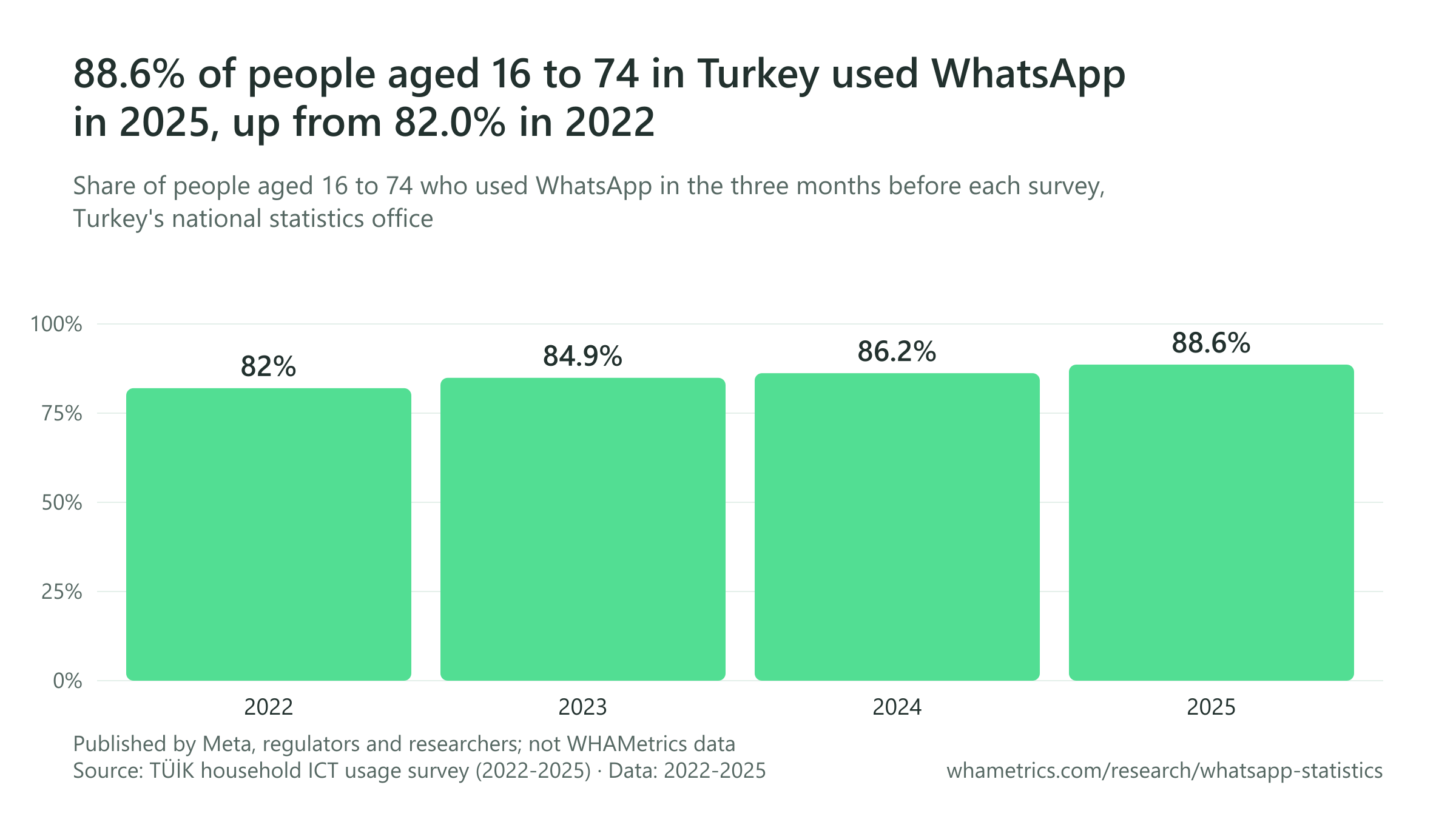
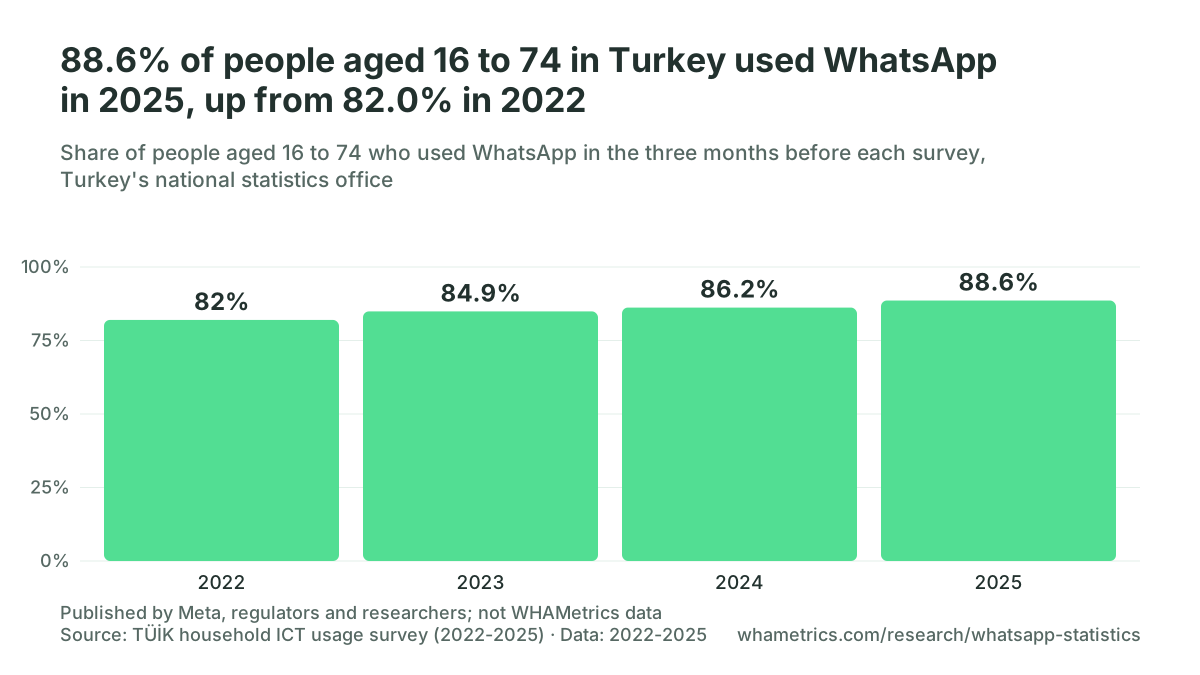
- Researchers counted 72,131,903 active WhatsApp accounts with Turkey's country code (2.09% of all accounts found, rank 9) between December 2024 and April 2025 (account enumeration; Gegenhuber et al., 2025).
Russia

- WhatsApp reached 74% of Russians aged 12 and over in a month and Telegram 62%, Mediascope reported in May 2023 (monthly reach, audience panel; Mediascope, 2023).
- WhatsApp was used on an average day by 67% of Russians aged 12 and over, Telegram by 49% and Viber by 16%, Mediascope reported in April 2024 (daily reach, audience panel; Mediascope, 2024).
- 28% of Russian adults used WhatsApp for calls and messages in March 2026, down 42 percentage points since August 2025 (face-to-face survey; Levada Center, 2026).
- 70% of Russian adults used WhatsApp for calls and messages in August 2025, the most used messaging app (face-to-face survey; Levada Center, 2025).
- 72% of Russian adults used WhatsApp for calls and messages in March 2024, up from 17% in February 2016 (face-to-face survey; Levada Center, 2024).
- 57% of Russian adults regularly used WhatsApp in August 2025, up from 53% in March 2025, the most used platform ahead of Telegram (46%) (face-to-face survey; FOM, 2025).
- 53% of Russian adults used WhatsApp in March 2025, the most popular social network or messenger (face-to-face survey; FOM, 2025).
- 87% of Russian adults used WhatsApp in April 2022, the most used social network or messenger, and 67% used it almost daily (telephone survey; WCIOM, 2022).
- More than 100 million users in Russia were cut off from WhatsApp when Russia tried to block it fully in February 2026, WhatsApp said in a statement on X (The Moscow Times, 2026).
Iran

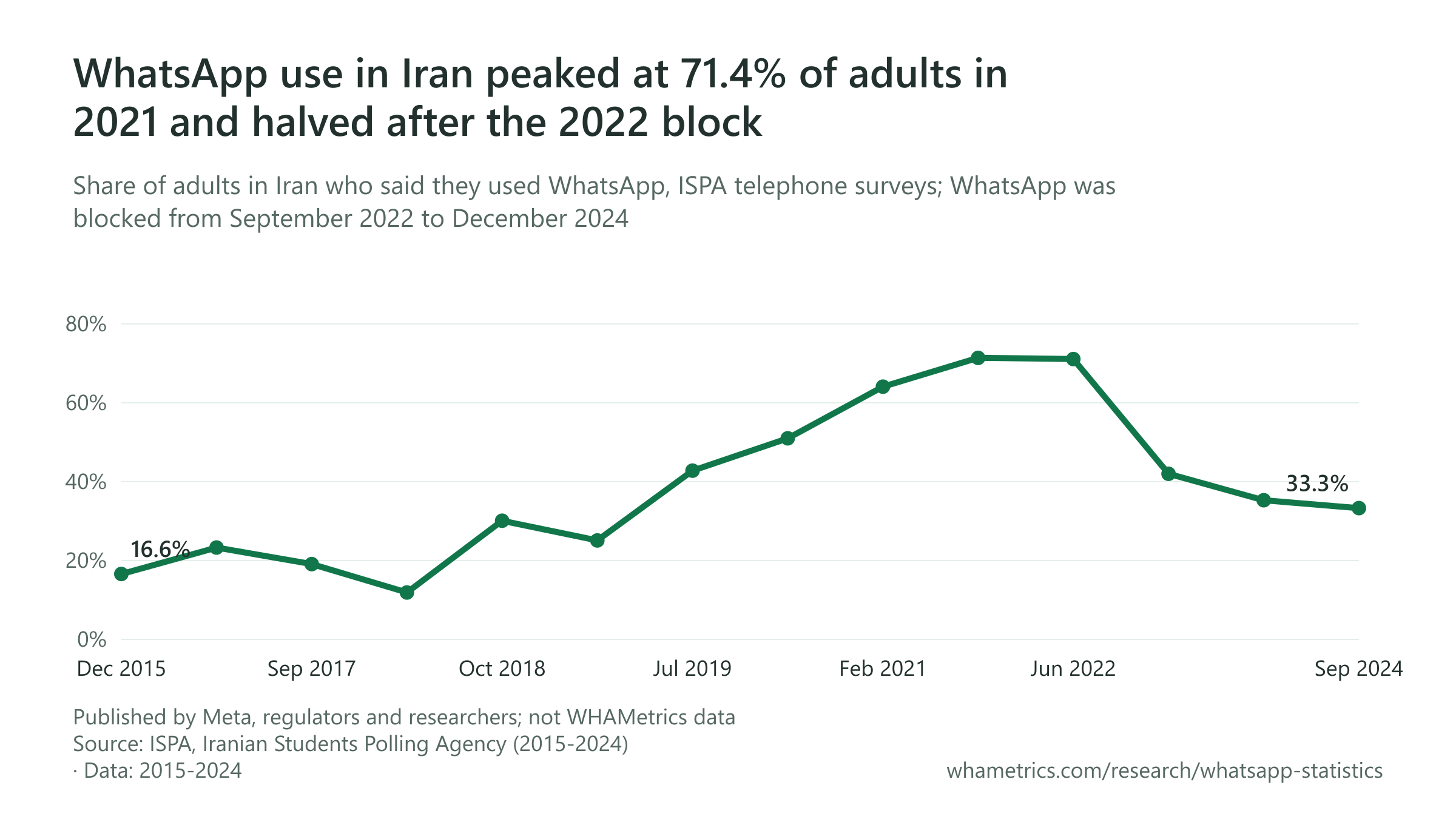
- Researchers counted 59,905,704 active WhatsApp accounts with Iranian phone numbers on December 22, 2024, equal to 66.49% of Iran's population, two days before Iran lifted its WhatsApp ban (account enumeration; Gegenhuber et al., 2025).
- Researchers counted 67,114,098 active WhatsApp accounts with Iranian phone numbers on March 19, 2025, equal to 74.49% of Iran's population, three months after Iran lifted its WhatsApp ban (account enumeration; Gegenhuber et al., 2025).
- 71.3% of urban and 42.8% of rural adults in Iran said they used WhatsApp in February 2021 (ISPA, 2021).
- 45.7% of internet users in Iran used WhatsApp in June 2026 (ISPA, 2026).
Mexico, Colombia and Argentina
- 90.6% of smartphone users aged 6 and over in Mexico used instant messaging apps in 2025, the most used type of app (category: instant messaging, not WhatsApp alone; INEGI ENDUTIH survey, 2026).
- 90.6% of smartphone users aged 6 and over in Mexico used instant messaging apps in 2024 (category: instant messaging, not WhatsApp alone; INEGI ENDUTIH survey, 2025).
- 91% of urban Mexican internet users aged 18 and over had an active WhatsApp account in 2026, ahead of Facebook at 85% and YouTube at 62% (Asociación de Internet MX online panel survey, 2026).
- 88% of Colombian smartphone users aged 15 and over used an app to send or receive messages in 2025, from 96% of those aged 15 to 24 to 79% of those aged 45 and over (category: messaging apps, not WhatsApp alone; CRC regulator's household survey, 2026).
- About 87% of Colombian smartphone users aged 15 and over used WhatsApp to chat in 2025 (CRC regulator's household survey, 2026; derived).
- 99% of Colombian smartphone users who make calls through an app used WhatsApp for voice or video calls in 2025; 84% of smartphone users call through apps (CRC regulator's household survey, 2026).
- 92% of Argentines aged 13 and over in urban areas had a WhatsApp account in 2022, the most of any network, ahead of YouTube at 82% and Facebook at 72% (Ministry of Culture national cultural consumption survey, 2023).
- 77 million people in Mexico used WhatsApp, a UNAM computing official said in February 2020 (Gaceta UNAM, 2020).
Nigeria, Kenya, South Africa and Egypt
- Researchers counted 69,317,806 active WhatsApp accounts with Egypt's country code (2.01% of all accounts found, rank 10) between December 2024 and April 2025 (account enumeration; Gegenhuber et al., 2025).
- 35% of South African TV viewers aged 15 and over are also on WhatsApp while the television is on, according to the country's audience measurement body (Broadcast Research Council Establishment Survey, 2026).
- 84% of Nigerian respondents in a 2019 national telephone poll used WhatsApp, second to Facebook (86%), and 51% named WhatsApp their preferred social platform (NOIPolls, 2019).
Pakistan
- WhatsApp has approximately 100 million user accounts in Pakistan, the head of the country's telecoms regulator told parliament in November 2026 (Minute Mirror, 2026).
- Pakistanis send approximately 12 billion WhatsApp messages and make around 1 billion WhatsApp calls a day, the head of Pakistan's telecoms regulator told parliament in November 2026 (Minute Mirror, 2026).
Sources: WhatsApp LLC; Facebook, Inc. (2020); AllThingsD; Ubergizmo; The Quint; GSMArena; Olhar Digital; Ministry of Electronics and Information Technology, Government of India; Lokniti, Centre for the Study of Developing Societies; PayNearby; Canaltech; Núcleo de Informação e Coordenação do Ponto BR, Cetic.br (2026); Instituto Brasileiro de Geografia e Estatística; Mobile Time and Opinion Box (2020, 2026); Opinion Box; Similarweb (2023, 2025); PA Media; Ofcom (2021-2025); ARD/ZDF-Forschungskommission, published in Media Perspektiven (2017, 2021, 2022); YouGov Deutschland; Médiamétrie and Médiamétrie//NetRatings (2023-2026); Arcep, Conseil général de l'économie, Arcom and ANCT (2026); Audicom; University of Vienna and SBA Research; Mediascope (2023, 2024); Levada Center (2024, 2025, 2026); Public Opinion Foundation (2025); WCIOM; The Moscow Times; Iranian Students Polling Agency (2021, 2024, 2026); Instituto Nacional de Estadística y Geografía (2025, 2026); Instituto Federal de Telecomunicaciones; Asociación de Internet MX; Comisión de Regulación de Comunicaciones, Colombia; Ministerio de Cultura de la Nación, Sistema de Información Cultural de la Argentina; Universidad Nacional Autónoma de México; Communications Authority of Kenya; Broadcast Research Council of South Africa, fieldwork and analysis by Ask Afrika; Media Council of Kenya; NOIPolls; Minute Mirror; Comisión Nacional de los Mercados y la Competencia, Panel de Hogares (2019-2026); Turkish Statistical Institute (2022-2025); RBC; Kommersant; Forbes Russia; Vedomosti (2026)
How do people use WhatsApp? Messages, calls and time spent
Figures published by Meta, regulators, surveys and studies; none is WHAMetrics data.
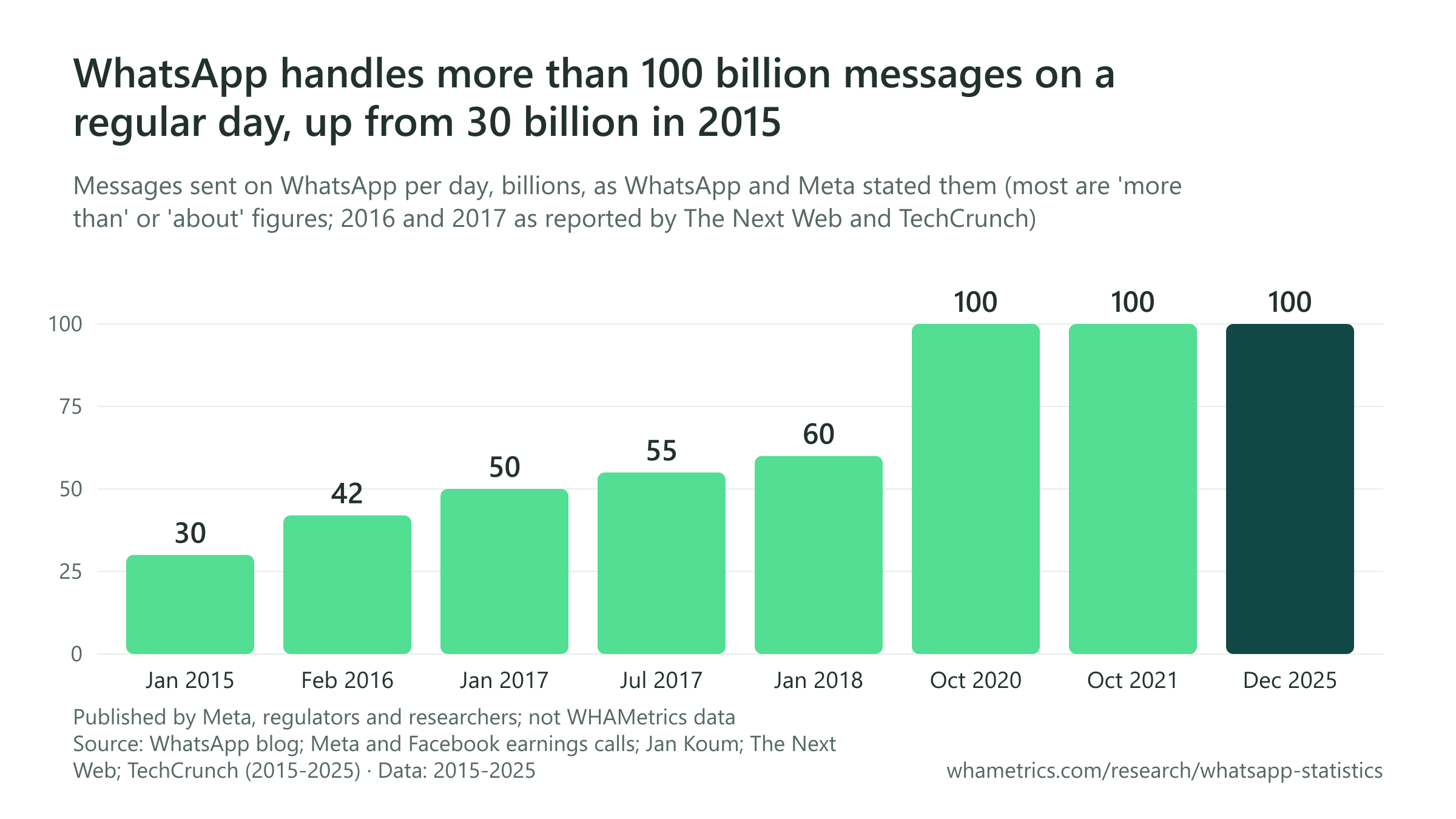
WhatsApp handles more than 100 billion messages on a regular day, it said in December 2025 (WhatsApp, 2025).

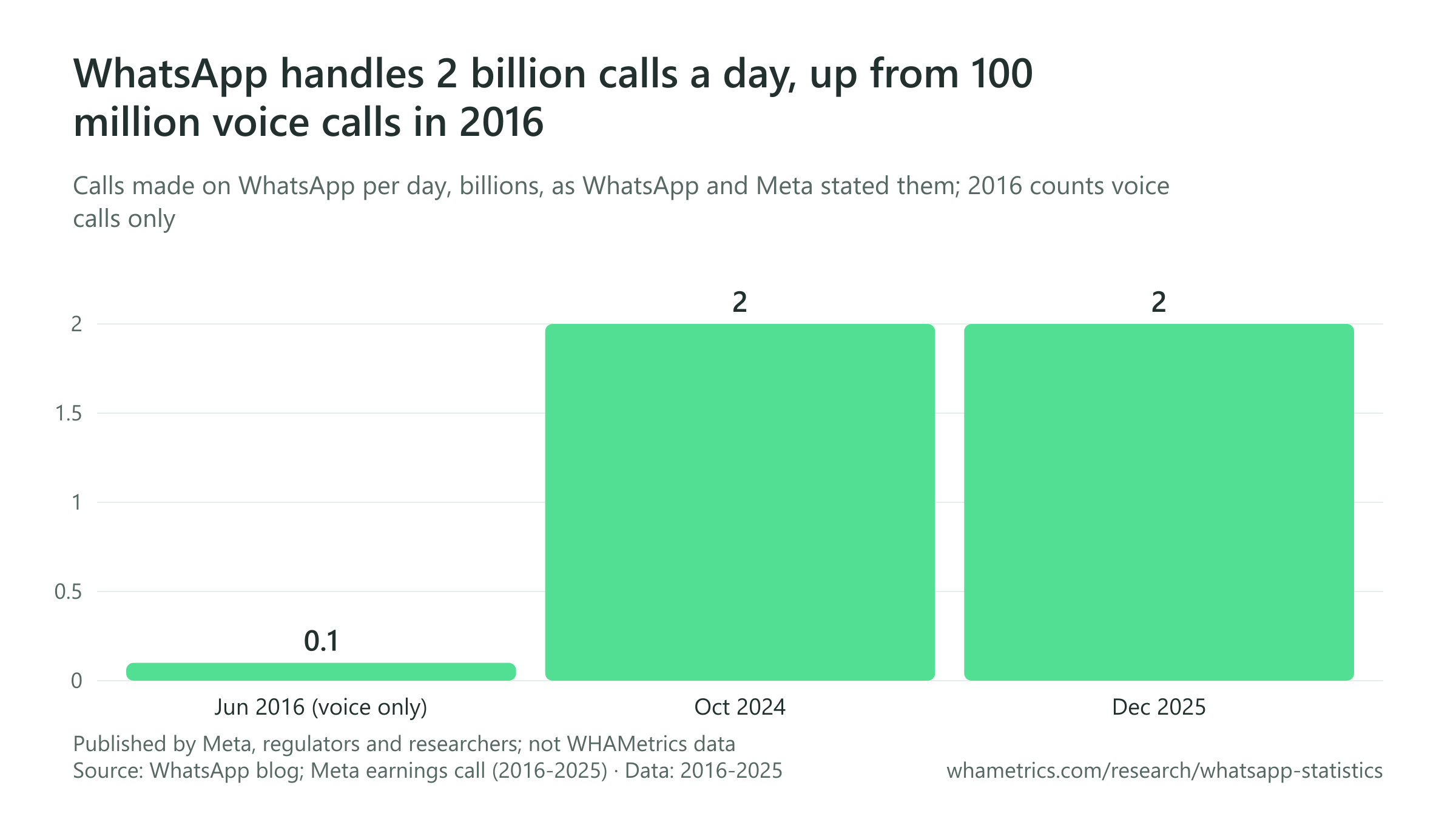
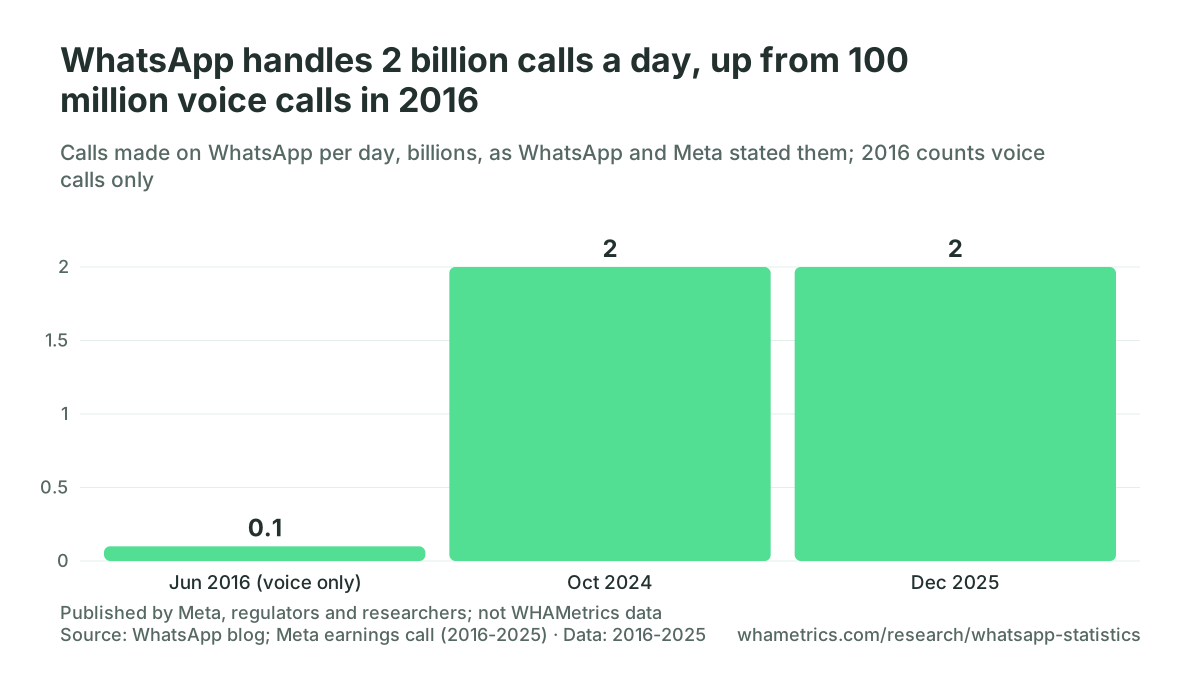
- WhatsApp handles 2 billion calls on a regular day, it said in December 2025.
- WhatsApp peaked at 30 million messages a second during the 2026 World Cup final, an all-time record.
- 7 billion voice messages were sent on WhatsApp on an average day in March 2022, the only count given.
- 91% of WhatsApp's monthly users used it daily in late 2023, more than for any other big app, a tracker estimated.
- Dutch WhatsApp users had a median of 203 contacts in 2023, from account data they donated to researchers.
| Who was measured, and how | Time a day |
|---|---|
| UK adults who use WhatsApp, May 2025 (audience panel) | 17 minutes |
| UK 15- to 17-year-olds online, May 2025 (audience panel) | 14 minutes |
| UK children aged 8 to 14 who use WhatsApp, winter 2024-25 (passive measurement) | 15 minutes |
| Children aged 4 to 18 on parental-control software, six countries, 2025 | 17 minutes |
| Children in Brazil on parental-control software, 2025 | 25 minutes |
| Children in the US on parental-control software, 2025 | 12 minutes |
| Smartphone users, mostly in Germany, 2015 (tracking app) | 32 minutes |
| Android users worldwide, 2025 (modelled app panel) | roughly one hour |
Sources: WhatsApp LLC (2025, 2022, 2021); Meta Platforms, Inc.; Sensor Tower; Social Network Analysis and Mining; Ofcom (2025a, 2025b); Qustodio; BMC Research Notes; Similarweb; Jan Koum; The Next Web; Facebook, Inc. (2020, 2018, 2017); TechCrunch
More statistics (95)
Most of what WhatsApp carries is private conversation between two people, which is why the company's own counts of messages and calls are almost the only window on its traffic. Those counts come every few years, worded differently each time. Studies that log real phones, or that ask people to donate their chat data, show how much time people spend, how fast they reply and what they share, but they are small and often old.
Messages a day
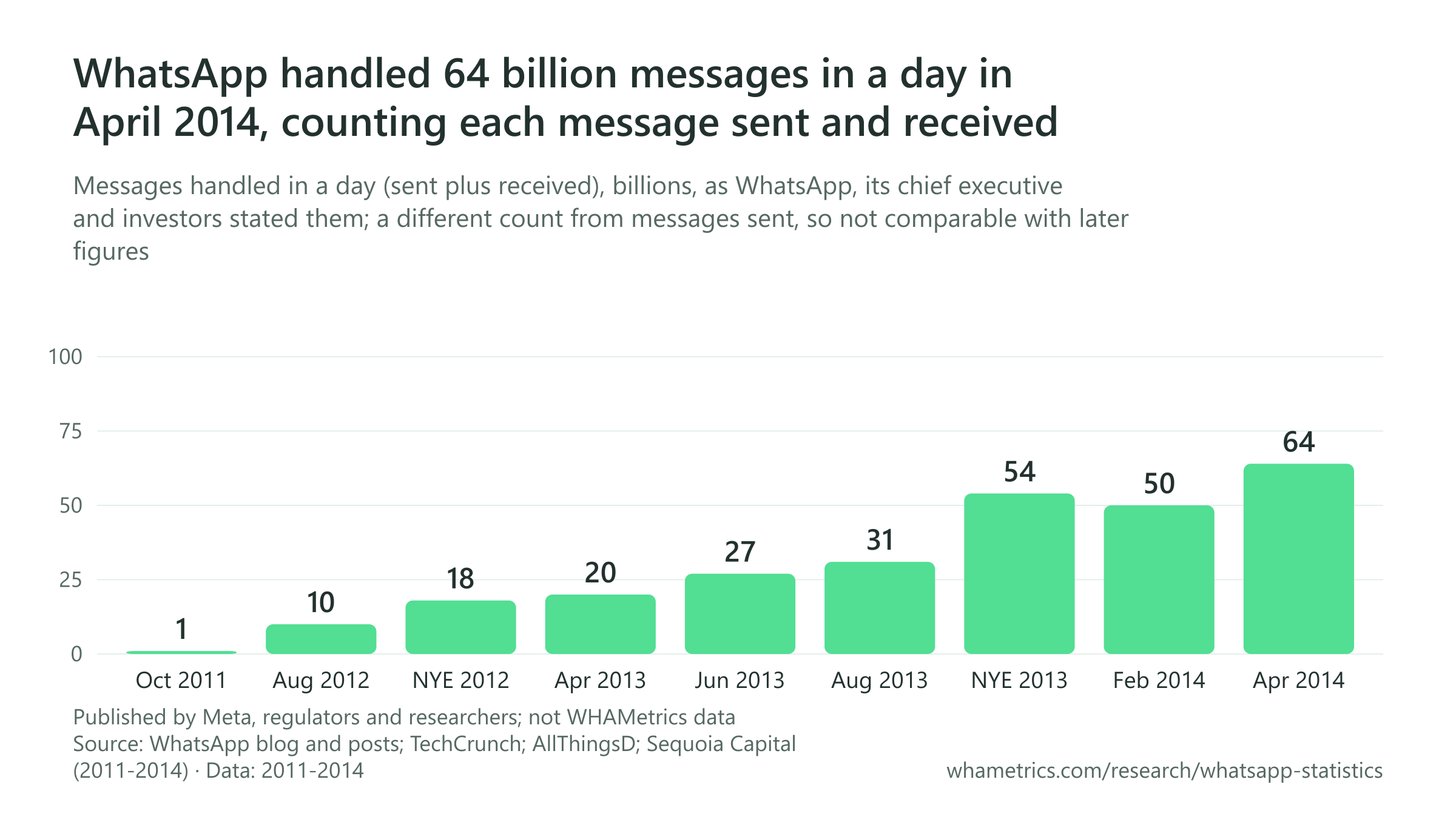
- More than 30 billion messages were sent on WhatsApp each day in January 2015, Facebook said on its fourth-quarter 2014 earnings call (Facebook, 2015).
- About 60 billion messages a day were sent on Messenger and WhatsApp combined in April 2016, Facebook said on its first-quarter 2016 earnings call (Facebook, 2016).
- Almost 100 billion messages a day were sent on WhatsApp and Messenger combined in April 2018, Facebook said on its first-quarter 2018 earnings call (Facebook, 2018).
- More than 3 billion messages were sent to COVID-19 helplines on WhatsApp run with more than 150 governments, WHO and UNICEF in the year to April 2021, WhatsApp said (WhatsApp, 2021).
- More than 45 billion messages a day were sent across Facebook's family of apps in April 2015, Facebook said (Facebook, 2015).

Calls and voice messages

- 80% of Brazilian adult WhatsApp users said they use voice (audio) messages, now the most used feature, ahead of text messages at 57%, in an online survey of 1,000 users in July 2026 (Opinion Box, 2026).
- 41% of smartphone users in Germany said they like sending voice messages on messengers such as WhatsApp, from 53% at ages 16 to 29 to 28% at 65 and over, in an early 2024 telephone survey (Bitkom, 2024).
- 75% of smartphone users in Germany said long voice messages annoy them, and 45% that a voice message should last one minute at most, in an early 2024 telephone survey (Bitkom, 2024).
- 15% of British adults used voice notes regularly (several times a week) in March 2026, against 89% for messaging, 50% for voice calls and 24% for video calls (YouGov, 2026).
- Only 7% of adults across 17 markets preferred sending messages as audio rather than text in November 2023, against 66% preferring text, with consumers in the UAE, Mexico and Spain the most likely to prefer audio (YouGov, 2024).
- WhatsApp users spent more than 2 billion minutes a day on calls in July 2018, WhatsApp said (WhatsApp, 2018).
- More than 3 billion minutes of video and voice calls a day were made on WhatsApp and Messenger combined in April 2018, Facebook said (Facebook, 2018).
- People spent more than 15 billion minutes a day on WhatsApp calls on average in the month to late April 2020, during the first COVID-19 lockdowns, WhatsApp said (WhatsApp, 2020).
- 1.4 billion voice and video calls were made on WhatsApp on New Year's Eve 2020, a record for a single day, WhatsApp's blog said in March 2021; Facebook's first report of the figure, on January 1, 2021, said 'more than 1.4 billion' (WhatsApp, 2021).
- More than 2 billion calls were made on WhatsApp every day in December 2024, WhatsApp said (WhatsApp, 2024).
- Messaging on Messenger and WhatsApp rose more than 50% in many of the places hardest hit by COVID-19 in early 2020, and voice and video calling more than doubled, Facebook said (Facebook, 2020).
- More than 700 million people a day took part in calls on WhatsApp and Messenger combined in April 2020, Facebook said (Facebook, 2020).
- More than 55 million video calls a day were made on WhatsApp in May 2017, six months after video calling launched, WhatsApp said, GSMArena reported (GSMArena, 2017).
- WhatsApp users spent 340 million minutes a day on video calls in May 2017, WhatsApp said, GSMArena reported (GSMArena, 2017).
Busy days, helplines and avatars

- More than 100 million people had created avatars on WhatsApp by February 2023, within a quarter of launch, Meta said (Meta, 2023).
- About one in five people who created a WhatsApp avatar used it as their profile photo in early 2023, Meta said (Meta, 2023).
- Nearly 2 billion photos a day were shared across Facebook, Instagram, Messenger and WhatsApp in January 2015, Facebook said (Facebook, 2015).
Contacts, chats and replies
- Women spent 40 minutes a day on WhatsApp and men 27 minutes, in a 2015 study that logged the phones of 2,418 mostly German smartphone users (Montag et al., 2015).
- Women sent and received over 155 WhatsApp messages a day and men about 134, in the logged phones of 111 young adults in Israel (Rosenfeld et al., 2018).
- Women sent about 46 WhatsApp messages a day and men slightly under 30, in the logged phones of 111 young adults in Israel (Rosenfeld et al., 2018).
- 57.82% of WhatsApp messages were replies written within one minute, in the logged phones of 111 young adults in Israel (Rosenfeld et al., 2018).
- About 99% of WhatsApp messages were text only and 1% carried a file or link, in the logged phones of 111 young adults in Israel (Rosenfeld et al., 2018).
- 37% of Brazilian adult WhatsApp users said they keep WhatsApp open all day and 42% open it several times a day even without a notification, in an online survey of July 2026 (Opinion Box, 2026).
- About 80% of WhatsApp users in a 2017 German study kept read receipts switched on and about 60% the 'last seen' status, though most knew how to turn them off (Blabst and Diefenbach, 2017).
- 42% of WhatsApp users in a 2017 German study tended to agree they would be more relaxed without read receipts, and 46% without the 'last seen' status (Blabst and Diefenbach, 2017).
- 72% of messaging-app users in Germany said they know the feeling of being overwhelmed by the number of messages, 20% often, in a July to August 2026 telephone survey (Bitkom, 2026).
- 73% of messaging-app users in Germany said they at least sometimes feel guilty when they do not reply to a message straight away, in a July to August 2026 telephone survey (Bitkom, 2026).
- 68.88% of WhatsApp messages were answered within five minutes in 344 chats donated by 64 people, mostly young adults, in a 2026 data-donation study at Bielefeld University in Germany (Martin, Hakobyan and Drimalla, 2026).
News and misinformation
- 15% of online adults across 36 markets surveyed in early 2017 said they used WhatsApp for news in the past week (online survey average; Reuters Institute, 2017).
- 23% of online adults across the 2017 markets said they used one or more messaging apps for news in a given week (online survey; Reuters Institute, 2017).
- 16% of online adults across 37 markets surveyed in early 2018 said they used WhatsApp for news in the past week (online survey average; Reuters Institute, 2018).
- 26% of online adults across 37 markets said they used a messaging app for news in the past week, up 3 points on 2017 (online survey; Reuters Institute, 2018).
- 7% of online adults on average across the long-tracked markets (ten in 2014, twelve from 2015) said in 2014 that they used WhatsApp for news in the past week (online survey; Reuters Institute, 2014).
- 16% of online adults on average across 12 long-tracked markets said in 2019 that they used WhatsApp for news in the past week (online survey; Reuters Institute, 2019).
- 17% of online adults on average across 12 long-tracked markets said in 2021 that they used WhatsApp for news in the past week (online survey; Reuters Institute, 2021).
- 20% of online adults on average across 12 long-tracked markets said in 2026 that they used WhatsApp for news in the past week (online survey; Reuters Institute, 2026).
- 75% of online adults across the 2019 survey's combined sample used a messaging app for any purpose, and 31% for news, up 8 points in two years (online survey; Reuters Institute, 2019).
- 21% of online adults across all markets surveyed in 2024 said they used WhatsApp for news each week (online survey; Reuters Institute, 2024).
- 19% of online adults across all markets surveyed in 2025 said they used WhatsApp for news each week (online survey; Reuters Institute, 2025).
- 55% of younger, mainly English-speaking online adults in Nigeria, South Africa and Kenya used WhatsApp for news each week in early 2022 (online survey; Reuters Institute, 2022).
- 30% of Arab nationals in seven Arab countries got news on WhatsApp, second only to Facebook at 42% (survey, mid-2019; Northwestern University in Qatar, 2019).
- 27% of people in the EU who follow current affairs on social media named WhatsApp among their most important platforms for it (online survey, June 2025; European Parliament Eurobarometer, 2025).
- 46% of WhatsApp users among Arab nationals in seven countries used it to get or share news, against 96% who used it to communicate (survey, 2017; Northwestern University in Qatar, 2017).
- 35% of online respondents in Brazil named WhatsApp and similar messaging apps as the platform they were most concerned about for false or misleading COVID-19 information (online survey, early 2021; Reuters Institute, 2021).
- 33% of online respondents in Indonesia named WhatsApp and similar messaging apps as the platform they were most concerned about for false or misleading COVID-19 information (online survey, early 2021; Reuters Institute, 2021).
- 28% of online respondents in India named WhatsApp and similar messaging apps as the platform they were most concerned about for false or misleading COVID-19 information (online survey, early 2021; Reuters Institute, 2021).
- 28% of online respondents in Nigeria named WhatsApp and similar messaging apps as the platform they were most concerned about for false or misleading COVID-19 information (online survey, early 2021; Reuters Institute, 2021).
- 11% of online respondents in the Philippines named WhatsApp and similar messaging apps as the platform they were most concerned about for false or misleading COVID-19 information (online survey, early 2021; Reuters Institute, 2021).
- 7% of online respondents in the UK named WhatsApp and similar messaging apps as the platform they were most concerned about for false or misleading COVID-19 information (online survey, early 2021; Reuters Institute, 2021).
- 6% of online respondents in the United States named WhatsApp and similar messaging apps as the platform they were most concerned about for false or misleading COVID-19 information (online survey, early 2021; Reuters Institute, 2021).
- 21% of UK adults aged 16 and over said they had seen or heard news on WhatsApp in the past month, in Ofcom's 2025-2026 News Consumption Survey (Ofcom, 2026).
- 79% of Brazilians with internet access said they always use WhatsApp as a source of information, against 50% for television and 49% for YouTube, in an October 2019 phone survey (DataSenado, 2019).
- 29% of Brazilians with internet access said they had taken information seen on WhatsApp into account when deciding a vote, second to Facebook at 31%, in an October 2019 phone survey (DataSenado, 2019).
- 33.1% of hospital doctors surveyed in London had sent patient-related clinical information to colleagues through app-based messaging such as WhatsApp, against 5.7% of nurses, in early 2015 (Mobasheri et al., 2015).
- 24% of people who used WhatsApp for news in the past week took part in a private discussion about news on it, and 16% in a group set up to discuss a news topic, across the Reuters Institute's 2018 markets (Reuters Institute, 2018).
- 24% of WhatsApp users in Kenya said they find it difficult to tell trustworthy from untrustworthy news and information on WhatsApp, against 35% of TikTok users for TikTok, in the Reuters Institute's 2024 survey (Reuters Institute, 2024).
- 65% of Jewish Israelis surveyed said they get news from WhatsApp, against 44% from Telegram, in a survey published in May 2024 (Israel Democracy Institute, 2024).
- 24% of Canadian WhatsApp users said they had received fake news or misinformation on the app and 23% had been targeted by a scam, in an online survey of June 2022 (Research Co., 2022).
- More than 1.4 billion voice and video calls were made on WhatsApp on New Year's Eve 2020, the most ever in a single day, Facebook said (Facebook, 2021).
- WhatsApp calling on New Year's Eve 2020 was more than 50% higher than on New Year's Eve 2019, Facebook said (Facebook, 2021).
Work, health care and livelihoods
- 85% of medical staff and students surveyed in Victoria, Australia, used WhatsApp as their main app for communicating clinical information, sending a median of 12 messages a day, in September and October 2017 (Nikolic et al., 2018).
- 92.7% of medical residents surveyed in France used WhatsApp for professional purposes, and 75.9% at least many times a week, in an online survey from June to November 2024 (Zouakia et al., 2026).
- About one in six working-age women in India, Kenya, Nigeria and Pakistan used WhatsApp to support their livelihoods, an estimated 80 million to 98 million women, in nationally representative surveys of June 2025 (Caribou Digital, 2026).
- 53% of self-employed women and 54% of self-employed men in India, Kenya, Nigeria and Pakistan used WhatsApp to support their livelihoods, from 39% of women in Kenya to 65% of men in Nigeria, in surveys of June 2025 (Caribou Digital, 2026).
- 42% of employed people in Germany said they read work short messages such as SMS or WhatsApp during their Christmas holiday, in a telephone survey from October to November 2025 (Bitkom, 2025).
Talking to businesses
- 49% of Brazilian adult WhatsApp users said they had tried Meta AI inside WhatsApp, and 72% of them rated its answers good, in an online survey of July 2026 (Opinion Box, 2026).
- 73.3% of online adults in 22 markets said they prefer messaging when communicating with a business, in a 2025 survey by Kantar commissioned by Meta (Meta, 2026).
- 72.4% of online adults in 22 markets said they are more likely to buy from a brand that offers messaging, in a 2025 survey by Kantar commissioned by Meta (Meta, 2026).
- 77% of Brazilian adult WhatsApp users said they already communicate with brands on the app, in an online survey of 1,000 users in July 2026 (Opinion Box, 2026).
- 58% of Brazilian adult WhatsApp users said they had bought products through WhatsApp more than once, and 75% had hired a service through it, in an online survey of July 2026 (Opinion Box, 2026).
- 66% of WhatsApp users surveyed worldwide said they had made a purchase after communicating with a brand on WhatsApp in the past year, from 44% in the US to 89% in Latin America, in a 2022 survey by a WhatsApp marketing vendor (Spectrm, 2022).
- 20.2% of Kenyans who take part in e-commerce placed and received orders mainly through WhatsApp, second to mobile apps at 44.8%, in a survey for July 2024 to June 2025 (Communications Authority of Kenya, 2025).
- 96% of WhatsApp users who answered a LocalCircles poll in India said they receive promotional or spam messages on WhatsApp every day, in a survey published in February 2026 (LocalCircles, 2026).
- 59% of WhatsApp users who answered a LocalCircles poll in India said they block senders of promotional or spam WhatsApp messages, and 35% ignore them, in a survey published in February 2026 (LocalCircles, 2026).
- 76% of Brazilian WhatsApp users said they communicate with brands on WhatsApp in January 2020, up from 69% six months earlier (Mobile Time/Opinion Box, 2020).
- 68% of Brazilian WhatsApp users said they had talked with brands on WhatsApp in January 2019, up from 55% a year earlier (Mobile Time/Opinion Box, 2019).
Privacy, security and scams
- About 57% of active WhatsApp accounts worldwide showed their profile picture to anyone, from 36% in the Philippines to 80% or more in some West African countries, in an enumeration of 3.5 billion accounts run from December 2024 to April 2025 (Gegenhuber et al., 2025).
- At least 29% of active WhatsApp accounts worldwide showed their 'about' text to anyone, from 6% in Algeria and the Philippines to over 45% in several European countries, in an enumeration of 3.5 billion accounts run from December 2024 to April 2025 (Gegenhuber et al., 2025).
- 8.8% of active WhatsApp accounts worldwide had a linked companion device such as WhatsApp Web or the desktop app, in an enumeration of 3.5 billion accounts run from December 2024 to April 2025 (Gegenhuber et al., 2025).
- Only 14% of attempts to find and complete the security-code check in WhatsApp, Viber or Facebook Messenger succeeded when users were warned of threats but not told about the check, rising to 79% for WhatsApp once its importance was explained, in a 2017 lab study (Vaziripour et al., 2017).
- 19.2 million of the 137.9 million active WhatsApp phone numbers in the US (13.9%) also appeared in the 2021 Facebook data leak, in an enumeration run from December 2024 to April 2025 (Gegenhuber et al., 2025).
- 58% of the 488 million phone numbers exposed in the 2021 Facebook data leak (281 million) were still active WhatsApp accounts when researchers enumerated WhatsApp between December 2024 and April 2025 (Gegenhuber et al., 2025).
- 56% of Singapore residents who were catfished in the past year said it happened on WhatsApp, ahead of Facebook at 41%, in a survey from November 2024 to February 2025 (MDDI, 2025).
- More than 1 billion people had set up a passkey to log in to WhatsApp by August 2026, WhatsApp said (WhatsApp, 2026).
Network traffic
- WhatsApp was used on a given day by 34% of mobile subscribers and 40% of fixed-broadband subscribers in networks measured by Sandvine in 2023 (Sandvine, 2024).
- WhatsApp carried 2% of downstream mobile traffic in 2023, eighth among apps, and 4% of upstream mobile traffic, in networks measured by Sandvine (Sandvine, 2024).
- A WhatsApp user on a fixed broadband network moved 112 MB a day on average, mostly photos and files, with voice calls at 22 MB, video calls at 19 MB and messaging at 3 MB, in networks measured by Sandvine in 2023 (Sandvine, 2024).
Sources: Facebook, Inc. (2015-2021); WhatsApp LLC (2011-2026); Opinion Box; Bitkom (2024, 2025, 2026); YouGov (2024, 2026); GSMArena; Meta Platforms, Inc. (2023, 2024); BMC Research Notes; arXiv (2018-2026); BCS Learning and Development, Proceedings of British HCI 2017; Reuters Institute for the Study of Journalism (2017-2026); Northwestern University in Qatar (2017, 2019); European Parliament; Ofcom (2025, 2026); Instituto DataSenado, with the ombudsman offices of the Chamber of Deputies and the Senate (2019); BMJ Innovations; Reuters Institute for the Study of Journalism, University of Oxford (2018, 2024); Israel Democracy Institute; Research Co.; JMIR Medical Informatics; JMIR Medical Education; Caribou Digital; Meta Platforms; Spectrm; Communications Authority of Kenya; LocalCircles; Mobile Time and Opinion Box (2019, 2020); USENIX Association, Symposium on Usable Privacy and Security; Ministry of Digital Development and Information, Singapore; Sandvine; WhatsApp Inc. (2012, 2013, 2014); TechCrunch; AllThingsD; Sequoia Capital; VentureBeat; Ubergizmo; The Quint
WhatsApp demographics: who uses it, by age and gender?
Figures published by Meta, regulators, surveys and studies; none is WHAMetrics data.
57% of EU residents aged 55 and over used WhatsApp in a week in 2022, against 63% aged 15 to 24 (Eurobarometer, 2022).

- 37% of UK children aged 5 to 7 used WhatsApp in 2023, when its UK minimum age was 16.
- WhatsApp reached 89% of UK children aged 13 to 14 in a month in early 2025, their top app.
- 94% of German internet users aged 60 and over who use messaging apps used WhatsApp in 2024.
- Women made up 52% of WhatsApp's UK online adult audience in May 2025, and men 48%.
- WhatsApp lowered its minimum age in Europe from 16 to 13 in April 2024, matching the rest of the world.
| Country, ages and measure | Share |
|---|---|
| Germany, ages 12 to 19, at least several times a week, 2026 | 95% |
| Israel, ages 13 to 17, use it, 2025 | 98% |
| Switzerland, ages 12 to 19 who use messaging apps, several times a week, 2024 | 96% |
| Ireland, ages 12 to 15, use it, school year 2025-26 | 85% |
| Austria, ages 11 to 17, use it, 2026 | 82% |
| UK, ages 11 to 17, use it to communicate online, 2026 | 74% |
| Brazil, internet users aged 9 to 17, daily, 2025 | 68% |
| Sweden, ages 8 to 19, use it, 2026 | 43% |
| Australia, ages 10 to 17, ever used it to chat or call, 2024-25 | 32% |
| Norway, ages 9 to 18, use it, 2026 | 25% |
Sources: European Parliament; Ofcom (2026, 2025a, 2025b, 2024); Medienpädagogischer Forschungsverbund Südwest (2026, 2025); WhatsApp Ireland Limited; Israel Internet Association; ZHAW Zürcher Hochschule für Angewandte Wissenschaften, JAMES study; CyberSafeKids; Saferinternet.at, Jugend-Internet-Monitor; Cetic.br, NIC.br; Internetstiftelsen, Svenskarna och internet; eSafety Commissioner; Medietilsynet; Australian Communications and Media Authority
More statistics (95)
WhatsApp is unusual among big apps in how evenly it spans ages: in much of Europe, Latin America and the Middle East, people in their fifties and sixties use it almost as much as people in their twenties, and grandparents join family groups. Women and men use it at similar rates. Children use it well below the minimum age, and parents in several countries say a child without WhatsApp misses out.
By age


- 75% of adults aged 18 to 29 in India said they use WhatsApp (survey, spring 2023; Pew Research Center, 2024).
- 17% of adults aged 50 and older in India said they use WhatsApp (survey, spring 2023; Pew Research Center, 2024).
- 93.1% of people aged 16 to 24 in the EU used the internet for instant messaging, such as WhatsApp, Messenger or Viber, in the three months before the 2025 survey (Eurostat, 2025).
- 68.2% of people aged 55 to 74 in the EU used the internet for instant messaging, such as WhatsApp, Messenger or Viber, in the three months before the 2025 survey (Eurostat, 2025).
- 30.8% of people aged 65 to 74 in the EU used the internet for instant messaging, such as WhatsApp, Messenger or Viber, in the three months before the 2019 survey (Eurostat, 2019).
- 58.9% of people aged 65 to 74 in the EU used the internet for instant messaging, such as WhatsApp, Messenger or Viber, in the three months before the 2025 survey (Eurostat, 2025).
- 28% of online adults aged 18 to 24 said they used WhatsApp for any purpose in the past week, across the markets charted in 2014 (online survey; Reuters Institute, 2014).
- 9% of online adults aged 55 and over said they used WhatsApp for any purpose in the past week, across the markets charted in 2014 (online survey; Reuters Institute, 2014).
- 63% of EU respondents aged 15 to 24 said they had used WhatsApp in the last 7 days (online survey, April to May 2022; European Parliament Eurobarometer, 2022).
- 76% of Arab nationals aged 18 to 24 in seven Arab countries used WhatsApp (survey, 2017; Northwestern University in Qatar, 2017).
- 48% of Arab nationals aged 45 and over in seven Arab countries used WhatsApp (survey, 2017; Northwestern University in Qatar, 2017).
- 68% of respondents aged 18 to 24 in four Central Asian countries said they use WhatsApp as a messenger (telephone survey; European Neighbourhood Council, 2023).
- 35% of respondents aged 65 and over in four Central Asian countries said they use WhatsApp as a messenger (telephone survey; European Neighbourhood Council, 2023).
- 94% of UK online smartphone users aged 18 to 34 used the WhatsApp app in May 2025 (Ofcom, 2025).
- 91% of UK online smartphone users aged 35 to 54 used the WhatsApp app in May 2025 (Ofcom, 2025).
- 93% of UK online smartphone users aged 55 and over used the WhatsApp app in May 2025 (Ofcom, 2025).
- 57% of UK online 18 to 24 year olds used the WhatsApp smartphone app on an average day in May 2023, the top app for that age group (Ofcom, 2023).
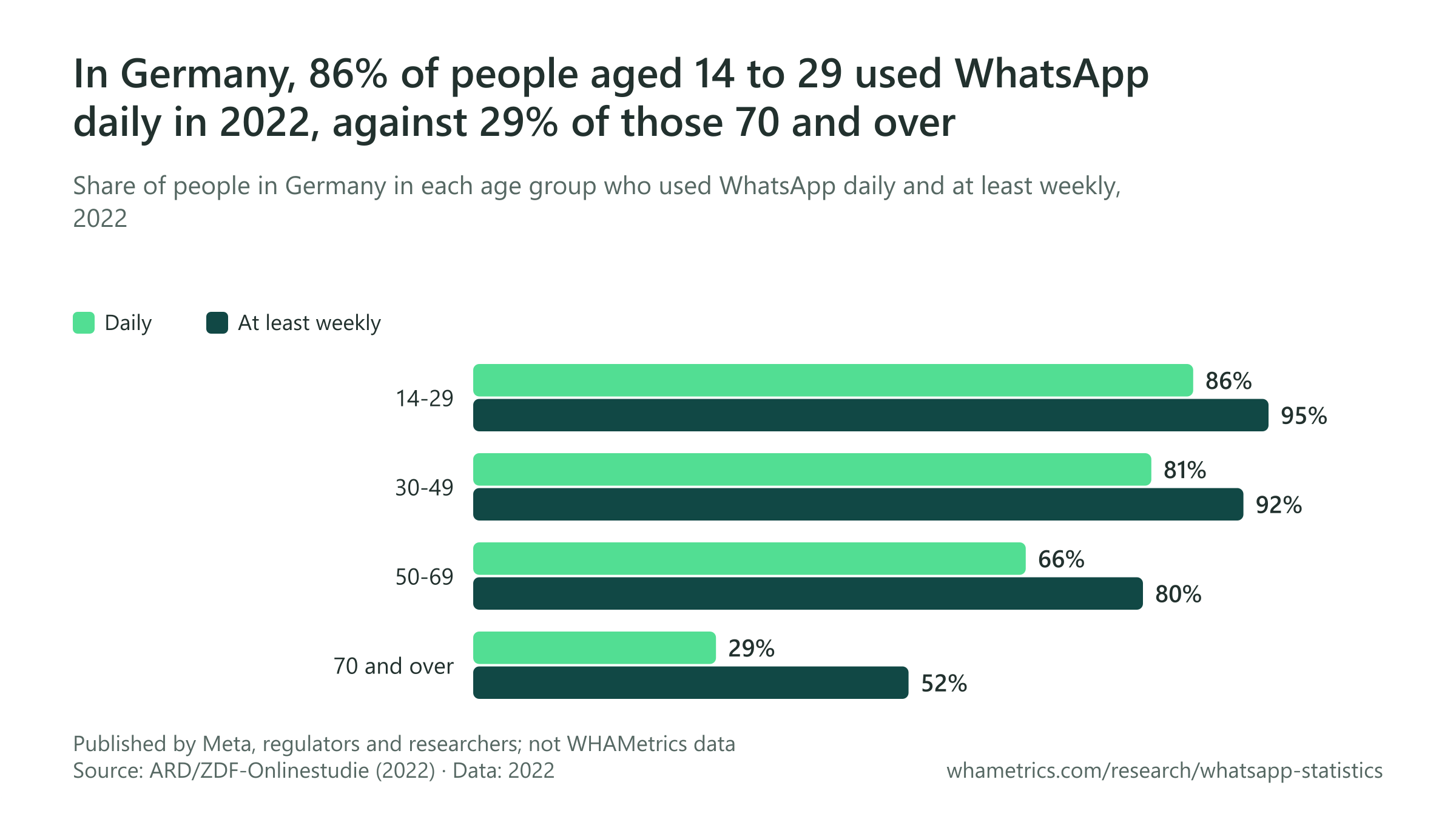
- 39% of people aged 70 and over in Germany used WhatsApp daily in 2021, up 7 points in a year (ARD/ZDF-Onlinestudie, 2021).
- 86.1% of Italians aged 14 to 80 used WhatsApp in 2025, more than any other platform (Censis, 21st Rapporto sulla comunicazione, 2026).
- 88.6% of people aged 14-29 in Italy used WhatsApp in 2025 (Censis, 21st Rapporto sulla comunicazione, 2026).
- 87.9% of people aged 30-44 in Italy used WhatsApp in 2025 (Censis, 21st Rapporto sulla comunicazione, 2026).
- 88.3% of people aged 45-64 in Italy used WhatsApp in 2025 (Censis, 21st Rapporto sulla comunicazione, 2026).
- 78.0% of people aged 65 to 80 in Italy used WhatsApp in 2025 (Censis, 21st Rapporto sulla comunicazione, 2026).
- 72% of internet users born in the 1980s in Sweden used WhatsApp in 2026, the highest share of any generation, against 32% of those born in the 1920s to 1940s (Svenskarna och internet, Internetstiftelsen, 2026).
- 44% of children born in the 2010s in Sweden used WhatsApp in 2026, five times the share using Facebook Messenger (9%), the only generation where WhatsApp leads (Svenskarna och internet, Internetstiftelsen, 2026).
- WhatsApp was used by 83% of national internet users aged 45 and over against 74% of those aged 18 to 24 in six Arab countries in early 2016 (Northwestern University in Qatar survey, 2016).
- WhatsApp was used by 79.8% of Saudi internet users aged 10 to 19 in 2025, against 96.7% of those aged 40 to 49 and 91.5% of those aged 60 to 74 (CST regulator's Saudi Internet report, 2026).
- 61.8% of Australian adults in metropolitan areas used WhatsApp for personal purposes in the six months to June 2025, against 52.1% in 2021 (ACMA consumer survey, 2026).
- 41.8% of Australian adults in regional areas used WhatsApp for personal purposes in the six months to June 2025, against 27.4% in 2021 (ACMA consumer survey, 2026).
- 94% of Malaysians aged 18 to 30 named WhatsApp as their main messaging app in April and May 2024, against about 4% for Telegram and 1.4% for WeChat (Merdeka Center National Youth Survey, 2024).
- 82.7% of adults aged 18 to 29 in Iran said they used WhatsApp in February 2021 (ISPA, 2021).
- 48% of German internet users over 80 used WhatsApp or another messaging service every day in 2024, against 75% of those aged 60 to 69 (mpfs SIM-Studie, 2025).
- 83% of Brazilian internet users aged 60 and over sent instant messages in 2025, against 92% of all internet users (category: instant messaging, not WhatsApp alone; Cetic.br TIC Domicílios, 2026).
- 47.1% of Chileans aged 60 and over habitually used WhatsApp in 2017, against 91.1% of those aged 16 to 29 (Subtel national internet access and use survey, 2018).
By gender
- 90% of UK online smartphone users who are men used the WhatsApp app in May 2025 (Ofcom, 2025).
- 94% of UK online smartphone users who are women used the WhatsApp app in May 2025 (Ofcom, 2025).
- 85% of women and 79% of men among UK adult internet users used WhatsApp in 2024 (Ofcom, 2025).
- 69% of women in Germany used WhatsApp daily in 2022 (ARD/ZDF-Onlinestudie, 2022).
- 67% of men in Germany used WhatsApp daily in 2022 (ARD/ZDF-Onlinestudie, 2022).
- 82% of women in Germany used WhatsApp at least weekly in 2022 (ARD/ZDF-Onlinestudie, 2022).
- 81% of men in Germany used WhatsApp at least weekly in 2022 (ARD/ZDF-Onlinestudie, 2022).
- 53% of women who use the internet in Sweden used WhatsApp in the past 12 months in 2026 (Svenskarna och internet, Internetstiftelsen, 2026).
- 50% of men who use the internet in Sweden used WhatsApp in the past 12 months in 2026 (Svenskarna och internet, Internetstiftelsen, 2026).
- WhatsApp was used by 94.4% of male and 90.4% of female internet users in Saudi Arabia in 2025 (CST regulator's Saudi Internet report, 2026).
- 54.3% of Australian men used WhatsApp for personal purposes in the six months to June 2025, against 42.2% in 2021 (ACMA consumer survey, 2026).
- 56.2% of Australian women used WhatsApp for personal purposes in the six months to June 2025, against 45% in 2021 (ACMA consumer survey, 2026).
- 91.3% of men aged 16 to 74 in Turkey used WhatsApp in the three months before the 2025 survey, against 85.9% of women (TÜİK, 2025).
- 85.9% of women aged 16 to 74 in Turkey used WhatsApp in the three months before the 2025 survey, against 91.3% of men (TÜİK, 2025).
Children and teenagers
- WhatsApp reached 64% of UK online children aged 8 to 14 in a month, more than any other messaging or calling service, in passive measurement from November 2024 to March 2025 (Ofcom, 2025).
- 57% of UK online children aged 8 to 14 used WhatsApp on a given day, rising from 22% of 8 to 9-year-olds to 79% of 13 to 14-year-olds, in passive measurement from November 2024 to March 2025 (Ofcom, 2025).
- WhatsApp users aged 13 to 14 opened the app 259 times a month on average, girls 304 times and boys 217, in UK passive measurement from November 2024 to March 2025 (Ofcom, 2025).
- 58% of UK children aged 8 to 14 said they had used WhatsApp in the past four weeks, second only to YouTube, in an online survey from November to December 2025 (Ofcom, 2026).
- 68% of UK teenagers aged 15 to 17 said they had used WhatsApp in the past four weeks, in an online survey from November to December 2025 (Ofcom, 2026).
- 41% of UK children aged 8 to 17 who said someone had been nasty or hurtful to them in the past year said it happened through text or messaging apps such as WhatsApp, in a 2025 survey (Ofcom, 2026).
- 85% of German teenagers aged 12 to 19 named WhatsApp among their three most important smartphone apps in 2026, unprompted, against about a third for Instagram (mpfs JIM-Studie, 2026).
- 73% of German children aged 6 to 13 who use the internet opened WhatsApp at least once a week in autumn 2024, up from 70% in 2022, and 60% used it daily or almost daily (mpfs KIM-Studie, 2025).
- 89% of German children aged 12 to 13 who use the internet used WhatsApp at least weekly in autumn 2024, against 32% of 6 to 7-year-olds (mpfs KIM-Studie, 2025).
- 57% of German parents of children aged 6 to 13 agreed that their child would be at a disadvantage without WhatsApp, and 82% that everything among friends is arranged on WhatsApp, in autumn 2024 (mpfs KIM-Studie, 2025).
- 66% of Brazilian internet users aged 9 to 17 had their own WhatsApp profile in 2025, level with Instagram and ahead of TikTok at 57% (Cetic.br TIC Kids Online Brasil, 2026).
- 74.2% of rural Indian children who received learning materials from school in a week of September 2020 got them through WhatsApp, 87.2% in private schools and 67.3% in government schools (ASER Centre, 2020).
- 17% of UK children aged 12 to 15 said they had seen or heard news on WhatsApp in the past month, against 42% on TikTok and 38% on YouTube, in a survey from November 2025 to March 2026 (Ofcom, 2026).
- 23% of UK children aged 3 to 4 used WhatsApp in 2023, rising to 83% of 16 to 17-year-olds (Ofcom, 2024).
- 24.8% of Spanish 13 and 14-year-olds with WhatsApp said they thought they were addicted to it, in school surveys from 2015 to 2018 (Grau-Grau et al., 2024).
- 56.6% of Spanish 13 and 14-year-olds with WhatsApp said they sent their last WhatsApp message of the day after 10 p.m., and 29.6% that checking WhatsApp was the first thing they did in the morning, in school surveys from 2015 to 2018 (Grau-Grau et al., 2024).
- 38% of Australian children aged 8 to 12 had used messaging apps such as WhatsApp and Messenger in 2024, the eSafety Commissioner said in October 2024 (eSafety Commissioner, 2024).
- 29% of Irish children aged 8 to 12 surveyed in the 2024-25 school year had their own WhatsApp account, though the app's minimum age is 13 (CyberSafeKids, 2025).
- 51% of UK children aged 11 to 17 who were added to a group chat with people they did not know well or at all in the past year said it happened on WhatsApp, the most of any platform, in a survey from February to March 2026 (Ofcom, 2026).
- 69% of UK children aged 8 to 14 who used WhatsApp used it late at night (11pm to 5am) at least once over four weeks in 2025 (Ofcom, 2025).
- 64% of UK online children aged 8 to 12 used WhatsApp over a three to four week period in 2023, in a small pilot Ofcom calls indicative (Ofcom, 2023).
- 86% of UK online 15 to 17 year olds (about 2 million) used WhatsApp in May 2023 (Ofcom, 2023).
- 33% of UK children aged 6 to 7 and 31% of those aged 3 to 5 used WhatsApp to send messages or make calls in 2024 (Ofcom, 2025).
- 75% of UK children aged 12 to 15 and 51% of those aged 8 to 11 used WhatsApp in 2021 (Ofcom, 2022).
- 78% of UK children aged 12 to 15 and 52% of those aged 5 to 15 used WhatsApp in 2020 (Ofcom, 2021).
- 84% of 12- to 19-year-olds in Germany with a smartphone named WhatsApp among their three most important apps in 2025, far ahead of Instagram at about a third (JIM-Studie, mpfs, 2025).
- 81% of 12- to 19-year-olds in Germany with a smartphone named WhatsApp among their three most important apps in 2024 (JIM-Studie, mpfs, 2024).
- 78% of teenage girls who use WhatsApp in Germany send voice messages on it regularly, against 50% of boys, in 2025 (JIM-Studie, mpfs, 2025).
- 63% of 12- to 19-year-olds in Switzerland who use messaging apps used WhatsApp several times a day in 2024, and another 21% daily (JAMES study, ZHAW, 2024).
- 83% of girls aged 11 to 17 in Austria used WhatsApp in the 2026 Jugend-Internet-Monitor (Saferinternet.at, 2026).
- 81% of boys aged 11 to 17 in Austria used WhatsApp in the 2026 Jugend-Internet-Monitor (Saferinternet.at, 2026).
- 84% of 11- to 17-year-olds in Austria who use WhatsApp use it daily, according to the 2026 Jugend-Internet-Monitor as reported by ORF (ORF Wien, 2026).
- 23% of 9- to 18-year-olds in Norway used WhatsApp in 2024, up from 21% in 2022 (Medietilsynet, Barn og medier 2024).
- 21% of 9- to 18-year-olds in Norway used WhatsApp in 2022 (Medietilsynet, Barn og medier 2024).
- 53% of internet users aged 9 to 17 in Brazil used WhatsApp several times a day in 2025 (Cetic.br TIC Kids Online Brasil, 2025).
- 53% of internet users aged 9 to 17 in Brazil used WhatsApp several times a day in 2024 (Cetic.br TIC Kids Online Brasil, 2024).
- 74% of internet users aged 15 to 17 in Brazil used WhatsApp several times a day in 2025 (Cetic.br TIC Kids Online Brasil, 2025).
- 25% of internet users aged 9 to 10 in Brazil used WhatsApp several times a day in 2025 (Cetic.br TIC Kids Online Brasil, 2025).
- 34% of internet users aged 9 to 10 in Brazil had their own WhatsApp profile in 2025 (Cetic.br TIC Kids Online Brasil, 2025).
- 91% of internet users aged 15 to 17 in Brazil had their own WhatsApp profile in 2025 (Cetic.br TIC Kids Online Brasil, 2025).
Age rules
- WhatsApp required users in the European Region, the EU countries and the UK among them, to be at least 16 years old, against 13 elsewhere, in terms last modified on April 24, 2018 (WhatsApp, 2018).
- WhatsApp launched parent-managed accounts for children under 13 on March 11, 2026, limited to messaging and calls and shown no ads (TechCrunch, 2026).
- Australia's eSafety Commissioner listed WhatsApp among services it considered were not age-restricted social media platforms when the under-16 social media minimum age took effect on December 10, 2025 (eSafety Commissioner, 2025).
- WhatsApp began rolling out parent-managed accounts on March 11, 2026, letting parents or guardians set up WhatsApp for pre-teens limited to messaging and calling (WhatsApp, 2026).
- WhatsApp introduced optional parental controls for teens on September 30, 2026, letting parents set privacy settings, see when a teen joins or leaves a group and choose a stricter Meta AI setting (WhatsApp, 2026).
- Australia's social media minimum age law, barring under-16s from holding accounts on age-restricted platforms, took effect on December 10, 2025, and eSafety lists WhatsApp among services that do not meet the criteria, as messaging services are excluded (eSafety Commissioner, 2026).
Sources: Pew Research Center; Eurostat (2026); Reuters Institute for the Study of Journalism; European Parliament; Northwestern University in Qatar (2016, 2017); European Neighbourhood Council; Ofcom (2021-2026); ARD/ZDF-Forschungskommission, published in Media Perspektiven (2021, 2022); Censis, 21° Rapporto sulla comunicazione; Internetstiftelsen, Svenskarna och internet; Communications, Space and Technology Commission, Saudi Arabia; Australian Communications and Media Authority; Merdeka Center for Opinion Research; Iranian Students Polling Agency; Medienpädagogischer Forschungsverbund Südwest (2025, 2026); Núcleo de Informação e Coordenação do Ponto BR, Cetic.br (2024, 2025, 2026); Subsecretaría de Telecomunicaciones de Chile, fieldwork by Brújula; Turkish Statistical Institute; Cetic.br, NIC.br; ASER Centre; Adicciones, vol. 36 no. 2, 2024; Child and Adolescent Psychiatry and Mental Health; eSafety Commissioner (2024, 2025, 2026); CyberSafeKids; Medienpädagogischer Forschungsverbund Südwest, JIM-Studie (2024, 2025); ZHAW Zürcher Hochschule für Angewandte Wissenschaften, JAMES study; Saferinternet.at, Jugend-Internet-Monitor; ORF Wien; Medietilsynet; WhatsApp Ireland Limited; TechCrunch; WhatsApp (2026); InternetNZ
WhatsApp group limit: how many people can be in a WhatsApp group?
Figures published by Meta, regulators, surveys and studies; none is WHAMetrics data.
WhatsApp allows up to 1,024 members in a group, as of November 2026 (WhatsApp Help Center, 2026).

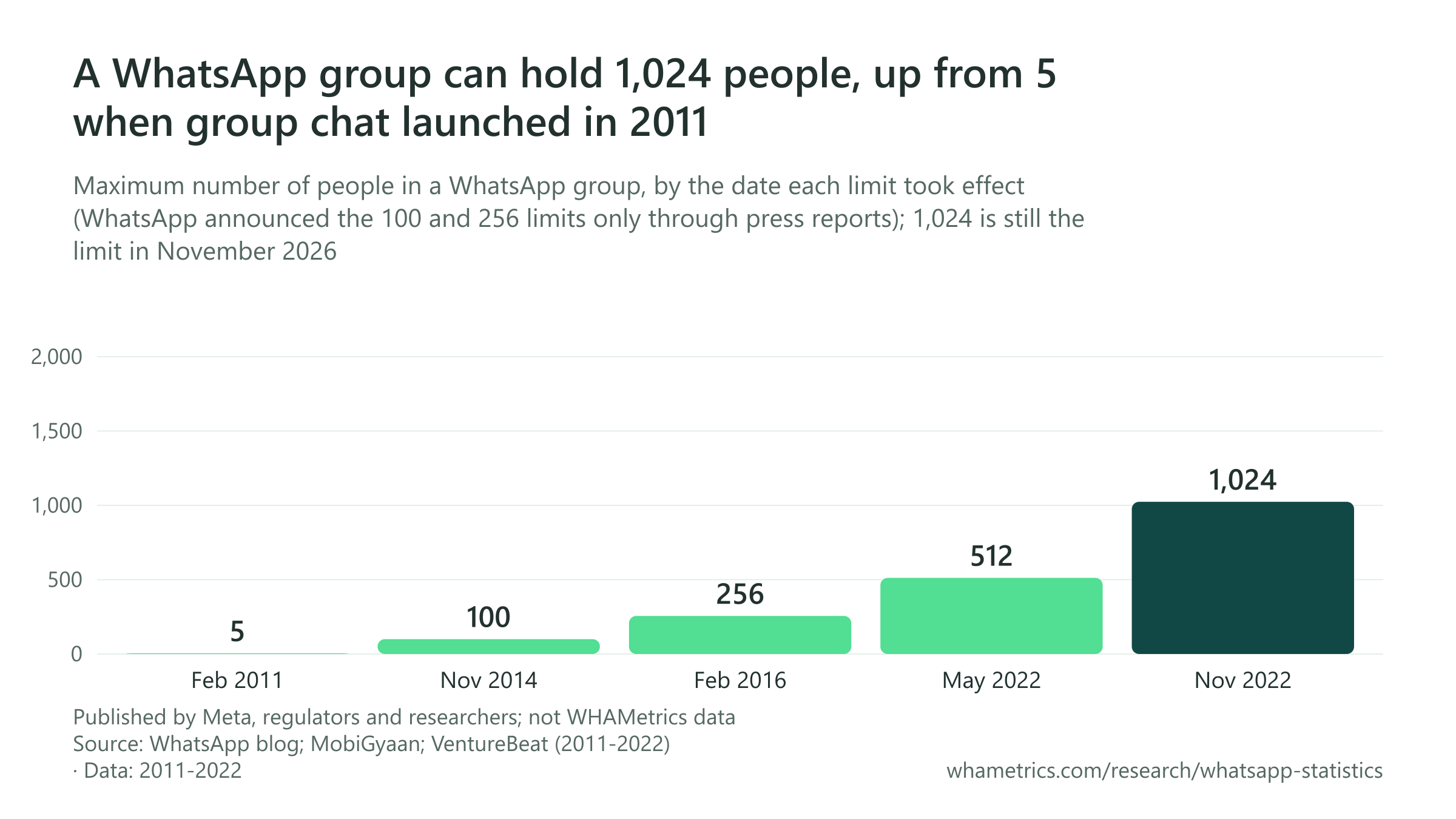
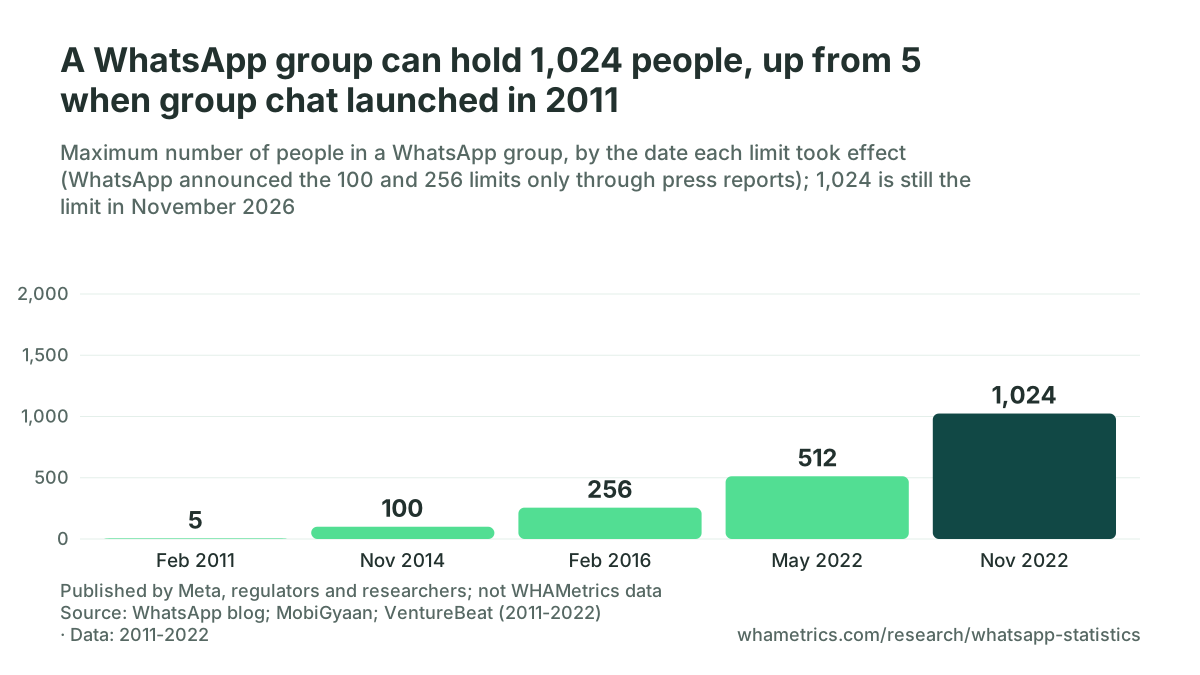
- About 90% of WhatsApp messages go from one person to another rather than to a group, WhatsApp said in 2019.
- Most WhatsApp groups have fewer than ten people, WhatsApp said in 2019.
- A WhatsApp community can hold up to 2,000 members and 100 groups, as of November 2026.
- WhatsApp had 1 billion groups in February 2016, the only count of groups it has given.
- 76% of WhatsApp users in nine countries had used a WhatsApp group in the past month, in a 2019 survey.
| Study, place and method | Groups per user |
|---|---|
| Netherlands, 2023: median, from donated account data | 35 |
| São Paulo, Brazil, 2023-24: average, from donated phones | 23.2 |
| Uttar Pradesh, India, 2023: average, from donated phones | 15.9 |
| Israel, Jewish adults, 2024: average, survey | 15 |
| UK adults in online groups, 2024: average, survey commissioned by Vodafone | 10 |
| Netherlands, ages 15 and over, 2020: average, survey | 6.8 |
| Germany, late 2025: average private group chats in any messenger, survey | 5 |
| Germany, children aged 6 to 13 who use WhatsApp, 2024: average, survey | 3 |
Sources: WhatsApp LLC (2011-2026); VentureBeat (2016a, 2016b); Reuters Institute for the Study of Journalism; Rense Corten, Laura Boeschoten, Thijs Carriere, Stein Jongerius, Bella Struminskaya, Joris Mulder, Parisa Zahedi and others; Kiran Garimella and Simon Chauchard; Israel Democracy Institute; Vodafone UK; Newcom Research & Consultancy; Bitkom e. V.; Medienpaedagogischer Forschungsverbund Suedwest, KIM-Studie 2024; MobiGyaan
More statistics (70)
Groups are where WhatsApp turns from a messenger into a community tool: class groups, family groups, neighbourhood groups, campaign groups. WhatsApp's rules set how big they can be, and its own figures say most messages are still one to one. How many groups people are in depends on how it is measured: people who donate their chat data turn out to be in far more groups than people asked in a survey remember.
The group size limit over time
- WhatsApp's Help Center said in October 2020 that a group could have 256 members ('participants', in its words; WhatsApp Help Center, 2020).
Communities and broadcast lists
- WhatsApp announced Communities, a way to bring separate groups together under one umbrella, on April 14, 2022 (WhatsApp, 2022).
- WhatsApp started rolling out Communities globally on November 3, 2022 (WhatsApp, 2022).
- WhatsApp said it built Communities with more than 50 organizations in 15 countries before the November 2022 launch (WhatsApp, 2022).
- At launch, a WhatsApp community could hold up to 50 groups in addition to its announcement group, according to WhatsApp's Help Center in December 2022 (WhatsApp Help Center, 2022).
- At launch, a WhatsApp community announcement group could hold up to 5,000 members, according to WhatsApp's Help Center in December 2022 (WhatsApp Help Center, 2022).
- From March 2023, WhatsApp's Help Center said only up to 2,000 members could be added to new and existing communities, calling it an issue it was working to resolve (WhatsApp Help Center, 2023).
- By October 2023, WhatsApp's Help Center said a community could hold up to 100 groups, up from 50 (WhatsApp Help Center, 2023).
- WhatsApp allows up to 100 groups in a community, as of November 2026 (WhatsApp Help Center, 2026).
- WhatsApp allows up to 256 contacts in each broadcast list, and only contacts who have saved the sender's number receive the message, as of November 2026 (WhatsApp Help Center, 2026).
- WhatsApp said on April 27, 2022, that Communities would launch in Brazil only after the October 2022 election, a decision it said it took alone and not at the electoral court's request (O Povo, 2022).
- 43% of Brazilian smartphone users of WhatsApp said they used the Communities tab, in a July 2026 online survey by Opinion Box (Opinion Box, 2026).
- UK publisher Reach ran 80 WhatsApp Communities with around 100,000 subscribers in October 2023, Press Gazette reported (Press Gazette, 2023).
Group calls

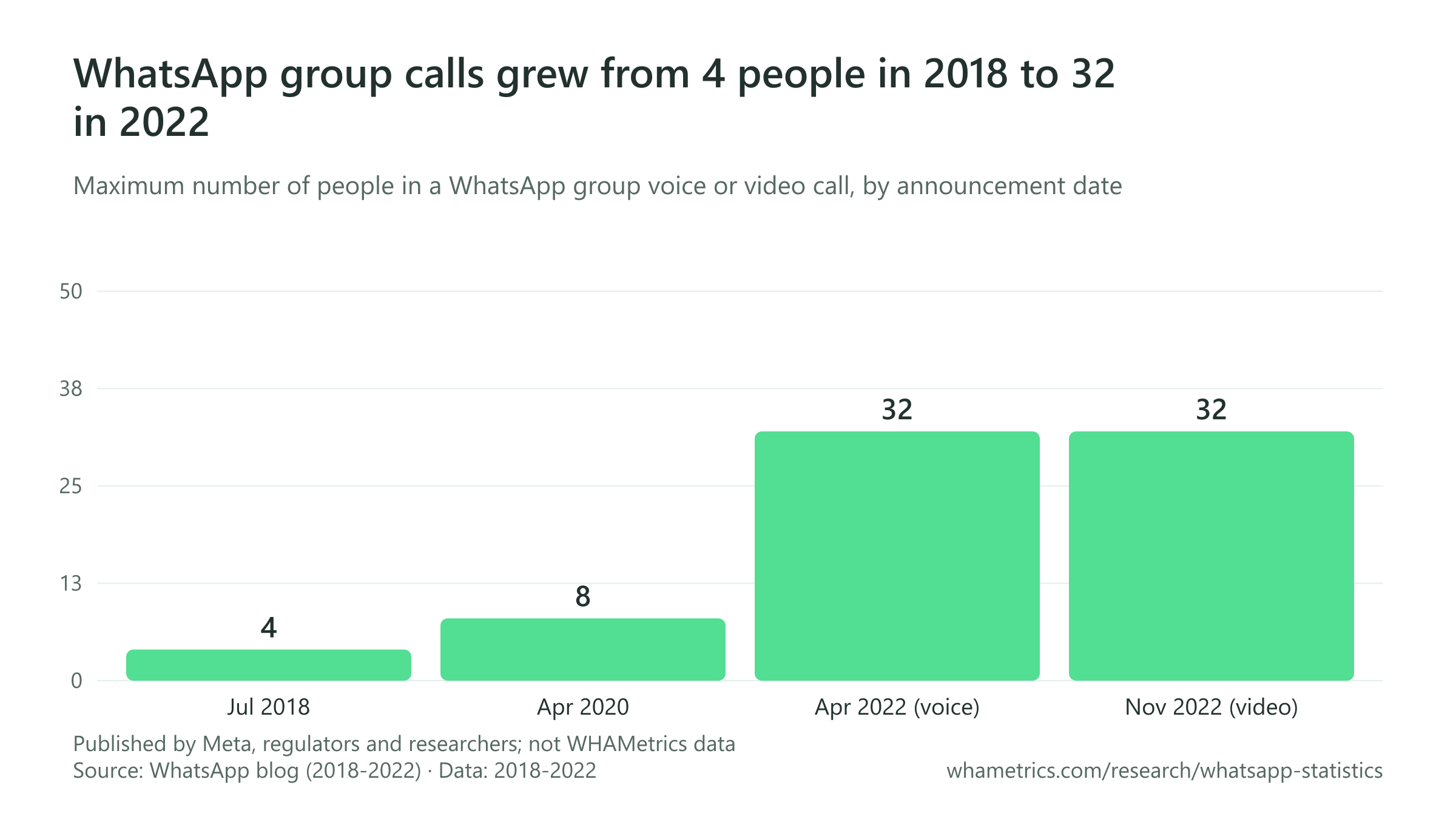
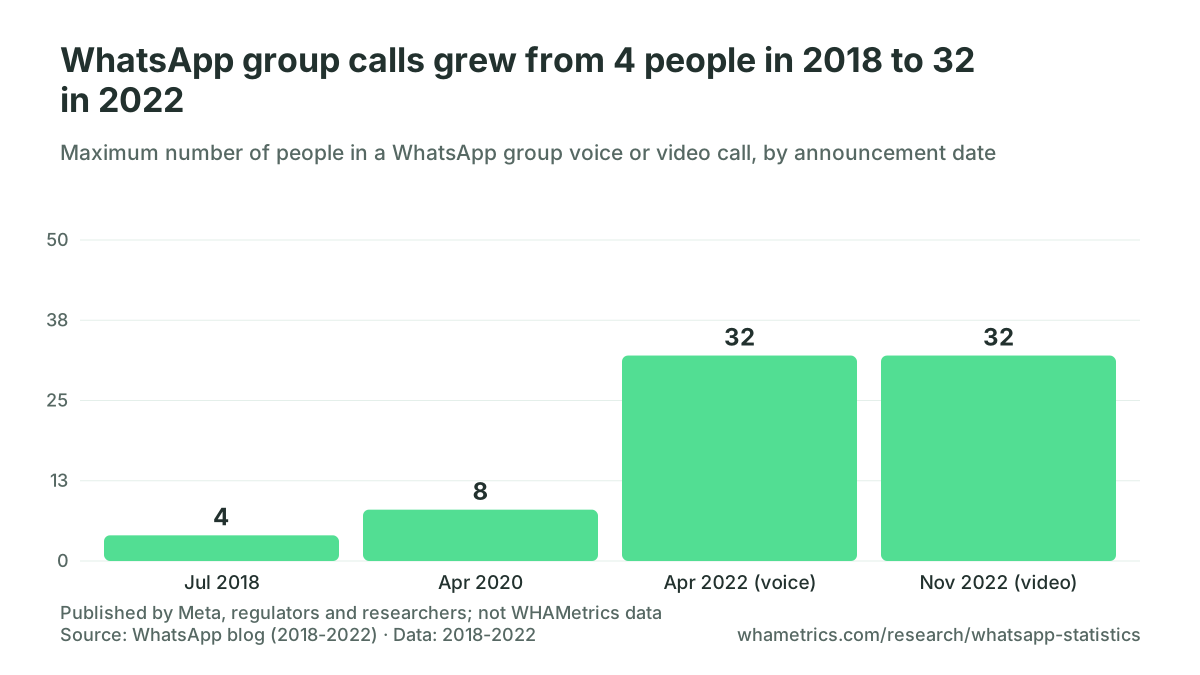
Forwarding limits
- WhatsApp began labelling forwarded messages on July 10, 2018 (WhatsApp, 2018).
- On July 19, 2018, WhatsApp began testing a forwarding limit for all users, with a lower limit of 5 chats at once in India (WhatsApp, 2018).
- From January 21, 2019, WhatsApp limited forwarding to five chats at once for all users on the latest versions of the app (WhatsApp, 2019).
- From April 7, 2020, WhatsApp limited messages that have been forwarded many times to one chat at a time (WhatsApp, 2020).
- WhatsApp said its earlier limits on forwarded messages were followed by a 25% decrease in total message forwards worldwide (WhatsApp, 2020).
- WhatsApp said the number of highly forwarded messages sent on WhatsApp fell 70% worldwide in the weeks after its April 2020 one-chat limit, a spokesperson told TechCrunch (TechCrunch, 2020).
- WhatsApp began piloting a 'search the web' button for messages forwarded many times on August 3, 2020, in seven countries: Brazil, Italy, Ireland, Mexico, Spain, the UK and the US (WhatsApp, 2020).
- WhatsApp lets users forward a message to up to five people or groups at a time; a message that was forwarded to them can be shared with only one more group chat, as of November 2026 (WhatsApp Help Center, 2026).
- Only about 1% of messages in donated WhatsApp groups in India and Brazil carried the 'forwarded many times' label in 2023 data-donation pilots (Garimella and Chauchard, 2024).
- 89.19% of messages in donated WhatsApp groups in Brazil were original rather than forwarded, against 76.44% in India, in data-donation pilots run in 2023 and 2024 (Garimella and Chauchard, 2024).
- 76.44% of messages in donated WhatsApp groups in one district of Uttar Pradesh, India were original rather than forwarded in 2023, so nearly a quarter were forwards (Garimella and Chauchard, 2024).
Group features
- WhatsApp added group icons, a custom picture for each group chat, in March 2012 (WhatsApp, 2012).
- WhatsApp introduced group descriptions, admin controls over a group's subject, icon and description, and protection against being re-added to groups a user has left, on May 15, 2018 (WhatsApp, 2018).
- WhatsApp launched a group setting that lets only admins send messages, for announcement-style groups, on June 29, 2018 (WhatsApp, 2018).
- WhatsApp introduced a privacy setting that lets users decide who can add them to groups, with invites that expire after three days, on April 3, 2019 (WhatsApp, 2019).
- WhatsApp let people join a group call after it has started from July 19, 2021 (WhatsApp, 2021).
- WhatsApp let users leave a group without notifying the whole group, telling only the admins, from August 2022 (WhatsApp, 2022).
- WhatsApp gave group admins control over who can join through an invite link or a community, and let users see groups in common with a contact, from March 21, 2023 (WhatsApp, 2023).
- WhatsApp added single-vote polls, poll search and vote notifications for groups on May 4, 2023 (WhatsApp, 2023).
- WhatsApp began showing how many members of a group are online, and added highlight-only notifications for groups, by April 2025 (WhatsApp, 2025).
- WhatsApp extended voice chat, a live audio space inside a group chat, from large groups to groups of all sizes on May 22, 2025 (WhatsApp, 2025).
- WhatsApp began letting group members send new members up to 100 recent messages (from 25 up to 100) on February 19, 2026 (WhatsApp, 2026).
- WhatsApp added @all mentions on August 4, 2026, limited to admins in groups of more than 32 people, along with polls that can close at a set time and hide voter names (WhatsApp, 2026).
- WhatsApp introduced group status, permanent pinned messages, a mentions-and-replies chat filter and message history for members who have already joined on October 29, 2026 (WhatsApp, 2026).
- WhatsApp let event invites reach people without a WhatsApp account, who can see details and RSVP from a link, on November 5, 2026 (WhatsApp, 2026).
- WhatsApp said on September 30, 2026, that parents using its teen controls are notified when their teen joins or leaves a group, or when a group their teen is in grows meaningfully in size (WhatsApp, 2026).
- WhatsApp began showing a safety overview, with notifications silenced, when someone not in a user's contacts adds them to a group, from August 5, 2025 (Meta, 2025).
Group sizes and how many groups people are in
- Public WhatsApp groups studied in 2017 had an average of 143.3 members (median 127), the largest 314, in a study of 178 groups (Garimella and Tyson, 2018).
- In public WhatsApp groups studied in 2017, the top 1% of users sent 37% of all messages (Garimella and Tyson, 2018).
- About 75% of users in public WhatsApp groups studied in 2017 sent five messages or fewer in six months, acting mostly as readers (Garimella and Tyson, 2018).
- 85% of public WhatsApp groups studied in 2017 had members from more than 10 countries (Garimella and Tyson, 2018).
- The median donated WhatsApp group had 104 members in an Indian data-donation pilot in Uttar Pradesh in 2023 (Garimella and Chauchard, 2024).
- The median donated WhatsApp group had 71 members in a Brazilian data-donation pilot in São Paulo in 2023-2024 (Garimella and Chauchard, 2024).
- Donors in São Paulo, Brazil had an average of 171.42 one-to-one WhatsApp conversations, against 23.2 groups, in a 2023-2024 data-donation pilot (Garimella and Chauchard, 2024).
- Donors in Uttar Pradesh, India had an average of 140.17 one-to-one WhatsApp conversations, against 15.85 groups, in a 2023 data-donation pilot (Garimella and Chauchard, 2024).
- 71.5% of WhatsApp conversations were between two people in a logging study of 111 young Israeli adults (Rosenfeld et al., 2018).
- Groups of more than 50 members were under 1% of WhatsApp conversations but carried 8.37% of messages in a logging study of 111 young Israeli adults (Rosenfeld et al., 2018).
- Young Israeli adults took part in an average of 63 to 65 WhatsApp conversations each, women and men alike, in a 2018 logging study of 111 users (Rosenfeld et al., 2018).
- Dutch WhatsApp users who donated their account data in 2023 belonged to a mean of 50.2 WhatsApp groups; the median, less affected by the few donors in up to 339 groups, was 35 (Corten et al., 2025).
- 63% of children aged 6 to 13 in Germany who use WhatsApp had a WhatsApp group for their whole school class in 2024, and one in three said not every classmate was in it (mpfs, 2025).
- WhatsApp group chats had an average of 12 members among UK adults in online groups, in a 2024 OnePoll survey commissioned by Vodafone (Vodafone UK, 2024).
- UK adults who use social media and belong to online groups said they were part of 83 active group chats on average across all apps, in a 2024 OnePoll survey commissioned by Vodafone (Vodafone UK, 2024).
- 27% of Canadian WhatsApp users said they had been added to a group without their consent, 41% in Quebec, in a June 2022 online poll (Research Co., 2022).
- 63% of people aged 16 and over in Germany were part of messenger group chats such as WhatsApp, Signal or Threema, 72% of those aged 16 to 29 and 43% of those 65 and over, in a late-2025 telephone survey (Bitkom, 2026).
Groups, news and elections

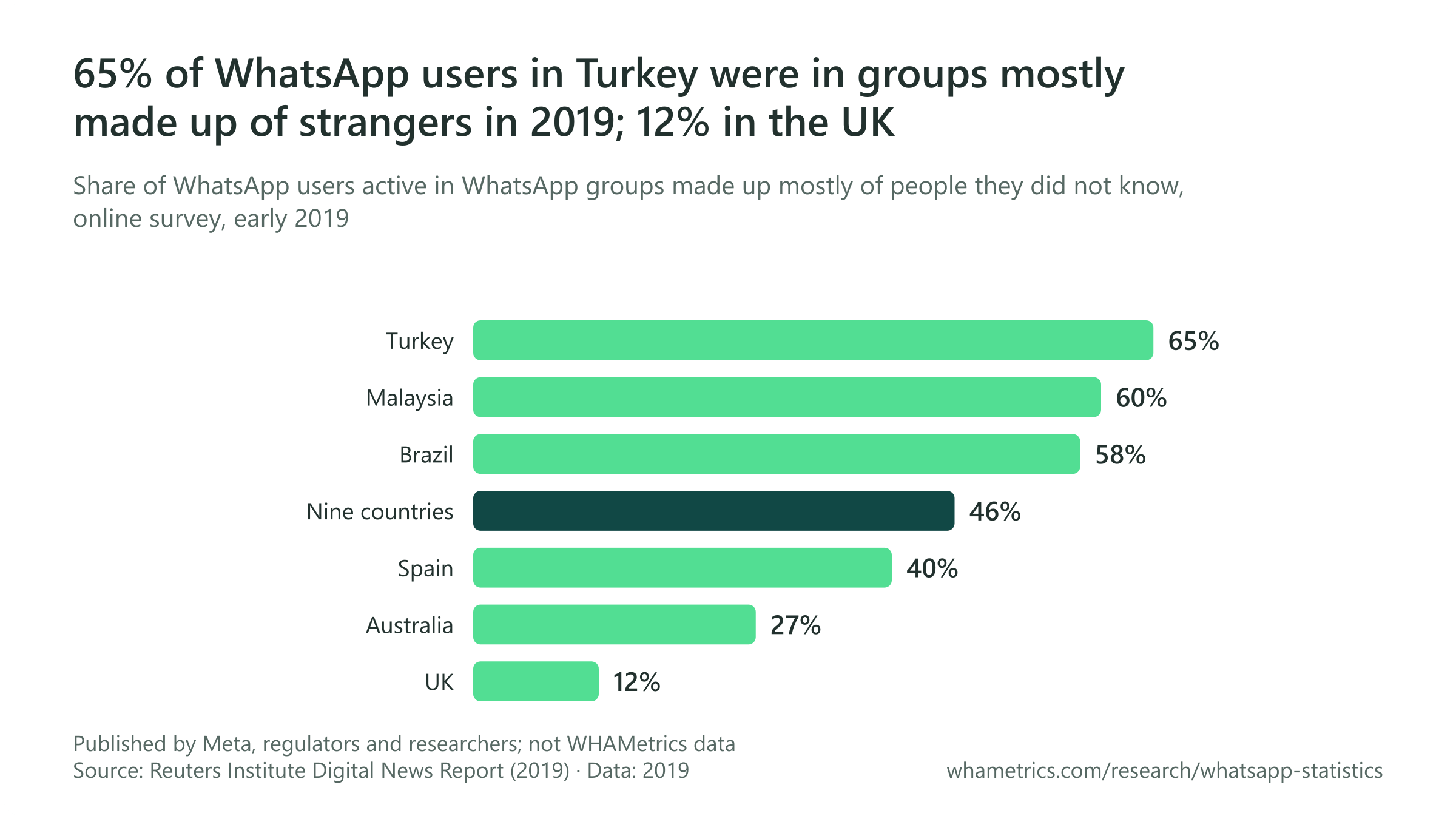
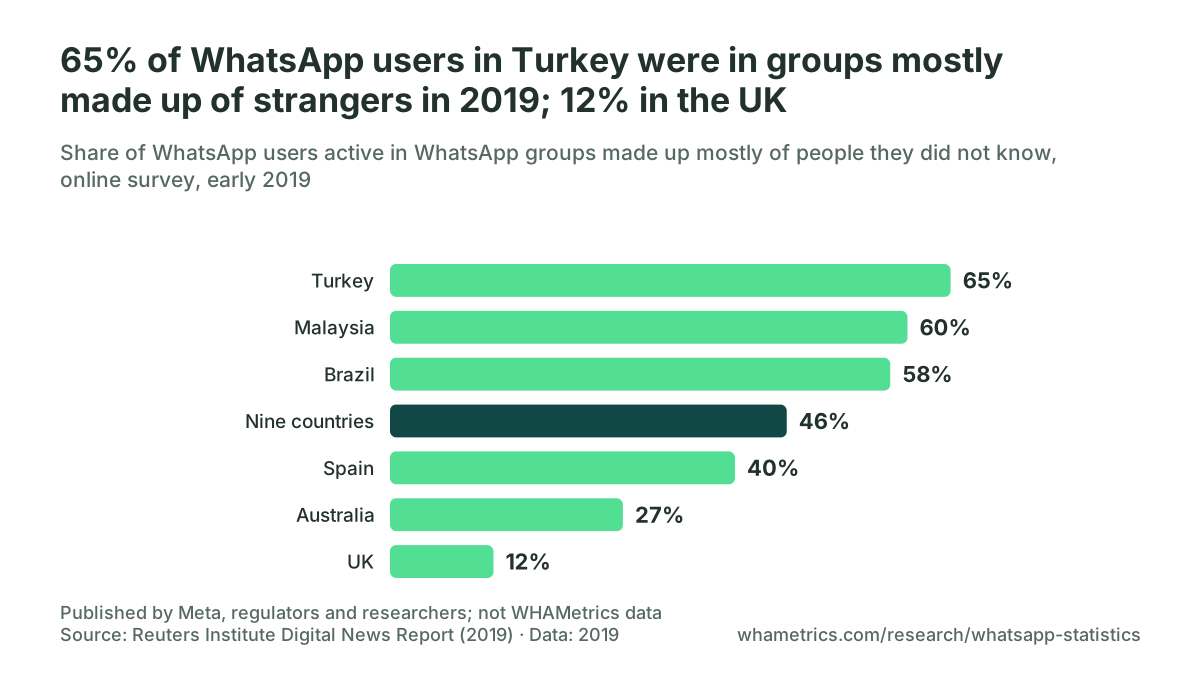

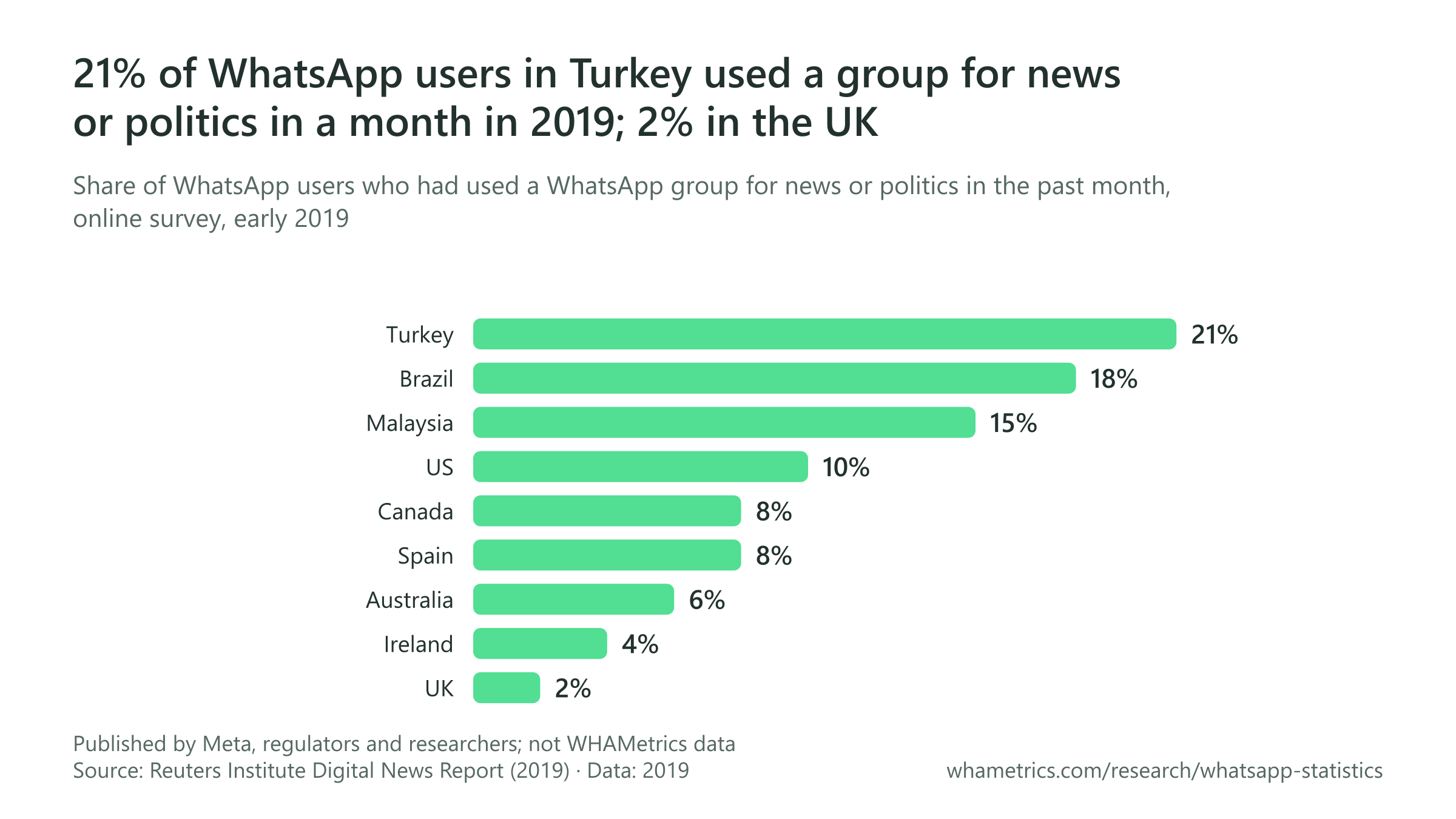
- 72% of WhatsApp users in nine countries were in WhatsApp groups with people they know well, such as friends, colleagues and family, in a 2019 online survey (Reuters Institute, 2019).
- 17% of WhatsApp users in nine countries used WhatsApp groups about shared hobbies or passions and 15% used local community groups, the most common group types, in a 2019 online survey (Reuters Institute, 2019).
- Roughly a million WhatsApp groups were created to promote candidates in Brazil's 2018 elections, the Reuters Institute wrote without citing a source (Reuters Institute, 2019).
- Brazil's electoral rules exempt instant messages sent with consent by private individuals, one to one or in restricted groups, from the rules on electoral propaganda, under a 2019 resolution re-worded in 2026 with the same substance (TSE, 2019).
- Brazil's electoral rules have banned campaign propaganda sent by mass instant messaging without the recipient's consent since Resolution 23.671 of 2021 (TSE, 2021).
- WhatsApp banned 1,004 accounts reported through the electoral court's mass-messaging channel during Brazil's 2020 municipal election, out of 3,236 valid accounts reported, the TSE and WhatsApp said (TSE, 2020).
- More than 63% of the accounts WhatsApp banned after reports to Brazil's electoral court in 2020 had already been blocked automatically by WhatsApp before they were reported, the TSE said (TSE, 2020).
- Brazil's electoral court and WhatsApp signed a memorandum for the 2022 elections that set up a channel for reporting accounts suspected of mass messaging, which WhatsApp agreed to investigate and ban where its terms were breached (TSE, 2022).
- About 13% of images shared in public political WhatsApp groups in India before the 2019 national election were known misinformation, a study of more than 5,000 groups found (Garimella and Eckles, 2020).
- Nearly 1 in 10 messages posted to public political WhatsApp groups in India in 2018-2019 was unwanted junk sent by junk senders, a study of 5,051 groups found (Agarwal et al., 2022).
- 16% of people who used WhatsApp for news took part in a WhatsApp group set up to discuss a news topic in the past week, across 37 markets in 2018 (Reuters Institute, 2018).
Sources: WhatsApp LLC (2012-2026); O Povo; Opinion Box; Press Gazette; TechCrunch; Kiran Garimella and Simon Chauchard; Meta Platforms, Inc.; Kiran Garimella and Gareth Tyson; Avi Rosenfeld, Sigal Sina, David Sarne, Or Avidov and Sarit Kraus; Rense Corten, Laura Boeschoten, Thijs Carriere, Stein Jongerius, Bella Struminskaya, Joris Mulder, Parisa Zahedi and others; Medienpaedagogischer Forschungsverbund Suedwest, KIM-Studie 2024; Vodafone UK; Research Co.; Bitkom e. V.; Reuters Institute for the Study of Journalism (2018, 2019); Tribunal Superior Eleitoral (2019, 2020, 2022); Kiran Garimella and Dean Eckles; Pushkal Agarwal, Aravindh Raman, Damiola Ibosiola, Nishanth Sastry, Gareth Tyson and Kiran Garimella
How many people use WhatsApp Channels?
Figures published by Meta, regulators, surveys and studies; none is WHAMetrics data.
WhatsApp Channels had about 62.5 million monthly active recipients in the EU in the first half of 2026 (WhatsApp, 2026).

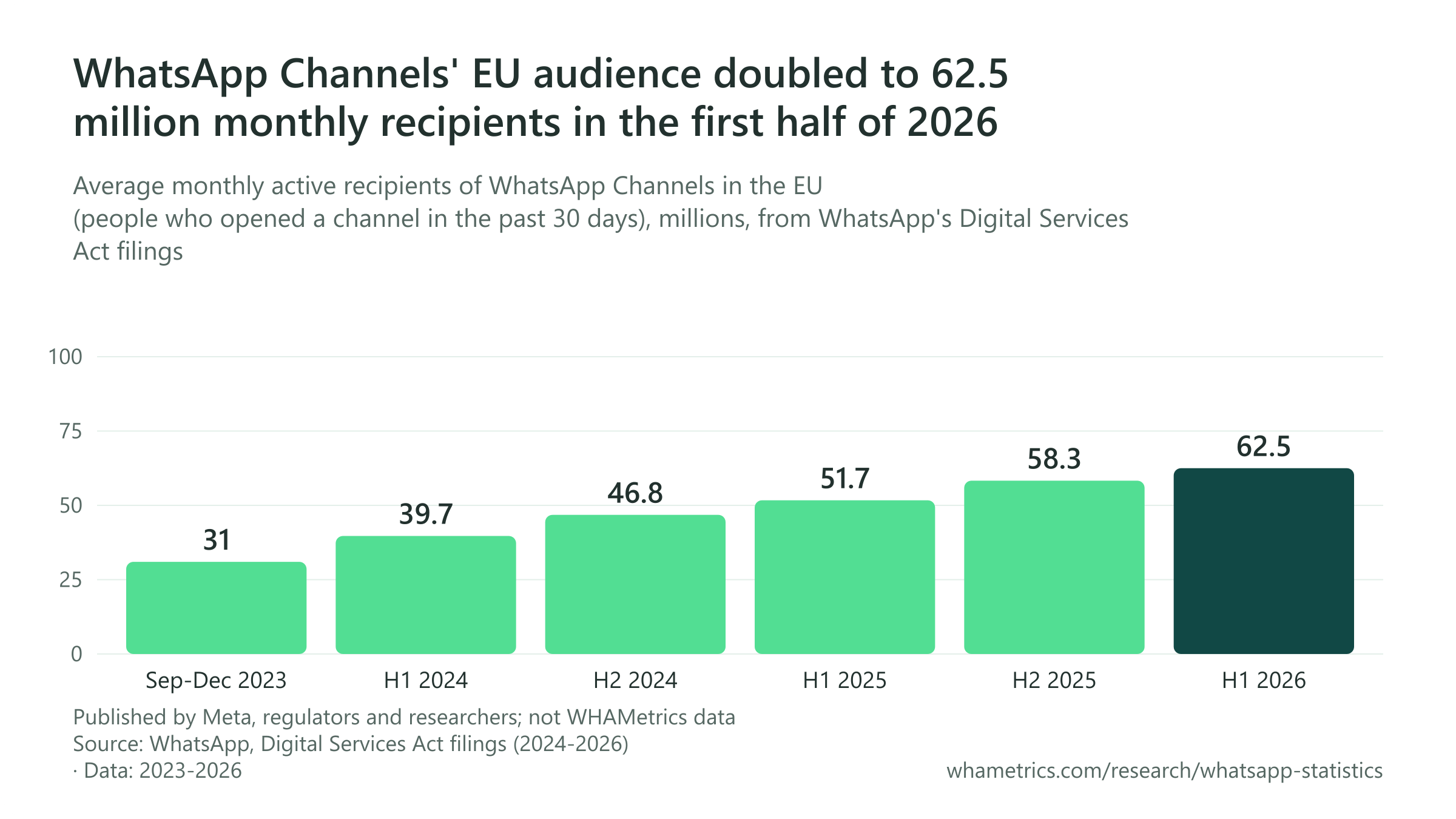
- WhatsApp Channels had more than 500 million monthly active users worldwide in early 2024, the last global count.
- WhatsApp's Updates tab, home to both Status and Channels, had 1.5 billion daily users in June 2025.
- Spain had 25.5 WhatsApp Channels recipients per 100 residents in the first half of 2026, the most in the EU.
- 42% of WhatsApp users in Brazil followed at least one channel in January 2025, up from 32% a year earlier.
- 17% of UK internet users aged 16 and over followed a WhatsApp channel in July 2024.
| Country | Monthly recipients |
|---|---|
| Germany | 19.7 million |
| Italy | 13.0 million |
| Spain | 12.7 million |
| France | 4.8 million |
| Netherlands | 2.3 million |
| Romania | 1.5 million |
| Austria | 1.5 million |
| Poland | 1.4 million |
| Portugal | 1.3 million |
Sources: WhatsApp Ireland Limited (2026, 2024a, 2024b); Meta Platforms, Inc.; WhatsApp LLC; Mobile Time and Opinion Box; Ofcom
More statistics (65)
Channels are WhatsApp's one-way broadcasts: an organisation or a person posts, followers read, and nobody sees who else follows. The only official, regular count of their audience comes from the EU, where the Digital Services Act makes WhatsApp report how many people open a channel each month. Elsewhere there is one global figure from the first months after launch, and surveys.
Channels in the EU
- WhatsApp Channels' average monthly active recipients in the EU grew about 21% between the first half of 2025 and the first half of 2026, from 51.7 million to 62.5 million, by WhatsApp's Digital Services Act filings (WhatsApp, 2026).
- WhatsApp Channels' average monthly active recipients in the EU roughly doubled in two and a half years, from about 31 million in its launch period (September to December 2023) to about 62.5 million in the first half of 2026, by WhatsApp's Digital Services Act filings (WhatsApp, 2026).
- The European Commission designated WhatsApp a Very Large Online Platform under the Digital Services Act on January 26, 2026, because its Channels feature had reached the threshold of at least 45 million users in the EU (European Commission, 2026).
- Meta had four months from the designation, until mid-May 2026, to bring WhatsApp Channels into line with the Digital Services Act's extra obligations for Very Large Online Platforms, such as assessing and mitigating systemic risks (European Commission, 2026).
- WhatsApp Channels had 13.8 average monthly active recipients for every 100 EU residents in the first half of 2026 (62,592,270, the exact total behind the 'approximately 62.5 million' of WhatsApp's August 14 filing, against a population of 451,990,314), by WhatsApp's Digital Services Act transparency report and Eurostat (WhatsApp; Eurostat, 2026).
- Hungary had the lowest use of WhatsApp Channels relative to population in the EU in the first half of 2026: 0.4 average monthly active recipients per 100 residents, with Bulgaria and Lithuania at 0.8, by WhatsApp's Digital Services Act report and Eurostat (WhatsApp; Eurostat, 2026).
Moderation of Channels in the EU
- WhatsApp took 886,271 measures in all on its own initiative against content it treated as illegal on WhatsApp Channels in the EU in the first half of 2026, 535,184 of them after detection by automated means alone (WhatsApp, 2026).
- WhatsApp took 102,483 measures on its own initiative against WhatsApp Channels content that broke its terms and policies in the EU in the first half of 2026, including 11,195 for child sexual abuse material and 14,019 for terrorist content (WhatsApp, 2026).
- WhatsApp received 28,996 complaints against its moderation decisions on WhatsApp Channels in the EU in the first half of 2026 and reversed 13,579 of them (47%), its Digital Services Act transparency report shows (WhatsApp, 2026).
- WhatsApp reported 494 content reviewers working on WhatsApp Channels content from the EU in the first half of 2026, all reviewing in English with translation systems (WhatsApp, 2026).
- WhatsApp received 286 notices of allegedly illegal content on WhatsApp Channels from people and organisations in the EU in the first half of 2026, 4 of them from trusted flaggers (WhatsApp, 2026).
- 578,465 of WhatsApp's moderation measures on WhatsApp Channels in the EU in the first half of 2026 were taken by automated means alone and 410,289 were not, with a reported precision of 98% for the automated ones (WhatsApp, 2026).
- WhatsApp took 909,469 measures in all on its own initiative against content it treated as illegal on WhatsApp Channels in the EU in the full year 2025, 886,434 of them (almost all) after detection by automated means alone (WhatsApp, 2026).
- WhatsApp received 30,589 complaints against its moderation decisions on WhatsApp Channels in the EU in 2025 and reversed 18,086 of them (59%), its Digital Services Act transparency report shows (WhatsApp, 2026).
- WhatsApp suspended 3,468 channels in the EU between February 17 and December 31, 2024, 1,756 of them for child sexual exploitation, its first Digital Services Act transparency report shows (WhatsApp, 2025).
- 47,714 channel updates caused a WhatsApp channel to be hidden in the EU between February 17 and December 31, 2024, most of them for nudity and pornography, 19,558, or hate organisations, 11,829 (WhatsApp, 2025).
- People who reported WhatsApp channels in the EU appealed 87,138 times between February 17 and December 31, 2024, and 574 channels were removed after those appeals (WhatsApp, 2025).
- WhatsApp received one valid EU terrorist-content removal order for WhatsApp Channels in 2025 and itself took action on 567 Channels violations of its terrorist-content rules in the EU, according to its report under the EU Terrorist Content Online regulation (WhatsApp, 2026).
Launch and rules
- WhatsApp introduced Channels on June 8, 2023, first available in Colombia and Singapore (WhatsApp, 2023).
- WhatsApp announced a new Updates tab holding Status and Channels, separate from chats, when it introduced Channels on June 8, 2023 (WhatsApp, 2023).
- WhatsApp began rolling out Channels in seven more countries on July 24, 2023: Egypt, Chile, Malaysia, Morocco, Ukraine, Kenya and Peru (WhatsApp, 2023).
- WhatsApp launched Channels in over 150 countries on September 13, 2023 (WhatsApp, 2023).
- WhatsApp said Channels had started in ten countries before its global launch in September 2023 (WhatsApp, 2023).
- WhatsApp launched Channels in India on September 13, 2023, with the Indian Cricket Team, Katrina Kaif, Diljit Dosanjh, Akshay Kumar and Vijay Deverakonda among the first channels (Meta, 2023).
- WhatsApp keeps channel history on its servers for up to 30 days, it said when it introduced Channels in June 2023 (WhatsApp, 2023).
- WhatsApp Channels are not end-to-end encrypted by default, unlike personal chats, WhatsApp said when it introduced them in June 2023 (WhatsApp, 2023).
- WhatsApp raised the number of admins a channel can have from one to up to 16 in January 2024, adding voice updates, polls and sharing to Status at the same time (TechCrunch, 2024).
- A WhatsApp channel owner can invite up to 16 admins at a time, as of November 2026 (WhatsApp Help Center, 2026).
- Channel admins can edit or delete channel updates for up to 30 days after sending, as of November 2026 (WhatsApp Help Center, 2026).
Global counts
- WhatsApp Channels reached 500 million monthly actives in its first seven weeks, Mark Zuckerberg wrote on his WhatsApp channel on November 15, 2023, Business Today reported (Business Today, 2023).
- More than 1.5 billion people use WhatsApp's Updates tab daily, where Meta is rolling out ads in Status and Channels and channel subscriptions, Meta said on its second-quarter 2025 earnings call (Meta, 2025).
Status

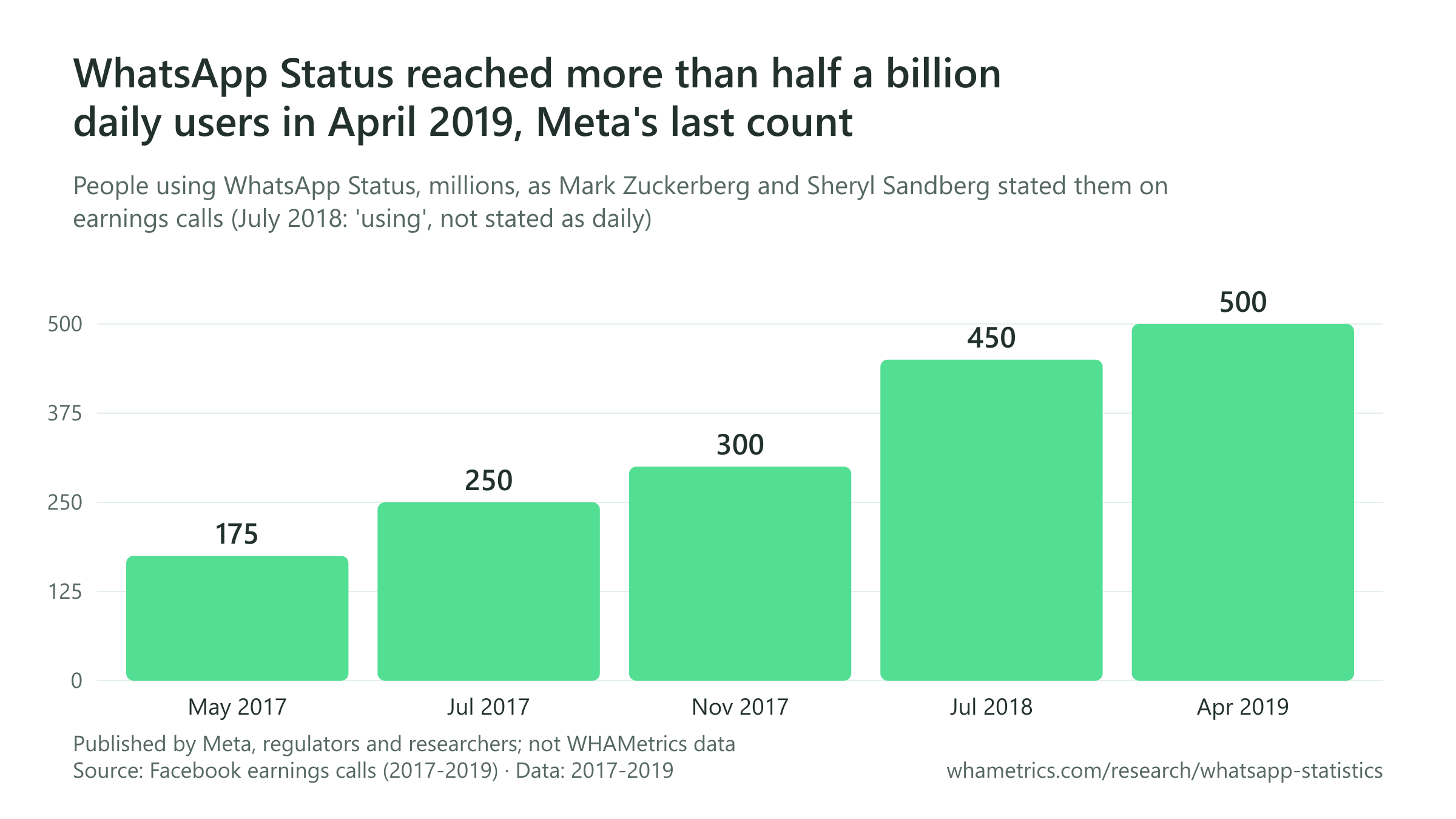
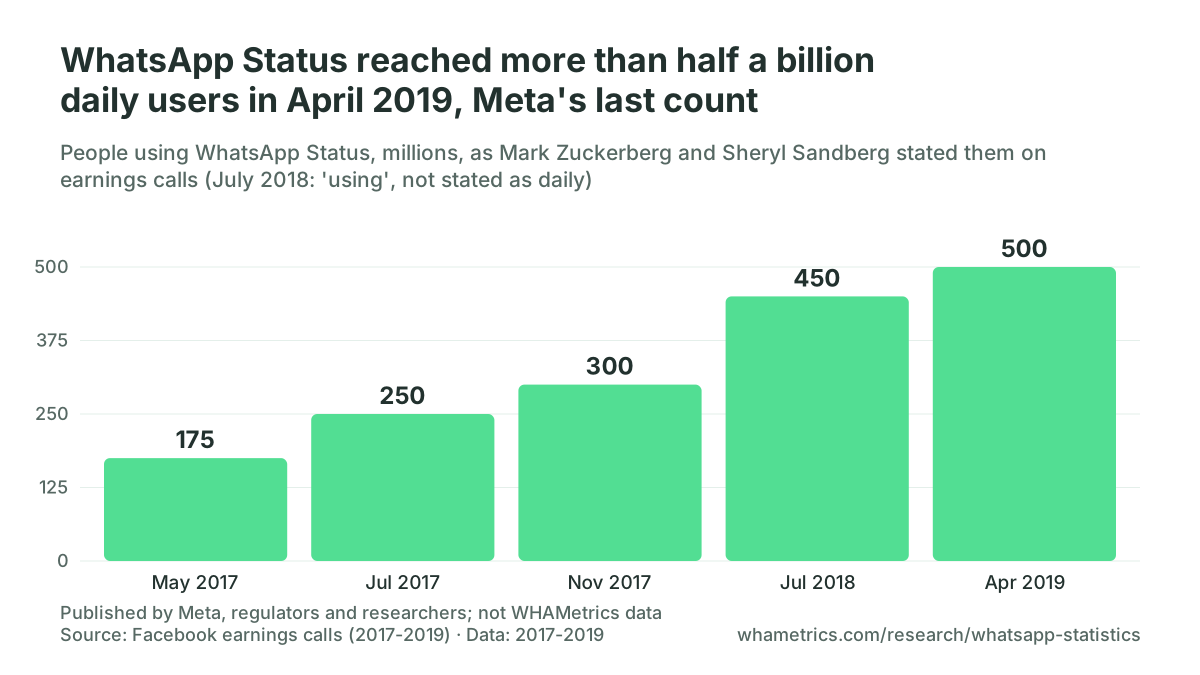
- WhatsApp Status posts get tens of billions of views each day, Meta said on its first-quarter 2025 earnings call on April 30, 2025 (Meta, 2025).
- WhatsApp Status posting often outpaces Instagram in Latin America, Asia and Africa, Meta said on its first-quarter 2026 follow-up call on April 29, 2026 (Meta, 2026).
Ads in Status and promoted channels
- Meta began the global rollout of ads in WhatsApp Status in the second quarter of 2025 with a limited set of advertisers and expected it to proceed slowly over 2025 and 2026 (Meta, 2025).
- Meta expected to complete the rollout of ads in WhatsApp Status during 2026, with ad levels kept low at first, it said on its fourth-quarter 2025 earnings call on January 28, 2026 (Meta, 2026).
- WhatsApp said on February 26, 2026, that Promoted Channels and ads in Status were available globally in the Updates tab (WhatsApp, 2026).
- Meta said on July 29, 2026, that it had added more ad destinations and advertiser goals to ads in WhatsApp Status and remained on track toward the global rollout (Meta, 2026).
- WhatsApp head Will Cathcart said in November 2023 that WhatsApp would not put ads in the inbox but 'there could be ads in other places, channels or status', including paid channel subscriptions and promoted channels (Folha de S.Paulo, 2023).
Surveys of channel use
- 14% of 12- to 19-year-olds in Germany regularly learned about current world events through WhatsApp channels in 2026, against 2% for Telegram channels, the JIM-Studie found (mpfs, 2026).
- 12% of 12- to 19-year-olds in Germany regularly learned about current world events through WhatsApp channels in 2025, against 3% for Telegram channels, the JIM-Studie found (mpfs, 2025).
- 45% of Brazilian WhatsApp users aged 18 and over said they use the Updates tab (Status and Channels) in July 2026, against 43% for the Communities tab, in Opinion Box's commercial online survey (Opinion Box, 2026).
- 56% of German-speaking people aged 14 and over in Germany had heard of WhatsApp Channels in 2024, the ARD/ZDF-Medienstudie found (ARD/ZDF-Medienstudie, 2024).
- 14% of German-speaking people aged 14 and over in Germany had used or subscribed to a WhatsApp channel in 2024, and 29% of 14- to 29-year-olds, the ARD/ZDF-Medienstudie found (ARD/ZDF-Medienstudie, 2024).
- 25% of boys and 23% of girls aged 12 to 19 who use WhatsApp in Germany used WhatsApp channels at least several times a week in 2025, the JIM-Studie found (mpfs, 2025).
- 32% of WhatsApp users in Brazil followed at least one WhatsApp channel in early 2024, by Mobile Time and Opinion Box's survey (Mobile Time/Opinion Box, 2025).
- 53% of Brazilian WhatsApp users who follow channels said they open them every day or almost every day in January 2025, in Mobile Time and Opinion Box's survey (Mobile Time/Opinion Box, 2025).
News publishers and the most-followed channels
- BBC News was the most-followed UK news publisher on WhatsApp Channels in early October 2023 with 691,000 followers, ahead of the Daily Mail (143,000), Press Gazette counted (Press Gazette, 2023).
- News publishers ran 74 of the 150 most-followed WhatsApp channels in late June 2024, Press Gazette found from the in-app leaderboard (Press Gazette, 2024).
- The New York Times's WhatsApp channel had 12.2 million followers in late June 2024, the most of any news publisher, by Press Gazette's reading of the in-app leaderboard (Press Gazette, 2024).
- CNN's WhatsApp channel had 9.6 million followers in late June 2024, by Press Gazette's reading of the in-app leaderboard (Press Gazette, 2024).
- The New York Post's WhatsApp channel had 9.1 million followers in late June 2024, by Press Gazette's reading of the in-app leaderboard (Press Gazette, 2024).
- CNN's WhatsApp channel had 14.5 million followers in September 2024, The New York Times reported (The New York Times, 2024).
- The New York Times's WhatsApp channel had 14 million followers in September 2024, The New York Times reported (The New York Times, 2024).
- BBC News's WhatsApp channel had 9.3 million followers in September 2024, The New York Times reported (The New York Times, 2024).
- WhatsApp's own channel was the most-followed WhatsApp channel in the world on October 23, 2023, with 47,981,000 followers, about twice Netflix's 23,493,000, OMR counted (OMR, 2023).
- Real Madrid's WhatsApp channel had 20,324,000 followers on October 23, 2023, the most of any sports club, OMR counted (OMR, 2023).
- Borussia Dortmund ran Germany's most-followed WhatsApp channel on October 24, 2023, with 3,343,000 followers, ahead of FC Bayern (2,774,000), OMR counted (OMR, 2023).
- WhatsApp's official channel led the global ranking of WhatsApp channels in April 2026 with 230 million followers, ahead of Real Madrid (67.5 million) and FC Barcelona (55.2 million), by a compilation from the Brazilian media hub Antro (ABC da Comunicação, 2026).
- Pack de Figurinhas became the largest Portuguese-language WhatsApp channel with 10.4 million followers in less than six months, 14th in the global ranking, its owner Antro said in April 2026 (ABC da Comunicação, 2026).
- Noticias Telemundo's WhatsApp channel had more than 820,000 followers in September 2024 and had become 'a huge source of traffic actually, larger than X', its senior director of digital news told The New York Times (The New York Times, 2024).
- The Financial Times' WhatsApp markets channel had 209,000 followers in September 2024, a year after launch, having passed its three-month target of 40,000 within weeks, the FT said (The New York Times, 2024).
- Reach, publisher of the Daily Mirror and Daily Express, said in May 2024 that its WhatsApp channels had two million followers but drove only about a million page views a month (Press Gazette, 2024).
- Indian Prime Minister Narendra Modi said on September 25, 2023, that his WhatsApp channel had passed 5 million followers ('more than 50 lakh'), less than a week after he joined (ANI, 2023).
- The campaign channel 'Exército do Lula' had 4.1 million WhatsApp followers on October 13, 2026, ahead of the opposing 'Tropa do Flávio' (1.4 million) and both candidates' official channels, Mobile Time reported (Mobile Time, 2026).
Sources: WhatsApp Ireland Limited; European Commission; WhatsApp LLC (2023, 2026); Meta Platforms, Inc. (2023, 2025, 2026); TechCrunch; Business Today; Folha de S.Paulo; Medienpädagogischer Forschungsverbund Südwest (2025, 2026); Opinion Box; ARD/ZDF-Forschungskommission; Mobile Time and Opinion Box; Press Gazette (2023, 2024); The New York Times; OMR; ABC da Comunicação; ANI; Mobile Time; Facebook, Inc. (2017, 2018, 2019)
WhatsApp revenue: how does WhatsApp make money?
Figures published by Meta, regulators, surveys and studies; none is WHAMetrics data.
WhatsApp's owner booked $1.1 billion of 'other revenue' in the third quarter of 2026, mostly WhatsApp paid messaging and subscriptions (Meta, 2026).

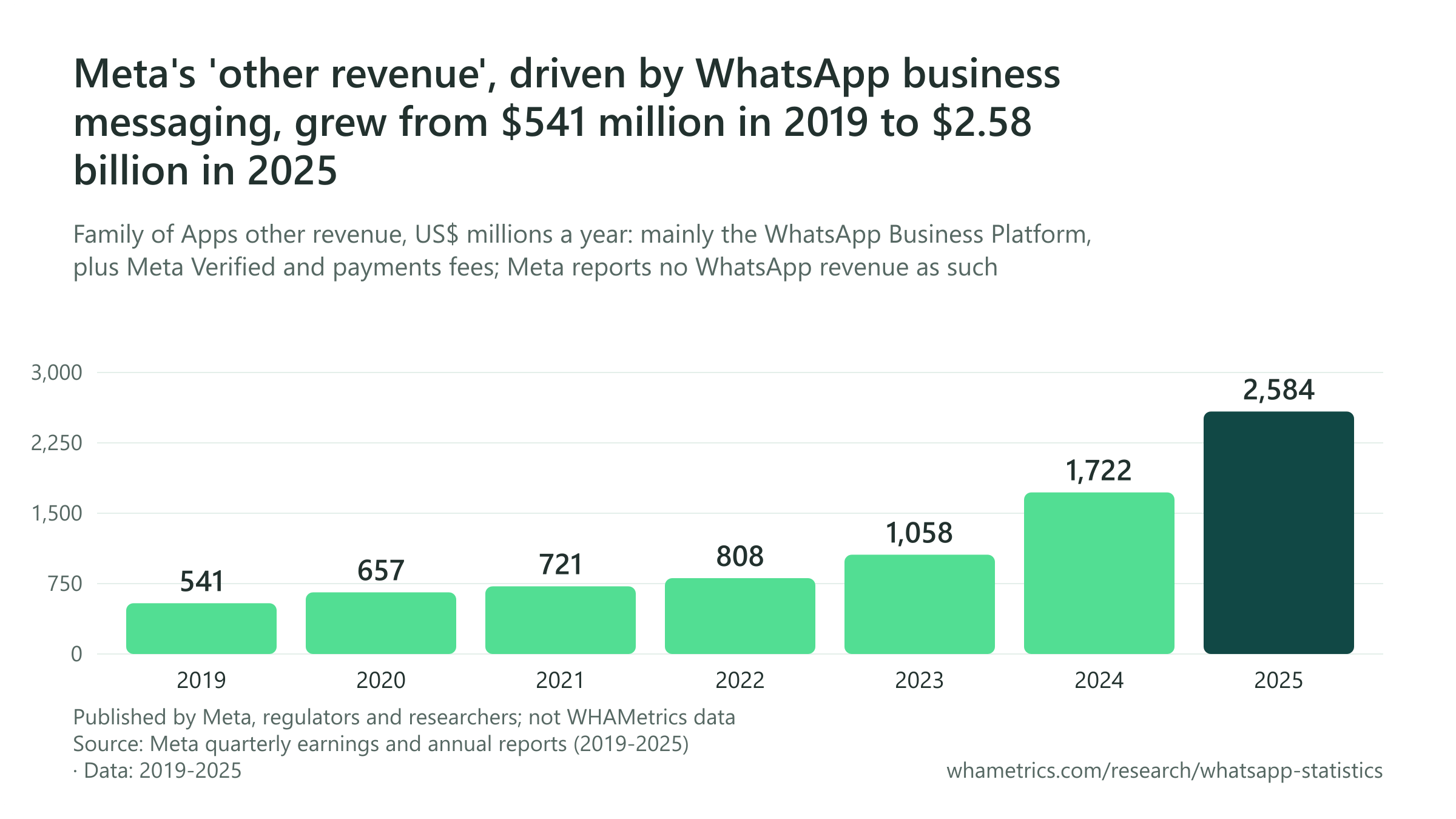
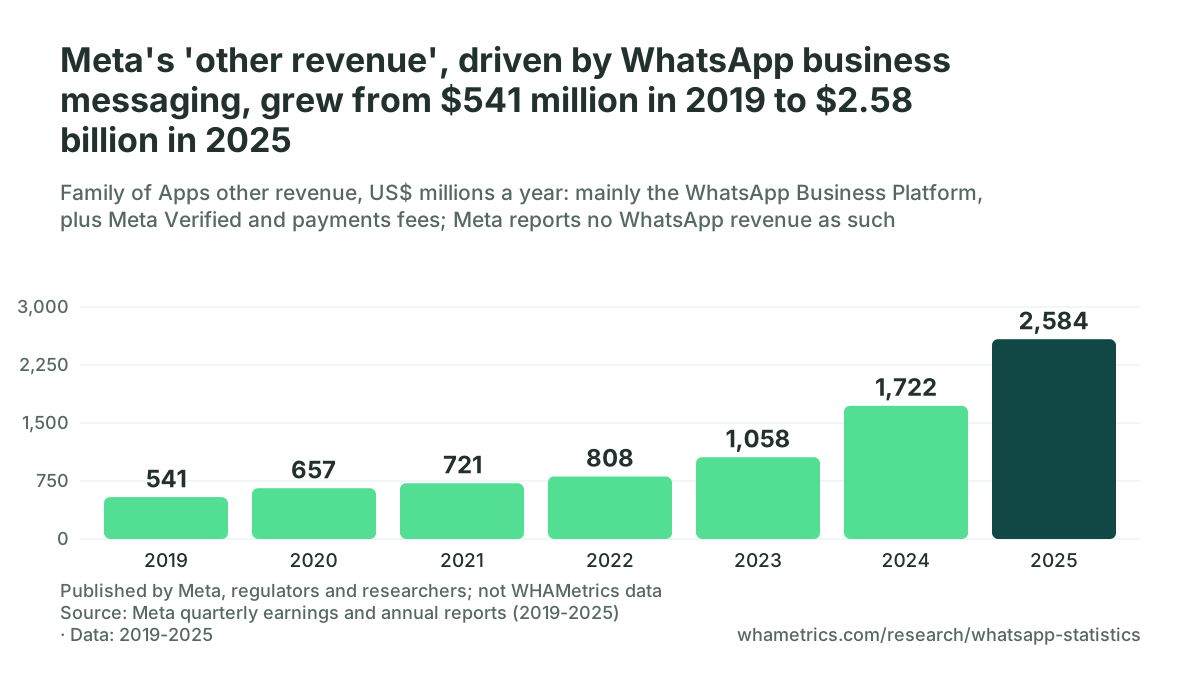
- Paid messaging on WhatsApp passed a $2 billion annual revenue run rate in the fourth quarter of 2025.
- Meta's Family of Apps other revenue reached $2.99 billion in the first nine months of 2026, already more than in all of 2025.
- The WhatsApp Business app had more than 200 million monthly users in July 2023, the last count given.
- Revenue from click-to-WhatsApp ads grew 60% from a year earlier in the third quarter of 2025.
- Facebook agreed to buy WhatsApp in February 2014 for about $19 billion, including $3 billion in stock units for staff.
| Recipient's market | Price per marketing message |
|---|---|
| India | $0.0118 |
| US and Canada | $0.025 |
| Mexico | $0.0397 |
| Indonesia | $0.0411 |
| Brazil | $0.0625 |
| UK | $0.0635 |
| Spain | $0.0707 |
| Italy | $0.0795 |
| France | $0.0859 |
| Germany | $0.1365 |
Sources: Meta Platforms, Inc. (2022-2026); Facebook, Inc.; WhatsApp LLC (2026)
More statistics (85)
WhatsApp gave up its small yearly fee early on and carries no ads in chats. Its money comes from businesses: they pay to send messages to customers through the WhatsApp Business Platform, they buy ads that open a WhatsApp chat, and lately they can advertise in Status and Channels. Meta does not report WhatsApp's revenue on its own. The closest public number is a line in its accounts, Family of Apps other revenue, which Meta says is driven mainly by WhatsApp.
Meta's 'other revenue'

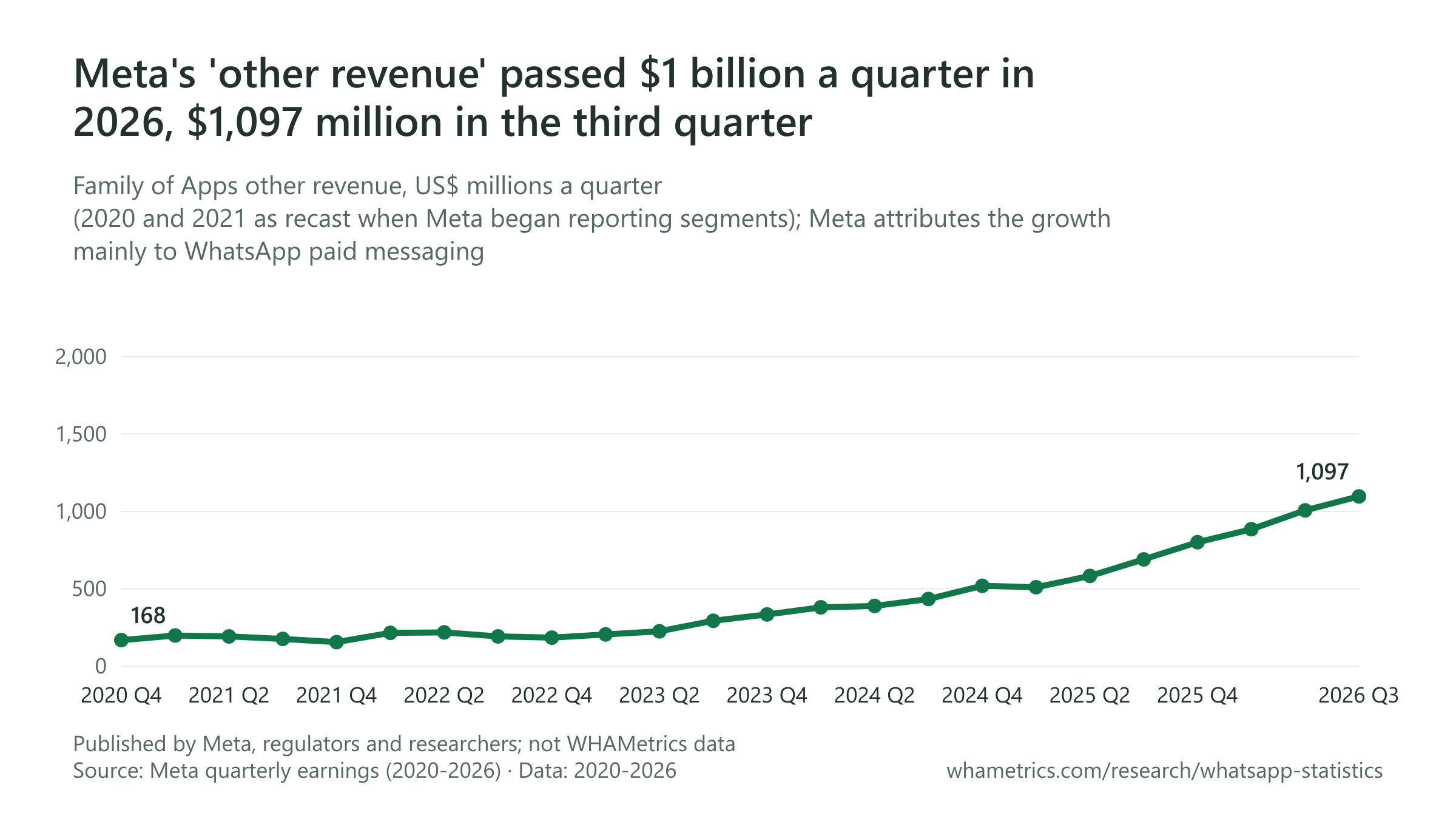
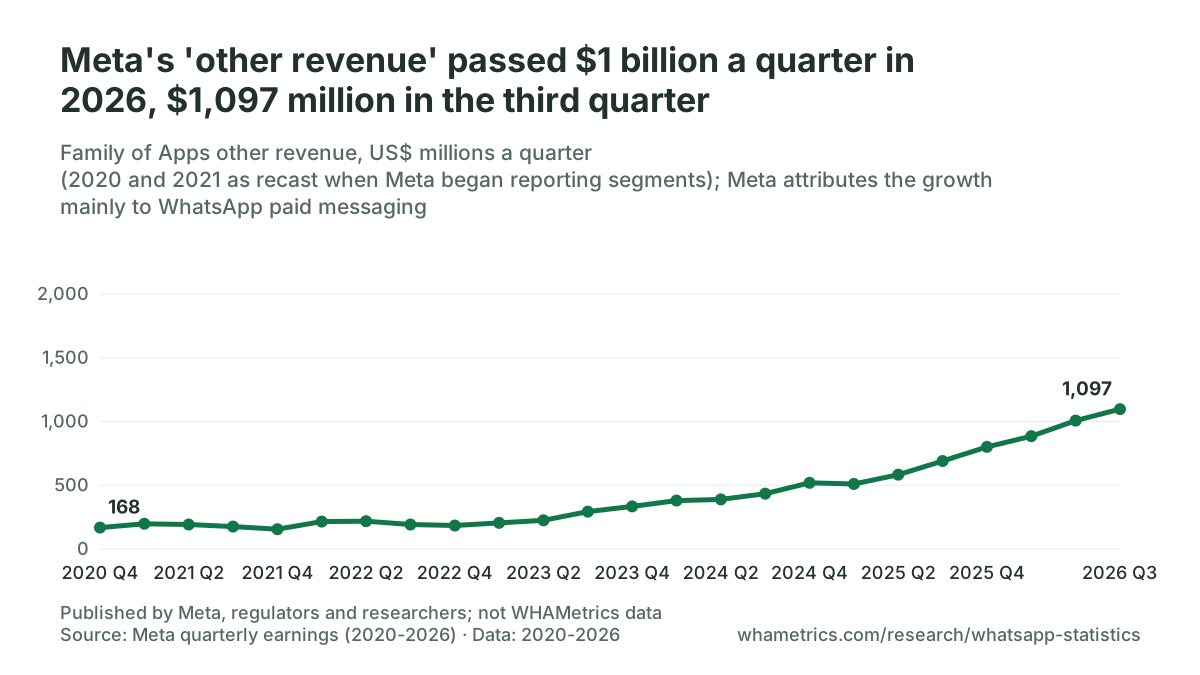
- Meta's Family of Apps other revenue rose $664 million, or 63%, in 2024, mainly because of WhatsApp Business Platform revenue, Meta's 2024 annual report says (Meta, 2025).
- Meta's Family of Apps other revenue rose $250 million, or 31%, in 2023, mainly because of WhatsApp Business Platform revenue, Meta's 2023 annual report says (Meta, 2024).
- Meta defines Family of Apps other revenue as revenue from the WhatsApp Business Platform, Meta Verified subscriptions, net fees from developers using its Payments infrastructure and other sources, per its 2024 annual report (Meta, 2025).
Paid messaging and click-to-WhatsApp ads
- Businesses using the WhatsApp Business API were sending more than 100 million messages a day in April 2021, Facebook said (Facebook, 2021).
- More than 600 million conversations between people and businesses took place every day across Meta's platforms in October 2023, Meta said (Meta, 2023).
- More than 60% of people on WhatsApp in India messaged a business account every week, Meta said in October 2023 (Meta, 2023).
- Nearly 1 million advertisers had used Click-to-WhatsApp ads by April 2021, against more than 3 million using Click-to-Message ads to Messenger, Facebook said (Facebook, 2021).
- 40% of Meta's advertisers were using Click-to-Messaging ads in July 2022, Meta said (Meta, 2022).
- Meta's Click-to-Messaging ads reached a $9 billion annual revenue run rate in October 2022, Meta said (Meta, 2022).
- Click-to-WhatsApp ads passed a $1.5 billion annual revenue run rate in October 2022, growing more than 80% from a year earlier, Meta said (Meta, 2022).
- Meta's click-to-message ads reached a $10 billion annual revenue run rate in February 2023, Meta said (Meta, 2023).
- Over half of Meta's click-to-message advertisers used only click-to-messaging ads on Meta's platform, Meta said in February 2023 (Meta, 2023).
- Daily revenue from Click-to-WhatsApp ads was growing more than 80% a year in July 2023, Meta said (Meta, 2023).
- Click-to-WhatsApp ads were at a multi-billion-dollar annual revenue run rate in October 2023, Meta said (Meta, 2023).
- Revenue from Click-to-Message ads in India doubled from a year earlier, Meta said in October 2023 (Meta, 2023).
- Click-to-message ad revenue in the US grew more than 40% from a year earlier in the second quarter of 2025, Meta said (Meta, 2025).
- Click-to-message ad revenue in the US grew more than 50% from a year earlier in the fourth quarter of 2025, Meta said (Meta, 2026).
- The number of businesses using paid messaging on WhatsApp grew 40% in one quarter, Meta said in April 2023 (Meta, 2023).
- The number of businesses using Meta's paid messaging products doubled from a year earlier, Meta said in July 2023 (Meta, 2023).
- Over 1 million conversations a week were taking place between people and Meta's Business AIs, mainly in Mexico and the Philippines, Meta said in January 2026 (Meta, 2026).
- More than 10 million conversations a week were facilitated through Meta's Business AIs in April 2026, up from 1 million at the start of the year, Meta said (Meta, 2026).
- Meta One, Meta's subscription across Instagram, Facebook and WhatsApp, had passed 15 million subscriptions and trials by October 2026, Meta said (Meta, 2026).
- More than 175 million people messaged a WhatsApp Business account every day in October 2020, WhatsApp said, announcing that it would charge business customers for some services (WhatsApp, 2020).
- More than one million businesses were using a Meta Business Agent on WhatsApp and Messenger when Meta launched it at Conversations 2026 on June 3, 2026 (Meta, 2026).
- There were more than one billion active threads between people and businesses on WhatsApp, Messenger and Instagram every day in June 2026, Meta said (Meta, 2026).
Ads in Status
- Facebook announced in October 2018 that it planned to introduce ads in WhatsApp Status in 2019 (Facebook, 2018).
- Meta said in July 2025 that it did not expect WhatsApp ads in Status to be a meaningful contributor to impressions or revenue growth for the next few years, and expected them to earn a lower average price than Facebook or Instagram ads (Meta, 2025).
- Hundreds of millions of people were viewing ads in WhatsApp Status every day by April 2026, Meta said (Meta, 2026).
- WhatsApp announced ads in Status, paid channel subscriptions and promoted channels in its Updates tab on June 16, 2025, its first ads inside the app, kept away from personal chats (Meta, 2025).
The WhatsApp Business app
- WhatsApp Business was the tenth most downloaded app worldwide in 2022, six places below WhatsApp (Sensor Tower estimate, 2023).
- WhatsApp Business was the tenth most downloaded app worldwide in the fourth quarter of 2023 (Sensor Tower estimate, 2024).
- The WhatsApp Business app's Google Play listing showed "1B+" downloads as of November 14, 2026 (Google Play, 2026).
- More than 3 million people were actively using the WhatsApp Business app a few months after its January 2018 launch, Facebook said in April 2018 (Facebook, 2018).
- WhatsApp Business had 50 million people using it in July 2020, Mark Zuckerberg said on Facebook's second-quarter 2020 call (Facebook, 2020).
- WhatsApp launched the WhatsApp Business app, a free Android app for small businesses, on January 18, 2018, in Indonesia, Italy, Mexico, the UK and the US (WhatsApp, 2018).
- More than five million businesses were using the WhatsApp Business app one year after launch, WhatsApp said in January 2019 (WhatsApp, 2019).
- WhatsApp supported more than 50 million WhatsApp Business app users in July 2020, alongside thousands of larger businesses on the WhatsApp Business API (WhatsApp, 2020).
- More than 40 million people viewed a business catalog on WhatsApp each month in July 2020, WhatsApp said (WhatsApp, 2020).
- Meta began rolling out Meta Verified, its paid verification for businesses, on the WhatsApp Business app in Brazil, India, Indonesia and Colombia on June 6, 2024 (Meta, 2024).
- More than 150 million users viewed a business catalog on WhatsApp each month, Meta said in February 2022, up from 40 million in July 2020 (Meta, 2022).
What businesses pay
| Recipient's market | Price per message |
|---|---|
| India | $0.0042 |
| US and Canada | $0.0085 |
| Brazil | $0.0473 |
| Germany | $0.0858 |
| Recipient's market | Price per marketing message |
|---|---|
| South Africa | $0.0379 |
| Nigeria | $0.0516 |
| Saudi Arabia | $0.0576 |
| United Arab Emirates | $0.0576 |
- WhatsApp opened its business API to larger companies on August 1, 2018, and said businesses would pay to send certain messages, its first charge on businesses (WhatsApp, 2018).
- From June 2019 WhatsApp charged businesses on its API per delivered template message, by recipient country and monthly volume, with replies free for 24 hours after a customer's last message (WhatsApp, 2019).
- On February 1, 2022, WhatsApp switched its business API from per-message to conversation-based pricing, charging once per 24-hour conversation session (Meta, 2022).
- From February 2022 until November 2024 every WhatsApp Business account got its first 1,000 conversations each month free (Meta, 2022).
- From June 1, 2023, WhatsApp priced business conversations by category (marketing, utility, authentication and service) instead of by who started them (Meta, 2023).
- From November 1, 2024, WhatsApp made service conversations (businesses replying to customers) free for all businesses (Meta, 2024).
- Since July 1, 2025, Meta has charged businesses on the WhatsApp Business Platform per message, by category and market, and only for messages businesses send to users (Meta, 2025).
- Since September 2025 Meta may change WhatsApp Business Platform prices only on the first day of a quarter, with at least one, three or six months' notice depending on the change (Meta, 2025).
- On October 1, 2026, Meta resumed charging per message for WhatsApp service messages, free since November 2024, and for utility messages sent in reply to users, free since July 2025 (Meta, 2026).
- Meta gives each WhatsApp business phone number 1,000 free service messages a month, without roll-over, as of November 2026 (Meta, 2026).
- When a user messages a business from a click-to-WhatsApp ad, Meta charges nothing for the business's marketing, utility, authentication or service messages for up to 7 days, as of November 2026 (Meta, 2026).
- Meta charges $2.00 per million tokens for Meta Business Agent messages on the WhatsApp Business Platform, about 4 to 5 US cents per message, a rate introduced on July 1, 2026 (Meta, 2026).
- Meta's WhatsApp Business Platform rate card had 47 markets as of October 1, 2026: 39 named countries and 8 regions (Meta, 2026).
- Meta requires eligible Indian businesses on the WhatsApp Business Platform to move all messaging accounts to rupee billing by December 31, 2026, after which it stops delivering their non-INR accounts' messages; Brazil's deadline for billing in reais (BRL) is June 30, 2027 (Meta, 2026).
- Since January 15, 2026, WhatsApp allows general-purpose AI assistants on its business platform only where Meta is legally required to, and it has charged those AI providers for service messages in some such markets since February 16, 2026 (Meta, 2026).
- WhatsApp opened its Business Platform to businesses of any size worldwide on May 19, 2022, with a free cloud-hosted API run by Meta (WhatsApp, 2022).
- A new WhatsApp Business Platform portfolio can message 250 unique users a day outside customer-service windows, rising to 2,000, 10,000, 100,000 and then unlimited as it scales, as of November 2026 (Meta, 2026).
- Calls from users to businesses on the WhatsApp Business Calling API are free, while businesses pay for the calls they place, per six-second pulse and by the called number's country, as of November 2026 (Meta, 2026).
How Facebook bought WhatsApp
- Facebook's 8-K filing of February 19, 2014, set the WhatsApp terms at 183,865,778 Class A shares valued at $12 billion plus $4 billion in cash, with cash at least 25% of the consideration, and 45,966,444 RSUs valued at $3 billion for employees (Facebook, 2014).
- Facebook agreed in February 2014 to pay WhatsApp $1 billion in cash and $1 billion in Facebook shares if the deal failed for lack of regulatory approval (Facebook, 2014).
- Facebook completed the WhatsApp acquisition in October 2014 and booked a purchase consideration of $17.19 billion: $4.59 billion in cash and Facebook shares valued at $13.79 billion at the closing price of $77.56, less compensation and acquired cash (Facebook, 2015).
- Facebook recorded $15.34 billion of goodwill on the WhatsApp acquisition, plus $2.03 billion for acquired users as an intangible asset with a seven-year life (Facebook, 2015).
- Facebook granted WhatsApp's founders 37.5 million restricted stock units as employment inducement awards on closing in October 2014: 24.9 million to Jan Koum and 12.6 million to Brian Acton (Facebook, 2014).
- Facebook told investors in its 2014 annual report that it monetized WhatsApp 'in only a very limited fashion' and might not generate meaningful revenue from it over the long term (Facebook, 2015).
- WhatsApp ran with 32 engineers at the time of Facebook's deal, one for every 14 million active users, its investor Sequoia Capital wrote on February 19, 2014 (Sequoia Capital, 2014).
- Jan Koum's offer letter on the acquisition set his annual base salary as WhatsApp's chief executive at $1, Facebook disclosed in October 2014 (Facebook, 2014).
The subscription fee
- In early 2013 WhatsApp charged iPhone users once, at download, and let users of other phones try it free for a year, then subscribe for $0.99 a year (WhatsApp, 2013).
- WhatsApp was free for the first year on all phones and then cost $0.99 a year, its FAQ said on the day Facebook announced the deal in February 2014 (WhatsApp, 2014).
- WhatsApp announced on January 18, 2016, that it would stop charging subscription fees, saying many users had no debit or credit card, and that it would test tools for businesses instead of third-party ads (WhatsApp, 2016).
Payments
- India's National Payments Corporation let WhatsApp go live on UPI payments in November 2020 with a cap of 20 million registered users (NPCI, 2020).
- NPCI approved 60 million more UPI users for WhatsApp in April 2022, lifting its cap to 100 million users in India (NPCI, 2022).
- NPCI removed its limit on how many users WhatsApp Pay could onboard to UPI on December 31, 2024, letting it offer payments to its entire user base in India (NPCI, 2024).
- WhatsApp launched payments for people across India on November 6, 2020, built on the National Payments Corporation of India's UPI system (WhatsApp, 2020).
Businesses' use of WhatsApp, by survey
- 82% of Brazilian small businesses that sell online (individual microentrepreneurs and micro and small firms) named WhatsApp as their main channel for communication and sales in Sebrae's February to March 2026 survey of more than 8,200 owners (Sebrae, 2026).
- 79% of Brazilian companies that sold online in 2025 used WhatsApp or Telegram to sell, and 68% of companies sold online at all, in Cetic.br's survey of 4,174 firms with more than ten employees (Cetic.br, 2026).
- 79% of Brazilian companies with more than ten employees had their own WhatsApp or Telegram account in 2025, up from 74% in 2024, Cetic.br's enterprise survey found (Cetic.br, 2026).
- 94% of Colombian companies used WhatsApp or WhatsApp Business to send and receive instant messages in 2025, while no other messaging channel passed 20%, the CRC regulator's survey of 1,385 firms found (CRC, 2025).
Sources: Meta Platforms, Inc. (2022-2026); Facebook, Inc. (2014-2021); WhatsApp LLC (2018-2026); Sensor Tower (2023, 2024); Google; WhatsApp (2019, 2020); Sequoia Capital; WhatsApp Inc. (2013, 2016); National Payments Corporation of India (2020, 2022, 2024); Sebrae; Cetic.br; Comisión de Regulación de Comunicaciones, Colombia
WhatsApp vs Telegram and other messaging apps: which is used most?
Figures published by Meta, regulators, surveys and studies; none is WHAMetrics data.
A median of 73% of adults in eight middle-income countries used WhatsApp in 2023, against 62% for Facebook (Pew Research Center, 2023).

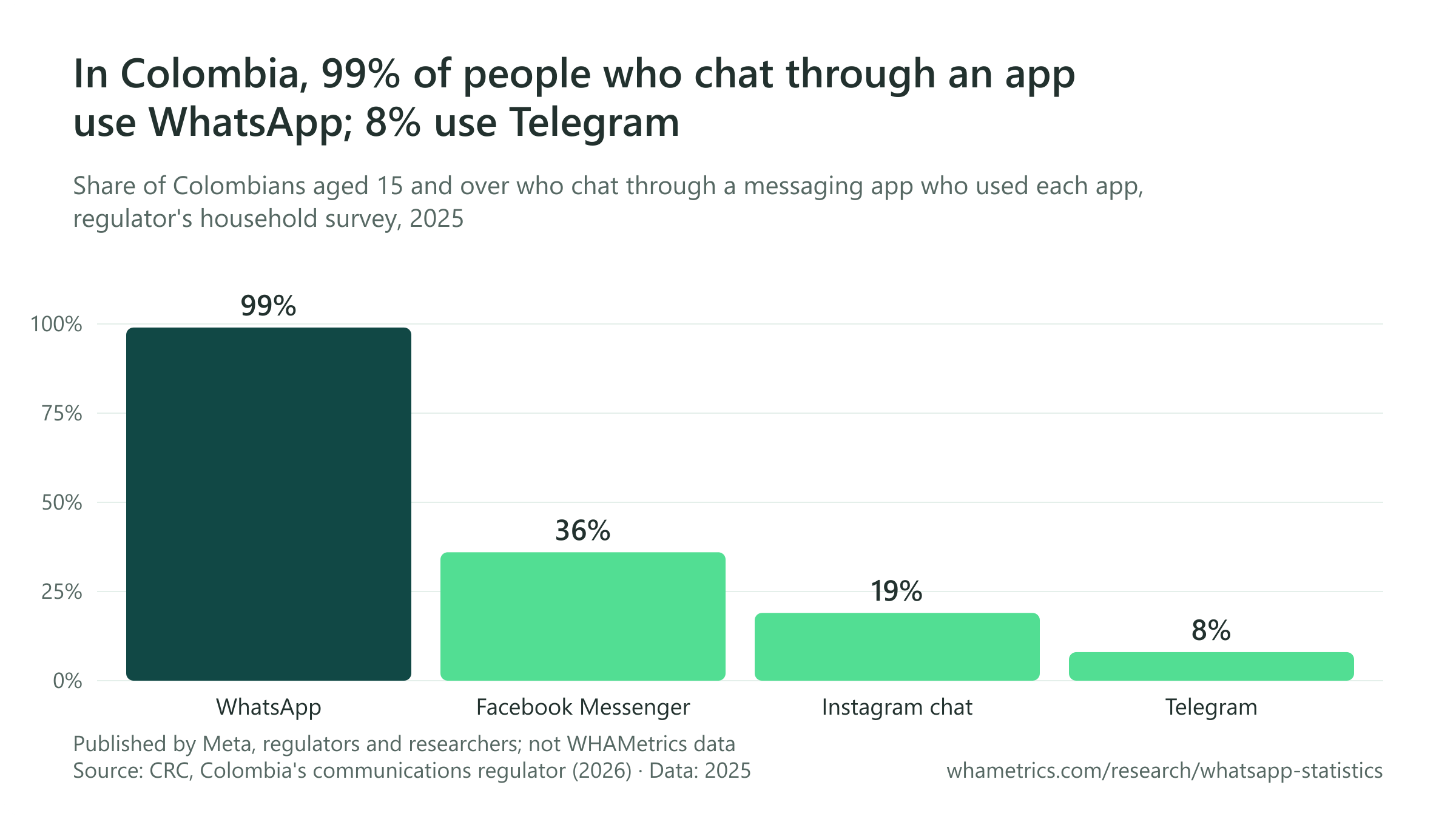
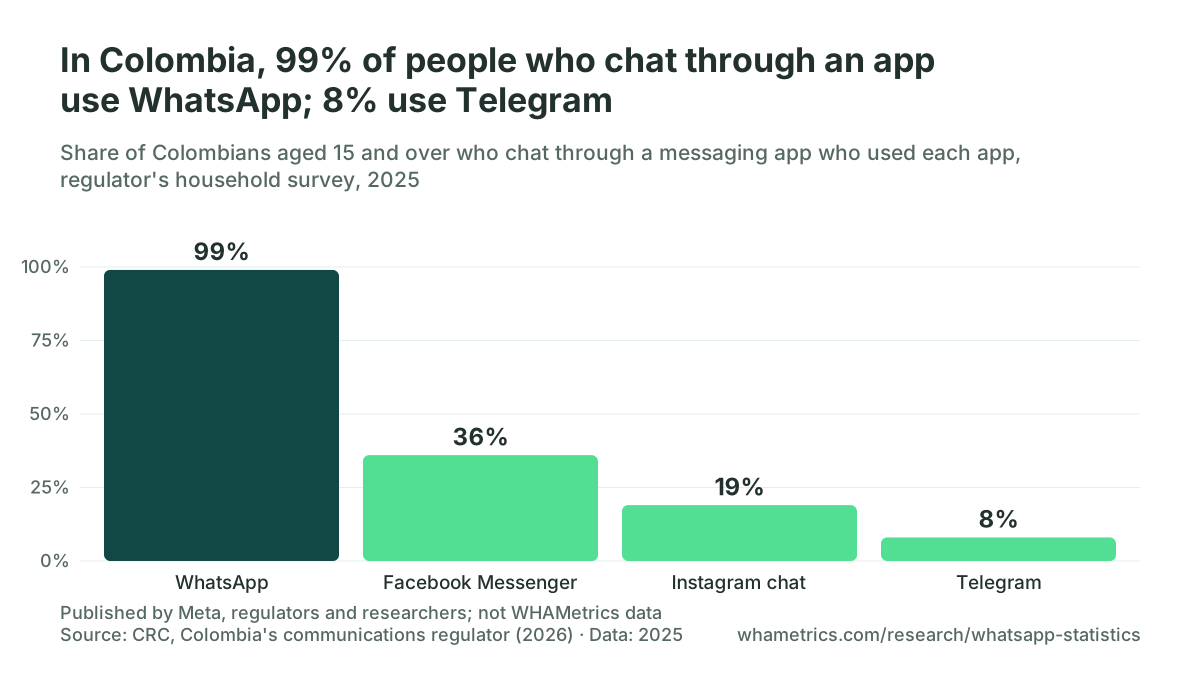
- 95.98 million Russians used Telegram in January 2026, overtaking WhatsApp (89.42 million) as the country's most used messenger.
- Only 24% of urban Ukrainians aged 18 to 65 used WhatsApp in mid-2026, against 78% for Telegram.
- WhatsApp was the fourth most downloaded app in 2025, with an estimated 541.4 million downloads.
- WhatsApp ranked first among messaging apps in 70 of 100 countries on Android in early 2025, a store rank, not usage.
- Signal's Google Play listing showed 100M+ downloads in November 2026, against 10B+ for WhatsApp and 1B+ for Telegram.
| Country, measure and date | |
|---|---|
| Peru: people who use instant messaging, 2025 (WhatsApp leads) | 98.6% |
| Malaysia: communication-app users with an account, 2022 (WhatsApp leads) | 97.7% |
| Netherlands: Signal users who still use WhatsApp, mid-2025 | 98% |
| Czechia: people aged 15 and over with an account, 2025 (WhatsApp ahead of Messenger) | 73% |
| Australia: adults who called on it in the past week, 2025 (Messenger leads) | 23% |
| New Zealand: online adults using it daily, late 2025 (Messenger leads) | 25% |
| Poland: app users in an average month, late 2025 (Messenger leads) | 18.4 million |
| US: monthly Android users, February 2025, estimate (Messenger leads) | 32.05 million |
| Russia: people 12 and over in a month, March 2026 (Telegram and MAX lead) | 76.5 million |
Sources: Pew Research Center; Forbes Russia; Internews-Ukraine; AppTweak; Similarweb; Google; Organismo Supervisor de Inversión Privada en Telecomunicaciones, Peru; Malaysian Communications and Multimedia Commission; NOS; CEDMO, Charles University, with Ipsos; Australian Communications and Media Authority; InternetNZ; Polskie Badania Internetu, Mediapanel; Vedomosti; Comisión de Regulación de Comunicaciones, Colombia
More statistics (88)
WhatsApp is the leading messenger across most of Latin America, Europe, Africa, the Middle East and South Asia, but not everywhere: LINE leads in Japan, Telegram in Ukraine and now Russia, domestic apps in Iran, and text messages, iMessage and Facebook Messenger in the United States. Downloads say little about use, because an app that almost everyone already has is rarely downloaded again.
Messaging apps side by side
- WhatsApp had 1.18 billion estimated yearly downloads on Google Play and was installed on 84.02% of the Android devices Similarweb measures, in its 2025 messaging-apps report (Similarweb estimate, 2025).
- WhatsApp was installed on 84.02% of Android devices in Similarweb's panel, the highest of any messaging app (modelled app panel, 2025; Similarweb, 2025).
- WhatsApp had 1.26 billion daily returning users on Android, with almost 90% of its users returning daily, by Similarweb's estimate (modelled app panel, 2025; Similarweb, 2025).
- In Australia, Facebook Messenger led WhatsApp in both daily and monthly active users on Android, although WhatsApp was first in Similarweb's one-day rank of Android communication apps, by Similarweb's estimate (modelled app panel; Similarweb, 2025).
- Snapchat briefly overtook WhatsApp as the top-ranked messaging app on Android in India in January 2025, by Similarweb's rankings (modelled app panel; Similarweb, 2025).
- WhatsApp ranked as the top messaging app in 53 of 90 countries on Similarweb's Android data in 2021 (modelled app panel; Similarweb, 2021).
- WhatsApp ranked as the top messaging app in 63 of 100 countries on Similarweb's Android data at the start of 2023 (modelled app panel; Similarweb, 2023).
- WhatsApp was installed on almost 90% of Android devices in Israel in 2021, by Similarweb's estimate (modelled app panel; Similarweb, 2021).
- WhatsApp was installed on 60.64% of Android devices in Canada in 2022, by Similarweb's estimate (modelled app panel; Similarweb, 2023).
- WhatsApp was installed on 64.68% of Android devices in Australia in 2022, by Similarweb's estimate (modelled app panel; Similarweb, 2023).
- WhatsApp took 48% and Telegram 47% of the time Russians aged 12 and over spent in messengers on mobile devices in January to August 2024; 80% of their monthly audiences overlapped (audience panel; Mediascope, 2024).
- 94.3 million Russians aged 12 and over used Telegram at least once in March 2026, still first among messengers, ahead of MAX (83.2 million) and WhatsApp (76.5 million) (monthly reach, Mediascope audience panel; Vedomosti, 2026).
- 92.9% of people in Japan aged 13 and over used LINE in December 2025, while the Ministry of Internal Affairs and Communications' annual media survey does not list WhatsApp among the services it measures (MIC, 2026).
- 21% of urban Ukrainians aged 18 to 65 used WhatsApp to communicate in mid-2025, up from 20% in 2024 (Internews-Ukraine, 2025).
- 20% of urban Ukrainians aged 18 to 65 used WhatsApp to communicate in 2024 (Internews-Ukraine, 2025).
Downloads and app-store ranks

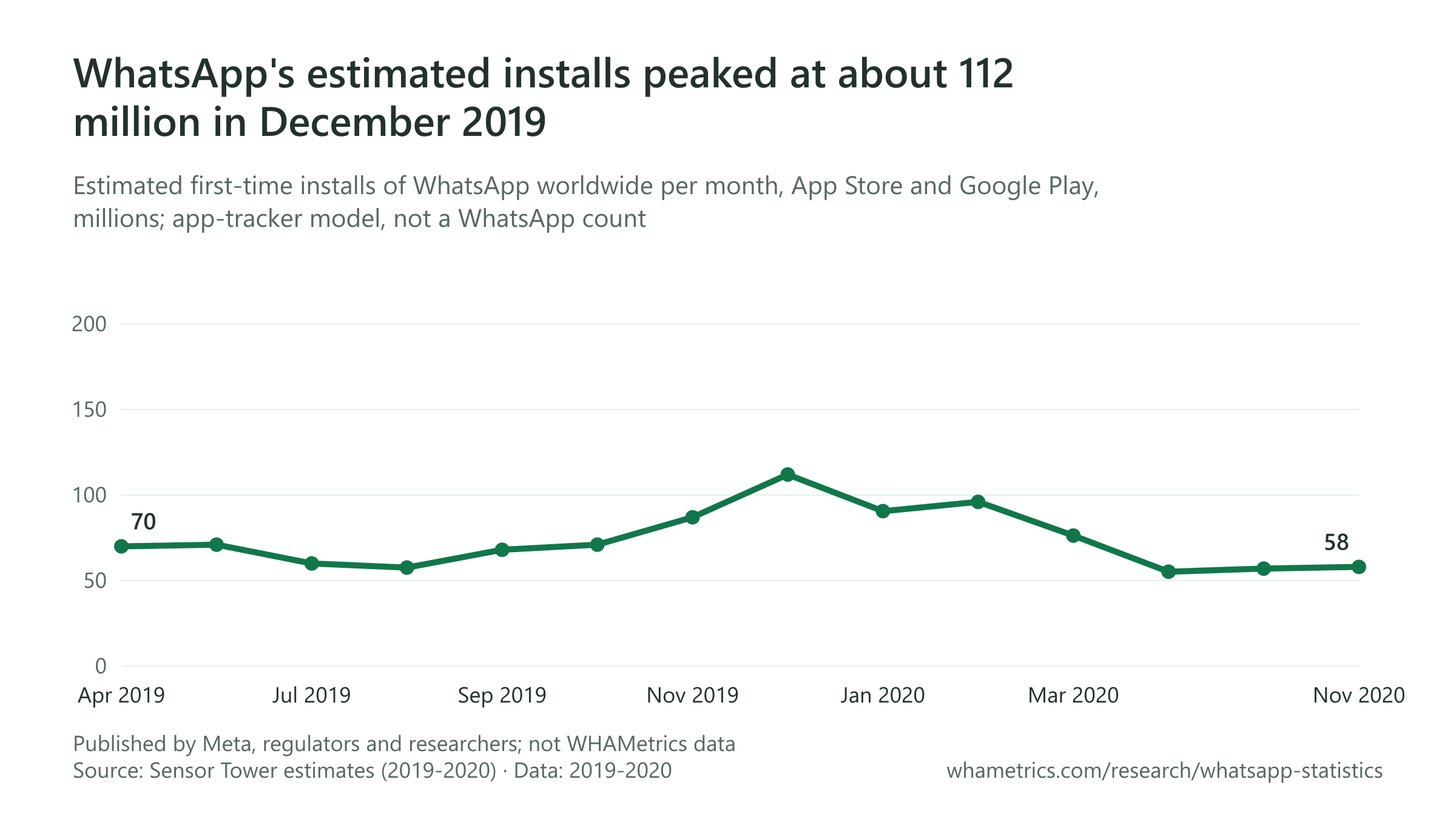
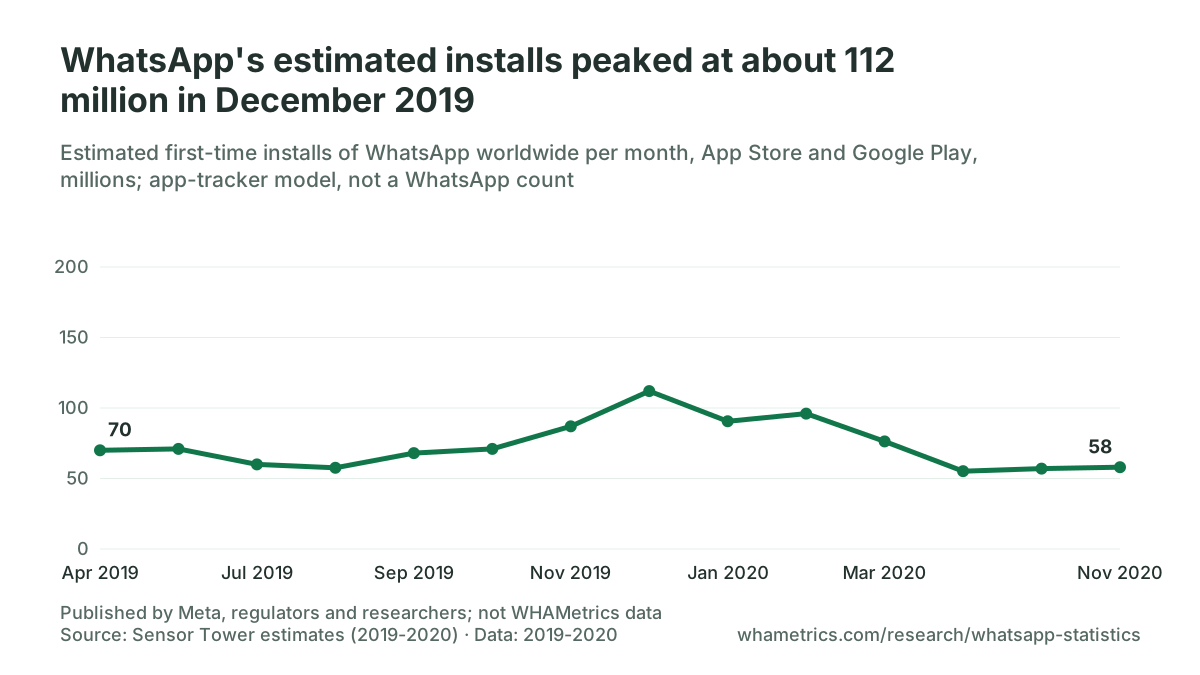
- WhatsApp was the most downloaded app worldwide in 2017, taking the top spot from Facebook, which led in 2016 (Sensor Tower estimate, 2018).
- WhatsApp was the most downloaded app worldwide in the first half of 2018, ahead of Messenger, Facebook and Instagram (Sensor Tower estimate, 2018).
- WhatsApp had close to 199 million estimated installs on Google Play worldwide in the first quarter of 2019, the most of any app on that store (Sensor Tower estimate, 2019).
- WhatsApp stayed the most downloaded app worldwide in the first half of 2019, ahead of Messenger and Facebook (Sensor Tower estimate, 2019).
- WhatsApp was the second most downloaded non-game app worldwide in the first half of 2020, behind TikTok (Sensor Tower estimate, 2020).
- WhatsApp had more than 598 million estimated installs on Google Play in 2020, the most of any app on that store (Sensor Tower estimate, 2021).
- WhatsApp was the fourth most downloaded non-game app worldwide in the first half of 2021, despite the backlash over its privacy policy (Sensor Tower estimate, 2021).
- WhatsApp was the fourth most downloaded app worldwide in the first half of 2022 (Sensor Tower estimate, 2022).
- WhatsApp had more than 161 million estimated installs in Europe in 2018, the most of any app there (Sensor Tower estimate, 2019).
- WhatsApp had more than 12 million estimated first-time installs in Germany in 2018, the most of any app there (Sensor Tower estimate, 2019).
- WhatsApp was the second most downloaded app in Europe in 2020, behind TikTok (Sensor Tower estimate, 2021).
- WhatsApp was the second most downloaded app in Europe in 2021, behind TikTok and ahead of Telegram (Sensor Tower estimate, 2022).
- WhatsApp had approximately 172.3 million estimated installs worldwide from January to April 2021, down 43% from a year earlier, after its privacy-policy backlash (Sensor Tower estimate, 2021).
- 55% of WhatsApp's monthly active Android users worldwide used it every day in the first quarter of 2022, up from 39% a year earlier (Sensor Tower estimate, 2022).
- WhatsApp was the fourth most downloaded app worldwide in 2021, after TikTok, Instagram and Facebook (Appfigures estimate, 2021).
- WhatsApp was the fifth most downloaded app worldwide in December 2021 (Appfigures estimate, 2022).
- WhatsApp was among the five most downloaded apps worldwide in October 2022 (Appfigures estimate, 2022).
- WhatsApp was among the five most downloaded apps worldwide in December 2022 (Appfigures estimate, 2023).
- WhatsApp was among the five most downloaded apps worldwide in May 2023 (Appfigures estimate, 2023).
- WhatsApp was the sixth most downloaded app worldwide in April 2026, behind ChatGPT, TikTok, Instagram, Facebook and Gemini (Appfigures estimate, 2026).
- WhatsApp was among the five most downloaded apps worldwide in August 2026, moving ahead of Instagram (Appfigures estimate, 2026).
- WhatsApp Messenger's Google Play listing first showed "5,000,000,000+" installs in a Wayback Machine capture of January 19, 2020; the capture of January 18, 2020, still showed "1,000,000,000+" (Google Play, 2020).
- WhatsApp Messenger's Google Play listing still showed "1,000,000,000+" installs in a Wayback Machine capture of January 18, 2020 (Google Play, 2020).
- WhatsApp Messenger's Google Play listing first showed "10B+" downloads in a Wayback Machine capture of March 12, 2025; the capture of March 11, 2025, still showed "5B+" (Google Play, 2025).
- WhatsApp Messenger's Google Play listing still showed "5B+" downloads in a Wayback Machine capture of March 11, 2025 (Google Play, 2025).
- WhatsApp Messenger's Google Play listing showed "10B+" downloads as of November 16, 2026 (Google Play, 2026).
- WhatsApp's active users in Greece rose from 2.5 million to over 3.2 million during the second quarter of 2025, by a machine-written Sensor Tower summary that does not define the measure (Sensor Tower estimate, 2025).
- WhatsApp crossed 1 billion Android downloads in March 2015, its co-founder and CEO Jan Koum wrote on March 11, 2015 (Koum, 2015).
- WhatsApp was the fourth most downloaded app worldwide in 2022, after TikTok, Instagram and Facebook (Sensor Tower estimate, 2023).
- WhatsApp accounted for 17% of Meta's estimated app installs worldwide in the first quarter of 2023, behind Instagram at nearly 30% and Facebook at 27% (Sensor Tower estimate, 2023).
- WhatsApp was the second most downloaded app in Europe in the first quarter of 2023, after TikTok and ahead of Telegram (Sensor Tower estimate, 2023).
- WhatsApp was the third most downloaded app in Europe in the third quarter of 2023, after Temu and TikTok and ahead of Telegram (Sensor Tower estimate, 2023).
- WhatsApp was the third most downloaded app in Europe in the fourth quarter of 2023, after Temu and TikTok and ahead of Telegram (Sensor Tower estimate, 2024).
- 91% of WhatsApp's monthly active users in the United Kingdom used it daily in the fourth quarter of 2023, the highest of any app there (Sensor Tower estimate, 2024).
- WhatsApp had an estimated 1.8 billion monthly active mobile users in February 2024, by Sensor Tower's analysis reported by the Financial Times (Sensor Tower estimate via FT, 2024).
Apple's year-end charts
- WhatsApp was the No. 7 free iPhone app by downloads in the United States in 2024, on Apple's year-end App Store chart (Apple, 2024).
- WhatsApp was the No. 5 free iPhone app by downloads in the United States in 2025, on Apple's year-end App Store chart (Apple, 2025).
- WhatsApp was the No. 8 free iPhone app by downloads in the United Kingdom in 2024, on Apple's year-end App Store chart (Apple, 2024).
- WhatsApp was the No. 8 free iPhone app by downloads in the United Kingdom in 2025, on Apple's year-end App Store chart (Apple, 2025).
- WhatsApp was the No. 7 free iPhone app by downloads in Germany in 2024, on Apple's year-end App Store chart (Apple, 2024).
- WhatsApp was the No. 7 free iPhone app by downloads in Germany in 2025, on Apple's year-end App Store chart (Apple, 2025).
- WhatsApp was the No. 6 free iPhone app by downloads in France in 2024, on Apple's year-end App Store chart (Apple, 2024).
- WhatsApp was the No. 7 free iPhone app by downloads in France in 2025, on Apple's year-end App Store chart (Apple, 2025).
- WhatsApp was the No. 8 free iPhone app by downloads in Italy in 2024, on Apple's year-end App Store chart (Apple, 2024).
- WhatsApp was the No. 13 free iPhone app by downloads in Italy in 2025, on Apple's year-end App Store chart (Apple, 2025).
- WhatsApp was the No. 8 free iPhone app by downloads in Spain in 2024, on Apple's year-end App Store chart (Apple, 2024).
- WhatsApp was the No. 7 free iPhone app by downloads in Spain in 2025, on Apple's year-end App Store chart (Apple, 2025).
- WhatsApp was the No. 2 free iPhone app by downloads in Mexico in 2024, on Apple's year-end App Store chart (Apple, 2024).
- WhatsApp was the No. 4 free iPhone app by downloads in Turkey in 2024, on Apple's year-end App Store chart (Apple, 2024).
- WhatsApp was the No. 7 free iPhone app by downloads in Brazil in 2025, on Apple's year-end App Store chart (Apple, 2025).
- WhatsApp was the No. 3 free iPhone app by downloads in India in 2025, on Apple's year-end App Store chart (Apple, 2025).
WhatsApp on the web
- web.whatsapp.com had an estimated 2.8 billion visits in the three months to June 2026, according to Similarweb's traffic model (Similarweb estimate, 2026).
- Brazil sent 20.11% of desktop traffic to web.whatsapp.com in June 2026, followed by India (14.49%), Indonesia (7.47%), Mexico (4.91%) and Peru (4.37%), according to Similarweb (Similarweb estimate, 2026).
- whatsapp.com was the ninth most visited website in the world in September 2026, according to Similarweb's ranking (Similarweb estimate, 2026).
When users tried to switch, in 2021
- Signal had 50.6 million estimated installs worldwide in January 2021, up from 992,000 in January 2020, during WhatsApp's privacy-policy backlash (Sensor Tower estimate, 2021).
- Signal had a little more than 7 million estimated installs worldwide in February 2021, down 86% from January (Sensor Tower estimate, 2021).
- Signal had 2.8 million estimated installs worldwide in April 2021, more than double the 1.3 million of April 2020 (Sensor Tower estimate, 2021).
- Signal had 64.6 million estimated first-time installs worldwide from January to April 2021, up 1,192% from a year earlier (Sensor Tower estimate, 2021).
- Signal was the third most downloaded non-game app worldwide in January 2021, behind Telegram and TikTok (Sensor Tower estimate, 2021).
- Signal's US installs rose 30% in the six days after the August 6, 2020, executive order against WeChat, to about 65,000 (Sensor Tower estimate, 2020).
- Signal had about 218 million estimated downloads worldwide from its 2014 launch to March 2025 (Sensor Tower estimate, 2025).
- The United States accounted for 27% of Signal's estimated downloads worldwide, followed by the Netherlands at 18% and Germany at 6% (Sensor Tower estimate, 2025).
- Signal had 787,000 estimated installs in Ukraine between February 24 and March 20, 2022, up 1,075% on the 25 days before Russia's invasion (Sensor Tower estimate, 2022).
- Signal had 17.8 million estimated downloads in the week of January 5 to 12, 2021, up from 285,000 the week before, Sensor Tower told the Associated Press (Sensor Tower estimate via AP, 2021).
- WhatsApp had 10.6 million estimated downloads in the week of January 5 to 12, 2021, down from 12.7 million the week before, as users tried Signal and Telegram (Sensor Tower estimate via AP, 2021).
- Facebook Messenger was the top messaging app in no country, while LINE led in Thailand, Japan and Taiwan, Signal in the Netherlands and Sweden, and Zalo in Vietnam, on Similarweb's February 2025 Android rankings (modelled app panel; Similarweb, 2025).
- 26% of WhatsApp users surveyed in Mexico, Spain, South Africa and the UK wanted to move at least some of their chats to other apps after the 2021 privacy-policy update, but only about a quarter of them (24%) managed to as much as they wanted (Griggio et al., 2022).
- Only 0.52% of WhatsApp users surveyed in Mexico, Spain, South Africa and the UK had uninstalled WhatsApp by late May 2021 over its privacy-policy update, and 15.87% used it less often (Griggio et al., 2022).
- Telegram was the alternative chosen by 74% of WhatsApp users who tried to switch after the 2021 privacy-policy update, ahead of Signal at 38%, in a survey in Mexico, Spain, South Africa and the UK (Griggio et al., 2022).
- 41.7% of WhatsApp users surveyed in Mexico, Spain, South Africa and the UK said they had accepted the 2021 privacy policy by the May 15, 2021, deadline, and only 5.77% had read it in full in February (Griggio et al., 2022).
- 5% of Indian WhatsApp users responding to a LocalCircles online poll in late January 2021 said they had deleted WhatsApp over its privacy-policy change, and 22% said they had cut their use (LocalCircles, 2021).
- 13% of WhatsApp users in Germany said they planned to delete the app after its privacy-policy change, while 76% did not, in a YouGov poll for dpa in June 2021 (YouGov, 2021).
Sources: Similarweb Ltd. (2025, 2026); Similarweb (2021, 2023, 2025); Mediascope; Vedomosti; Ministry of Internal Affairs and Communications, Institute for Information and Communications Policy; Internews-Ukraine; Sensor Tower (2018-2025); AppTweak; Appfigures (2021-2026); Google; Jan Koum, Twitter; Financial Times; Apple Inc. (2024, 2025); The Associated Press; ACM, CHI Conference on Human Factors in Computing Systems 2022; ACM, CHI 2022; LocalCircles; YouGov Deutschland
WhatsApp timeline: milestones, fines and bans
Figures published by Meta, regulators, surveys and studies; none is WHAMetrics data.
WhatsApp banned 4.54 million Indian accounts in September 2026, by its monthly report under India's IT Rules (WhatsApp, 2026).

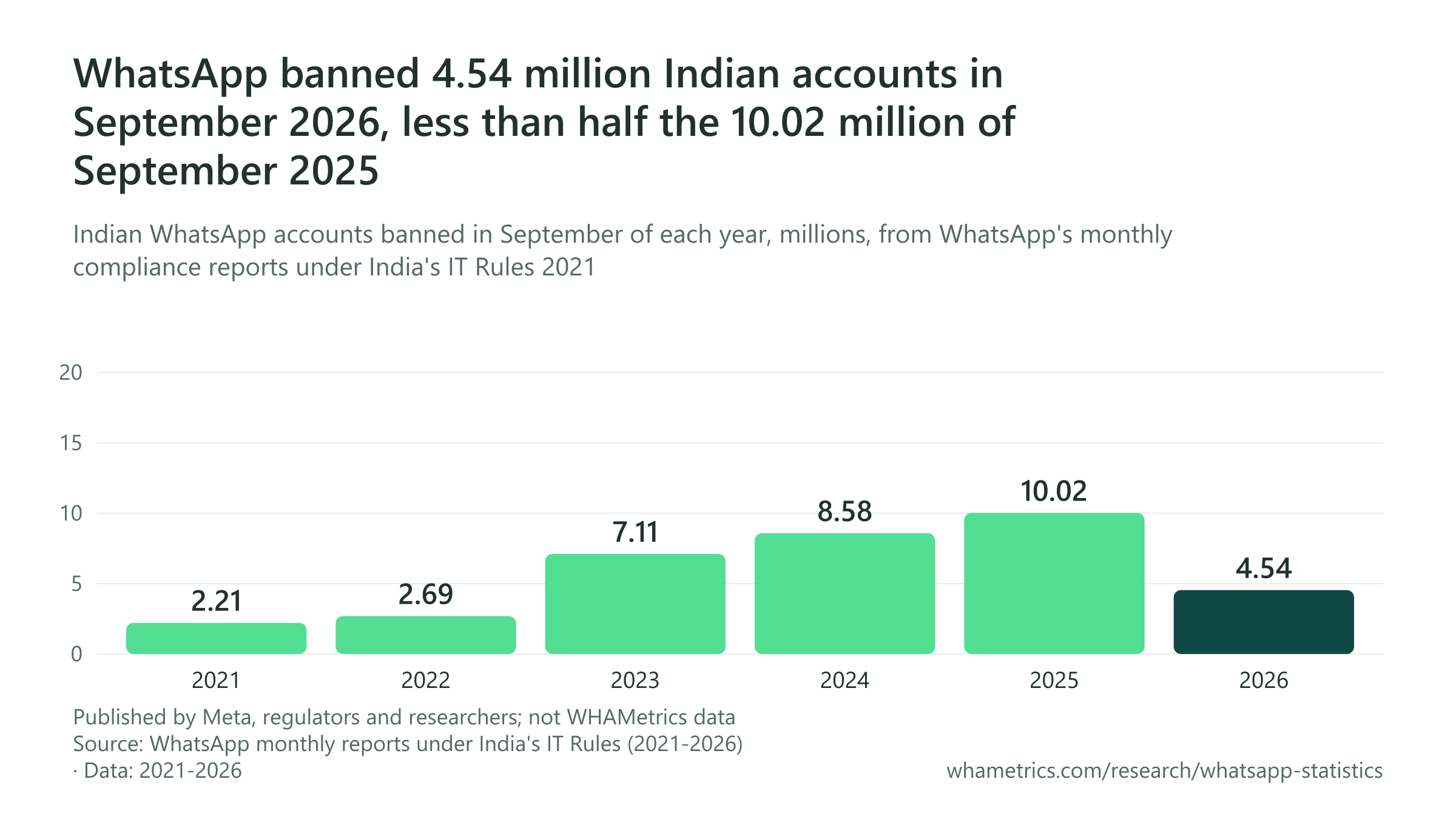
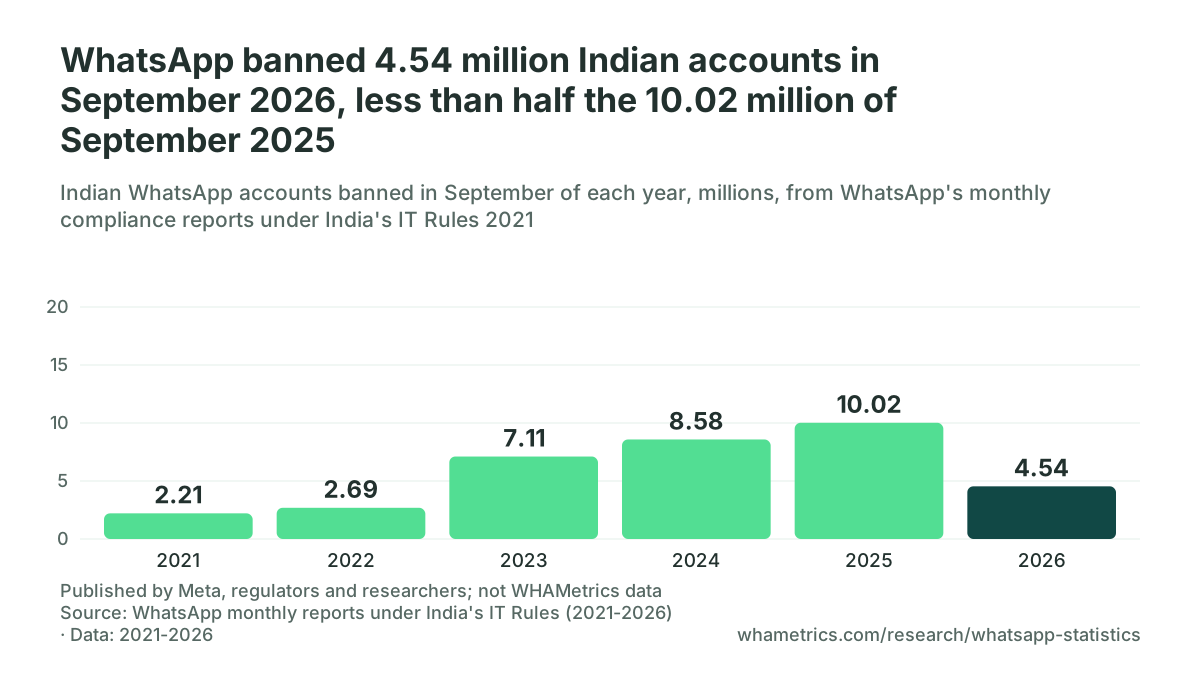
- WhatsApp's monthly bans of Indian accounts peaked at 11.3 million in May 2025.
- WhatsApp was blocked 27 times in 2025, more often than any platform but Facebook, by a digital rights coalition's count.
- WhatsApp terminated 6.4 million messenger accounts in the EU from mid-February to December 2024, most of them for spam.
- WhatsApp traffic in Russia slowed by 70 to 80% in December 2025 under the regulator's phased restrictions.
- Iran lifted its ban on WhatsApp on December 24, 2024, after more than two years.
| Authority, date and finding | Amount |
|---|---|
| Ireland's Data Protection Commission, September 2021: GDPR transparency | €225 million |
| Nigeria's competition and consumer protection regulator, July 2024: consumer practices (upheld 2025) | $220 million |
| India's Competition Commission, November 2024: the 2021 privacy policy (upheld 2025) | ₹213.14 crore |
| European Commission, May 2017: misleading information on the merger | €110 million |
| Turkey's Competition Board, October 2022: combining user data | ₺346.7 million |
| Ireland's Data Protection Commission, January 2023: GDPR legal basis | €5.5 million |
| Italy's competition authority, May 2017: pushing users to share data with Facebook | €3 million |
| Spain's data protection agency, March 2018: data passed to Facebook without consent | €300,000 |
| Brazil's competition authority, April 2026: daily fine over rival AI chatbots | BRL 250,000 a day |
| Owed to WhatsApp by NSO Group, US court, October 2025 (the jury's punitive award, as cut) | $4 million |
Sources: WhatsApp LLC; Access Now; WhatsApp Ireland Limited; Novaya Gazeta Europe; The Associated Press; Data Protection Commission (2023, 2021); Federal Competition and Consumer Protection Commission; Competition Commission of India; European Commission; Rekabet Kurumu; Autorità Garante della Concorrenza e del Mercato; Agencia Española de Protección de Datos; Conselho Administrativo de Defesa Econômica; CyberScoop
More statistics (99)
WhatsApp started as a status app, became a messenger, was bought by Facebook and turned on end-to-end encryption for everyone. Since then its story has been as much about regulators, courts and governments as about features: privacy fines in Europe, competition cases in India, Turkey, Nigeria and Brazil, orders on rival AI assistants, and blocks in countries from China to Russia and Iran.
Accounts banned in India

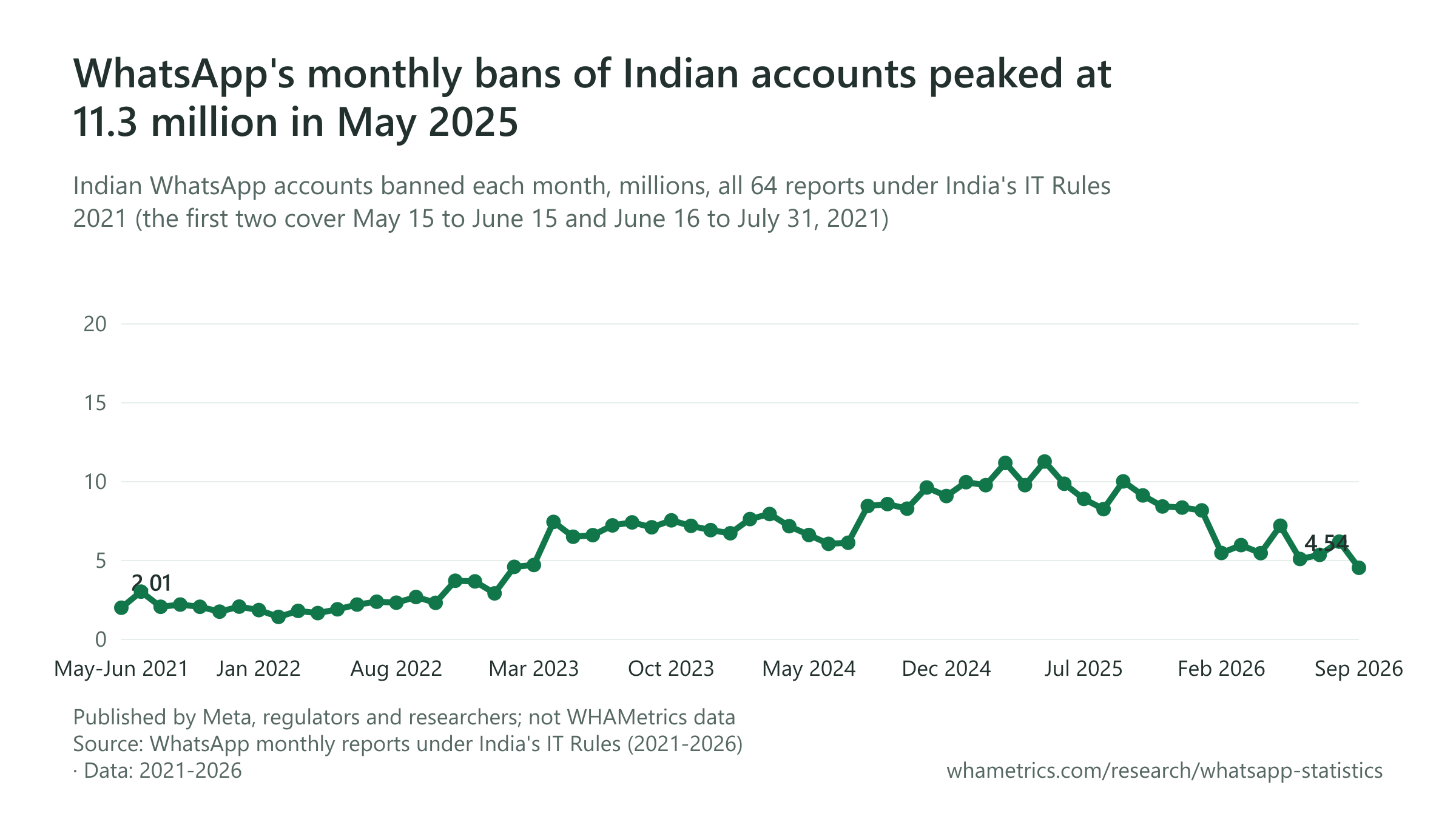
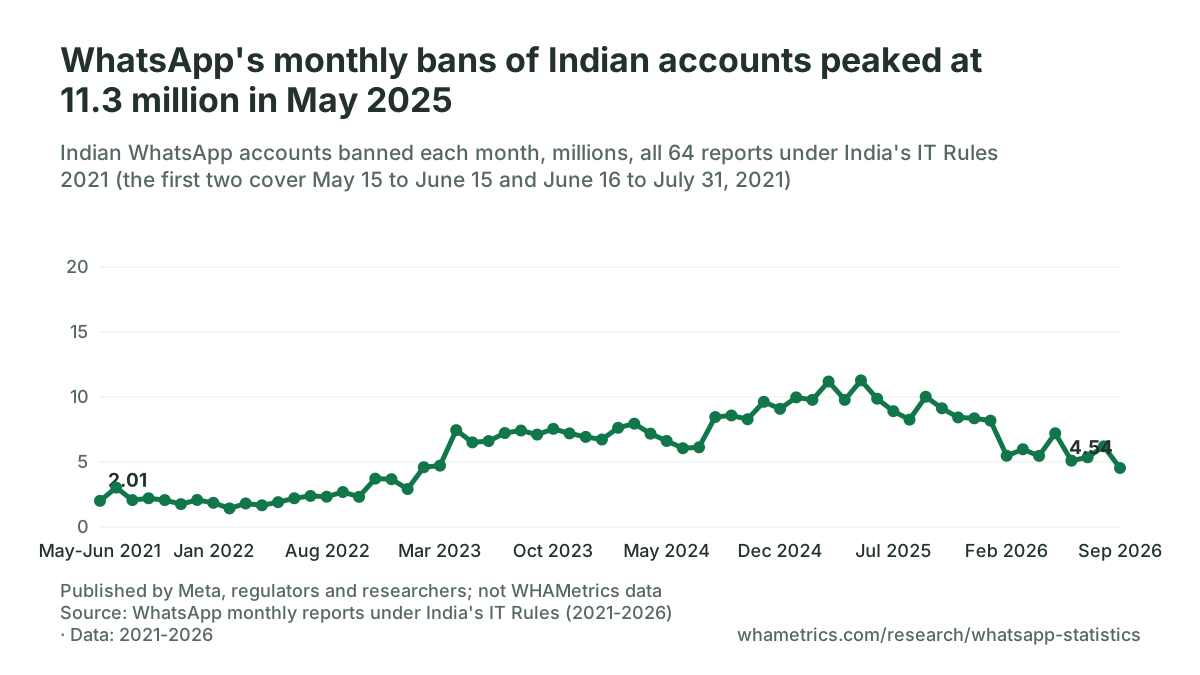
| Month | Accounts banned |
|---|---|
| October 2025 | 9,126,723 |
| November 2025 | 8,431,911 |
| December 2025 | 8,362,961 |
| January 2026 | 8,179,740 |
| February 2026 | 5,482,423 |
| March 2026 | 5,978,096 |
| April 2026 | 5,470,958 |
| May 2026 | 7,214,702 |
| June 2026 | 5,104,127 |
| July 2026 | 5,364,000 |
| August 2026 | 6,202,400 |
Other account bans
- WhatsApp said it banned more than two million accounts a month for bulk or automated messaging in the three months before February 2019 (WhatsApp, 2019).
- More than 75% of the accounts WhatsApp banned for bulk or automated messaging had no recent user report, WhatsApp said in February 2019 (WhatsApp, 2019).
- Roughly 20% of WhatsApp's bans for bulk or automated messaging happened at registration, before the account sent a message, WhatsApp said in February 2019 (WhatsApp, 2019).
- WhatsApp banned more than 400,000 Brazilian accounts for violating its terms between August 15 and October 28, 2018, the 2018 election campaign, it told a Brazilian congressional inquiry, as reported by Tecnoblog (Tecnoblog, 2019).
- WhatsApp banned more than 6.8 million accounts linked to criminal scam centres in the first half of 2025, Meta said (Meta, 2025).
Product milestones
- WhatsApp dates its start to February 2009, when its founders began writing the app's first code, and counts February 24 as its birthday (WhatsApp, 2017).
- WhatsApp began as an app for sharing a status with contacts and added messaging in the summer of 2009, Jan Koum wrote (WhatsApp, 2017).
- WhatsApp submitted version 2.0 of its iPhone app to Apple's App Store on August 26, 2009, and Apple approved it by September 12, 2009 (WhatsApp, 2009).
- WhatsApp moved its BlackBerry app to direct download with a free trial and a paid yearly subscription in April 2010 (WhatsApp, 2010).
- WhatsApp released its Android app for download from its website by September 2010, two months after its Nokia Symbian app (WhatsApp, 2010).
- WhatsApp's Windows Phone app went live in September 2011, bringing the number of mobile platforms WhatsApp supported to six (WhatsApp, 2011).
- WhatsApp introduced voice messages on all its platforms on August 7, 2013 (WhatsApp, 2013).
- Facebook announced a definitive agreement to acquire WhatsApp on February 19, 2014 (Facebook, 2014).
- Facebook completed its acquisition of WhatsApp on October 6, 2014, and WhatsApp co-founder and CEO Jan Koum joined Facebook's board that day (Facebook, 2014).
- WhatsApp announced on April 5, 2016, that every message, call, photo, video, file and voice message sent on the latest version of the app is end-to-end encrypted by default, group chats included (WhatsApp, 2016).
- WhatsApp launched a desktop app for Windows and Mac, mirroring the phone like WhatsApp Web, on May 10, 2016 (WhatsApp, 2016).
- WhatsApp announced video calling on November 14, 2016, for Android, iPhone and Windows Phone users (WhatsApp, 2016).
- WhatsApp relaunched its Status feature on February 20, 2017, letting users share photos and videos with contacts, end-to-end encrypted (WhatsApp, 2017).
- WhatsApp introduced disappearing messages on November 5, 2020, deleting new messages in a chat after 7 days when turned on (WhatsApp, 2020).
- WhatsApp added one-to-one voice and video calls to its desktop app on March 4, 2021 (WhatsApp, 2021).
- WhatsApp made end-to-end encryption available for chat backups stored on Google Drive or iCloud on October 14, 2021, as an optional setting (Meta, 2021).
- WhatsApp let users link one account on up to four additional devices, phones included, from April 25, 2023, a year after multi-device messaging reached users globally (WhatsApp, 2023).
- WhatsApp opened reservations for usernames on June 29, 2026, so people can contact others without sharing a phone number, with the feature itself to roll out gradually later in 2026 (WhatsApp, 2026).
- WhatsApp upgraded two-step verification from a six-digit PIN to a full alphanumeric password on August 25, 2026 (WhatsApp, 2026).
- WhatsApp launched guest calling on October 14, 2026, letting people without a WhatsApp account join calls of up to 32 people from a browser through a call link (WhatsApp, 2026).
- WhatsApp said in December 2022 that video calls on mobile could include up to 32 people, as voice calls already could, four times the previous limit (WhatsApp, 2022).
- Meta announced on November 14, 2025, that WhatsApp users in Europe would soon be able to opt in to third-party chats under the Digital Markets Act, with BirdyChat and Haiket as the first interoperable services (Meta, 2025).
Leadership
- WhatsApp co-founder Brian Acton announced in September 2017 that he was leaving WhatsApp to start a nonprofit, about three years after the Facebook acquisition (Engadget, 2017).
- Brian Acton walked away from about $850 million in unvested Facebook stock when he left a year before his final stock grants vested, Forbes reported in September 2018 (Forbes, 2018).
- WhatsApp co-founder and chief executive Jan Koum announced on April 30, 2018, that he was leaving WhatsApp and Facebook, writing that it was time for him to move on (Android Police, 2018).
- Mark Zuckerberg named Will Cathcart head of WhatsApp on March 14, 2019, as Chris Daniels, who had led WhatsApp after Jan Koum, left the company (Meta, 2019).
- Meta plans to appoint Cred founder Kunal Shah head of WhatsApp, replacing Will Cathcart, who ran WhatsApp for about seven years, Bloomberg reported on June 22, 2026 (Bloomberg, 2026).
- Meta is investing $900 million in Cred for a stake of about 20%, valuing the Indian fintech company at $4.5 billion, as part of the deal that brings its founder to lead WhatsApp, Bloomberg reported in June 2026 (Bloomberg, 2026).
Regulators, courts and fines
- The US Federal Trade Commission wrote to Facebook and WhatsApp on April 10, 2014, that WhatsApp must keep its privacy promises after the acquisition and that material changes to the use of data already collected need users' affirmative consent (FTC, 2014).
- The European Commission cleared Facebook's acquisition of WhatsApp under the EU Merger Regulation on October 3, 2014, finding that Facebook Messenger and WhatsApp were not close competitors (European Commission, 2014).
- WhatsApp updated its terms and privacy policy on August 25, 2016, for the first time in four years, to coordinate more with Facebook, including connecting users' phone numbers with Facebook's systems for friend suggestions and ads (WhatsApp, 2016).
- WhatsApp updated its terms and privacy policy for users in the European Union on April 24, 2018, ahead of the GDPR, and set up an entity within the EU to provide its service there (WhatsApp, 2018).
- WhatsApp postponed its 2021 terms and privacy policy update on January 15, 2021, saying no account would be suspended or deleted on February 8 and that new business options would come on May 15, 2021 (WhatsApp, 2021).
- Hamburg's data protection commissioner ordered Facebook Ireland on May 11, 2021, to stop processing WhatsApp users' personal data for its own purposes, an urgency order limited to three months, ahead of WhatsApp's May 15, 2021, deadline for its new terms (HmbBfDI, 2021).
- The European Commission designated Meta a gatekeeper under the Digital Markets Act on September 6, 2023, with WhatsApp and Messenger listed as its designated messaging services, and gave it six months to comply (European Commission, 2023).
- Meta said on September 6, 2024, that under the Digital Markets Act it would add the option of group chats with third-party apps in 2025 and voice and video calls in 2027 (Meta, 2024).
- WhatsApp committed to EU consumer protection authorities on March 6, 2023, to explain future changes to its terms, to show the option to reject them as prominently as the option to accept, and confirmed that it does not share users' personal data for advertising (European Commission, 2023).
- Italy's competition authority opened an abuse-of-dominance investigation into Meta on July 30, 2025, over the pre-installation of its Meta AI assistant in WhatsApp from March 2025 (AGCM, 2025).
- Italy's competition authority ordered Meta on December 24, 2025, to suspend WhatsApp's new Business Solution Terms that would exclude competing AI chatbots from WhatsApp, while its investigation continues (AGCM, 2025).
- The European Commission opened a formal antitrust investigation on December 4, 2025, into Meta's new WhatsApp policy barring AI providers from the WhatsApp Business Solution when AI is their main service; WhatsApp called the claims baseless (European Commission, 2025).
- The European Commission told Meta on February 9, 2026, in a Statement of Objections, that it was likely dominant in the EEA market for consumer communication apps through WhatsApp and likely abusing that position by excluding third-party AI assistants (European Commission, 2026).
- The European Commission said on April 15, 2026, that Meta's March 2026 decision to readmit third-party AI assistants to WhatsApp for a fee was in effect equivalent to its earlier ban, and widened its investigation to cover Italy, which it had left out because of the Italian competition authority's own case (European Commission, 2026).
- The European Commission ordered Meta on June 9, 2026, to restore free access to the WhatsApp Business API for rival general-purpose AI assistants within five working days and keep it until the investigation ends; Meta said it would appeal (European Commission, 2026).
- India's Competition Commission directed in November 2024 that WhatsApp must not share user data with other Meta companies for advertising for five years (Competition Commission of India, 2024).
- Meta said in November 2024 that it disagreed with the Competition Commission of India's decision and would appeal, adding that the 2021 WhatsApp update did not change the privacy of personal messages and was offered as a choice (Storyboard18, 2024).
- India's National Company Law Appellate Tribunal upheld the ₹213.14 crore penalty on Meta on November 4, 2025, but set aside the five-year ban on WhatsApp sharing data with Meta companies for advertising and the finding that Meta leveraged WhatsApp's dominance into display advertising (LiveLaw, 2025).
- India's government said on May 26, 2021, that WhatsApp's last-minute court challenge to the rule requiring large messaging services to identify the first originator of a message (Rule 4(2) of the 2021 Intermediary Guidelines) was an attempt to stop the rules taking effect (Government of India, 2021).
- WhatsApp's lawyer told the Delhi High Court in April 2024 that WhatsApp would cease to operate in India if forced to break end-to-end encryption to meet the traceability rule (Business Today, 2024).
- Brazil's central bank ordered Visa and Mastercard on June 23, 2020, to suspend WhatsApp's payment service, eight days after its launch, saying it had to assess the risks and preserve competition in the payments system (O Povo, 2020).
- Turkey's Competition Authority opened an investigation into Facebook and WhatsApp on January 11, 2021, and ordered as an interim measure that WhatsApp's data-sharing condition, due from February 8, 2021, be suspended in Turkey (Rekabet Kurumu, 2021).
- Nigeria's Competition and Consumer Protection Tribunal upheld the $220 million penalty against Meta and WhatsApp on April 25, 2025, and awarded the regulator $35,000 for the cost of its investigation (FCCPC, 2025).
- The UK's Online Safety Act 2023, which gives Ofcom powers over messaging services that WhatsApp said could be used to undermine end-to-end encryption, became law on October 26, 2023 (UK legislation, 2023).
- The UK's Online Safety Act 2023, as enacted, sets the maximum penalty for a regulated service at the greater of £18 million or 10% of the provider's qualifying worldwide revenue (UK legislation, 2023).
- WhatsApp and other encrypted messaging services, in an open letter signed by WhatsApp head Will Cathcart, urged the UK government on April 17, 2023, to rethink the Online Safety Bill, saying that as drafted it could break end-to-end encryption (WhatsApp, 2023).
- The US Federal Trade Commission sued Facebook on December 9, 2020, alleging illegal monopolization through acquisitions including WhatsApp in 2014, and sought remedies that could include divesting Instagram and WhatsApp (FTC, 2020).
- A US federal judge ruled for Meta on November 18, 2025, finding the FTC had not shown that Meta holds a monopoly, so WhatsApp and Instagram will not be spun off; the FTC said it was deeply disappointed (NPR, 2025).
- A US jury ordered spyware maker NSO Group on May 6, 2025, to pay WhatsApp $167,254,000 in punitive damages and about $444,719 in compensatory damages over its 2019 hacking campaign against about 1,400 WhatsApp users (TechCrunch, 2025).
- The EU Court of Justice ruled on February 10, 2026, that WhatsApp Ireland's challenge to the European Data Protection Board's binding decision behind the €225 million fine is admissible, and sent the case back to the General Court to rule on the merits (Court of Justice of the European Union, 2026).
- Brazil's competition authority CADE opened an inquiry into Meta on January 12, 2026, and suspended WhatsApp's new Business Solution Terms restricting AI providers as an interim measure (CADE, 2026).
- CADE's tribunal unanimously dismissed WhatsApp's and Facebook Brazil's appeal on March 4, 2026, keeping the suspension of WhatsApp Business terms that would bar AI providers (CADE, 2026).
- Turkey's Competition Board opened an investigation into Meta and WhatsApp on May 14, 2026, over Meta AI's integration into WhatsApp and the exclusion of third-party AI assistants, and ordered as an interim measure that rival general-purpose AI chatbots be able to offer their services on WhatsApp (Rekabet Kurumu, 2026).
Blocks and restrictions
- A Brazilian criminal court in São Bernardo do Campo ordered WhatsApp blocked nationwide for 48 hours from midnight on December 17, 2015, for not providing user data in a criminal case, and a São Paulo appeals judge reversed the block the same day (Agência Brasil, 2015).
- A judge in Lagarto, Sergipe, ordered Brazil's mobile operators to block WhatsApp nationwide for 72 hours from May 2, 2016, for not handing over message contents in a drug-trafficking investigation; Sergipe's court of justice lifted the block on May 3, 2016 (Migalhas, 2016).
- Brazil's Supreme Court president Ricardo Lewandowski ordered WhatsApp restored on July 19, 2016, suspending a Duque de Caxias (Rio de Janeiro) court's nationwide block as an apparent breach of freedom of expression and communication (Supremo Tribunal Federal, 2016).
- The US House of Representatives' Chief Administrative Officer told staff on June 23, 2025, that WhatsApp was not allowed on any House device, calling it high-risk; Meta said it disagreed in the strongest possible terms (Axios, 2025).
- Russia's telecoms regulator Roskomnadzor said on August 13, 2025, that it was partially restricting calls on WhatsApp and Telegram, which it called the main voice services used for fraud and extortion, and that no other functions were being restricted (Interfax, 2025).
- Roskomnadzor said on November 28, 2025, that it was gradually restricting WhatsApp in Russia for refusing to meet legal requirements, that restrictions would continue and that WhatsApp could be fully blocked, and recommended switching to national services (Interfax, 2025).
- WhatsApp said on February 12, 2026, that the Russian government was trying to fully block it, cutting off over 100 million users in Russia, and the Kremlin's spokesman confirmed that Roskomnadzor was blocking the app (The Moscow Times, 2026).
- China largely blocked WhatsApp in September 2017, including text messages, after restricting its photos, video and voice chats from mid-July 2017, The New York Times reported (The New York Times, 2017).
- Many internet providers in Iran began blocking WhatsApp on September 21, 2022, amid the Mahsa Amini protests, according to OONI network measurements (OONI, 2022).
- Iran blocked WhatsApp again from June 15 to July 12, 2025, amid the twelve-day war with Israel, according to OONI's censorship findings (OONI, 2025).
- Guinea blocked social media from May 17 to 23, 2023, amid protests, with WhatsApp Web and WhatsApp's registration service blocked, according to OONI measurements (OONI, 2023).
- Senegal blocked WhatsApp, Facebook, Instagram, YouTube, Twitter, TikTok and Telegram from June 1 to 7, 2023, amid political unrest, according to OONI measurements (OONI, 2023).
- Some internet providers in Guinea blocked WhatsApp, Telegram, Facebook, Twitter, Instagram and YouTube from November 24, 2023, until about February 22, 2024, according to OONI measurements (OONI, 2023).
- Internet providers in Mozambique blocked Facebook, Instagram and WhatsApp between October 29 and November 14, 2024, amid post-election protests, according to OONI measurements (OONI, 2024).
- Uganda blocked WhatsApp and other social media and messaging apps from January 18, 2026, after its general election, and the block was still listed as ongoing by OONI (OONI, 2026).
- The UAE's telecoms regulator said in June 2017, after WhatsApp calls briefly worked, that there was no change to its policy reserving internet voice calls to licensed providers, and WhatsApp calls were blocked again (Khaleej Times, 2017).
- Saudi Arabia lifted its ban on internet voice and video calls through apps such as WhatsApp and Skype in September 2017, a block in place since 2013, while its telecoms regulator said the calls would be monitored (Reuters, 2017).
- Apple removed WhatsApp and Threads from its App Store in China on April 19, 2024, saying the Cyberspace Administration of China had ordered the removal over national security concerns; Telegram and Signal were also no longer available (AFP, 2024).
- WhatsApp had about 2 million estimated downloads in China from January 2023 until Apple removed it from the Chinese App Store in April 2024 (Appfigures estimate, 2024).
- 2.3 million active WhatsApp accounts had Chinese phone numbers in early 2025, and 1.6 million had Myanmar numbers, although WhatsApp was banned in both countries, researchers found (account enumeration; Gegenhuber et al., 2025).
Sources: WhatsApp LLC (2019, 2025); Tecnoblog; Meta Platforms, Inc. (2021, 2024, 2025); WhatsApp (2009-2026); Facebook, Inc. (2014, 2019); Engadget; Forbes; Android Police; Bloomberg News; US Federal Trade Commission (2014, 2020); European Commission (2014-2026); Hamburgischer Beauftragter für Datenschutz und Informationsfreiheit, as republished by the Thuringian commissioner; Autorità Garante della Concorrenza e del Mercato (2025); Competition Commission of India; Storyboard18; LiveLaw; Press Information Bureau, Government of India; Business Today; O Povo; Rekabet Kurumu (2021, 2026); Federal Competition and Consumer Protection Commission; The National Archives, UK Parliament (2023); NPR; TechCrunch; Court of Justice of the European Union; Conselho Administrativo de Defesa Econômica (2026); Jornal de Brasília; Agência Brasil; Migalhas; Supremo Tribunal Federal; Axios; Interfax (2025); The Moscow Times; The New York Times; OONI (2022-2026); Khaleej Times; Reuters; Agence France-Presse; Appfigures; University of Vienna and SBA Research
WhatsApp statistics nobody can source: where the popular numbers come from
Figures published by Meta, regulators, surveys and studies; none is WHAMetrics data.
The widely copied figure of 3.3 billion WhatsApp users rests on a statistics portal's estimate; Meta says 'more than 3 billion' (A statistics roundup, 2026).
- The '98% open rate' attached to WhatsApp traces to a 2010 finding about SMS text messages, not WhatsApp.
- 'More than 150 billion messages a day' has no source; WhatsApp says over 100 billion on a regular day.
- The '124 million US users' figure traces to an app tracker's estimate; WhatsApp's own count is 100 million.
- The 'average group of 27 members' goes back to a roundup that gave no source and later withdrew its figures.
- Country tables giving India 853.8 million WhatsApp users rest on a commercial forecast, not a measurement.
| Figure and its origin | As repeated |
|---|---|
| Daily users, traced to a model that gives no daily figure | 2.3 billion (claimed) |
| Messages a day, first seen in December 2023 with no source | 140 billion (claimed) |
| Messages a day on a roundup that later withdrew its figures | 130 billion (claimed) |
| Share of messages sent in groups, from a 2018 study of young Israelis | 41-57.5% (claimed) |
| WhatsApp revenue in 2024, a site's own estimate (Meta reports none) | $1.785 billion (estimate) |
| Daily Status users presented as current (Meta's April 2019 count) | 500 million daily (claimed) |
| Daily Status users (Meta's figure counts the whole Updates tab) | 1.5 billion (claimed) |
| Channels users dated June 2024 (Meta's figure is from November 2023) | 500 million (claimed, June 2024) |
| Active users (a study's count of registered phone numbers) | 3.5 billion accounts (claimed) |
| Businesses on WhatsApp Business (Meta counted app users, in 2023) | 200 million businesses (claimed) |
Sources: A statistics roundup (2025, 2026); Mobilesquared; A messaging vendor's statistics page (2026); A ranking site; A statistics blog; An app industry site; A coupon site's statistics page; A technology news site
More statistics (64)
Search for WhatsApp statistics and the same handful of figures appear on page after page, usually credited to another page that repeated them. We followed each one back as far as it goes. Some are a vendor's paid forecast, some an old company figure presented as new, some a finding about text messages, and some have no origin at all. Each record describes the kind of page that repeats the figure, without naming it, and what lies behind it.
User counts
- A messaging vendor's statistics page says WhatsApp has more than 3.3 billion monthly active users as of January 2026, citing an aggregator that gives no source for the figure (A messaging vendor's statistics page, 2026).
- A statistics aggregator's WhatsApp users page says WhatsApp has more than 3.3 billion monthly active users as of January 2026 and 2.3 billion daily users, with no source given for the monthly table and a statistics portal cited for the daily figure (A statistics aggregator, 2026).
- A marketing news site reported that WhatsApp reached 3.24 billion unique mobile users worldwide in June 2025, up 6.7% from a year earlier, citing a statistics portal's report; the figure is a Mobilesquared model, not a Meta count (A marketing news site, 2025).
- A statistics aggregator's WhatsApp users page says WhatsApp has 2.3 billion daily active users and may exceed 2.5 billion by the end of 2026, citing a statistics portal (A statistics aggregator, 2026).
- A software vendor's WhatsApp statistics page (December 2025 version) said 2.3 billion people use WhatsApp daily, about 83% of monthly users, with an empty citation (A software vendor's statistics page, 2025).
- A messaging vendor's US WhatsApp statistics page says WhatsApp has 3.3 billion+ monthly active users globally, beside Meta's 100 million US figure, with no source for the global number (A messaging vendor's statistics page, 2026).
- A software vendor's WhatsApp statistics page (December 2025 version) said WhatsApp has over 3.3 billion monthly active users, up 6 to 8% a year, with an empty citation (A software vendor's statistics page, 2025).
- An online encyclopedia's WhatsApp article says the service had 3 billion monthly active users as of May 2025, citing TechCrunch; Meta's statement was "more than 3 billion monthly actives" on April 30, 2025 (An online encyclopedia, 2026).
- A software vendor's WhatsApp Business statistics page, which Google's AI overviews cite, still says WhatsApp has more than two billion monthly active users across 180 countries, a 2020 figure (A software vendor's statistics page, 2025).
- TechCrunch wrote in July 2017 that WhatsApp had 450 million monthly and 350 million daily users in February 2014; WhatsApp's own figures at the time were 320 million daily (blog) and Koum's 330 million (Mobile World Congress; TechCrunch, 2017).
Messages a day
- A messaging vendor's statistics page says more than 150 billion messages are exchanged on WhatsApp daily as of June 2024, citing a roundup that later withdrew its message figures as unsourced (A messaging vendor's statistics page, 2026).
- A statistics aggregator's WhatsApp users page says WhatsApp's users exchange 150 billion messages daily and credits the WhatsApp blog, whose cited post gives only call minutes (A statistics aggregator, 2026).
- A coupon site's WhatsApp statistics page says users exchange upwards of 140 billion messages a day, with some estimates reaching 150 billion, and projects more than 157 billion; a messaging vendor's statistics page credits it for its message table (A coupon site's statistics page, 2026).
- A messaging vendor's statistics page says around 140 billion messages were sent on WhatsApp every day in 2023, citing a statistics blog that gives no source (A messaging vendor's statistics page, 2025).
- A statistics roundup, which a messaging vendor's statistics page cites for WhatsApp's message volume, group size and group share of messages, said in August 2026 that it had replaced its unsourced messaging, call and country figures with Meta and regulator data (A statistics roundup, 2026).
- A marketing news site's WhatsApp users guide gives 100 billion messages a day, crediting a post by Will Cathcart without saying that it dates from October 2020; WhatsApp repeated "over 100 billion" on a regular day in December 2025 (A marketing news site's statistics guide, 2026).
- A software vendor's WhatsApp statistics page (December 2025 version) said 140 to 150 billion messages are sent on WhatsApp every day, with an empty citation; a messaging vendor's statistics page cites it for other WhatsApp figures (A software vendor's statistics page, 2025).
- TechCrunch wrote in January 2024 that WhatsApp's 2 billion users send 7 billion voice messages daily, attributing to WhatsApp a figure WhatsApp first published in March 2022 (TechCrunch, 2024).
US and country counts
- A marketing site's WhatsApp users page added in January 2026 that WhatsApp has an estimated 124 million active users in the US as of Q2 2025, citing Sensor Tower (A marketing site's statistics page, 2026).
- A marketing news site's WhatsApp users guide, which took over a marketing site's earlier page, says WhatsApp has an estimated 124 million active users in the US as of Q2 2025, citing Sensor Tower, beside Meta's 100 million (A marketing news site's statistics guide, 2026).
- WhatsApp had about 124 million active users in the United States in Q2 2025, by a Sensor Tower app-tracker estimate that does not say whether they are daily, weekly or monthly users (Sensor Tower, 2025).
- A statistics roundup says India has 853.8 million WhatsApp users, Brazil 148 million and Indonesia 112 million, citing a ranking site, and itself notes that Meta shares no country figures (A statistics roundup, 2026).
- A statistics aggregator's WhatsApp users page says India has over 853.8 million WhatsApp users, citing a coupon site's statistics page and a ranking site (A statistics aggregator, 2026).
- A coupon site's WhatsApp statistics page says India has over 535.8 million WhatsApp users, a ranking site's 2021 column, while other roundups give 853.8 million for the same country (A coupon site's statistics page, 2026).
- A marketing news site's WhatsApp users guide says India has 596.6 million WhatsApp monthly users as of 2024 in its key figures but 532.2 million (an analyst forecast, July 2022) in its country table (A marketing news site's statistics guide, 2026).
- A messaging vendor's page on WhatsApp in the US says about 98 million people in the United States use WhatsApp, a ranking site's projection, rather than WhatsApp's own 100 million (A messaging vendor's statistics page, 2026).
- A messaging vendor's US WhatsApp page gives 39% for Asian Americans and 56% for Hispanic Americans, group splits from Pew's 2024 survey, beside Pew's 2025 headline share (32% of US adults), so the 39% reads as current when Pew's 2025 figure was 54%; the Hispanic share has stayed the same since (A messaging vendor's statistics page, 2026).
- A news site reported in November 2025 that Pakistan has about 98.3 million WhatsApp accounts, seventh in the world, from the University of Vienna enumeration study; the count is of registered phone numbers, while Pakistan's regulator reports about 91.7 million WhatsApp users (A news site, 2025).
- TechCrunch's July 2024 report on WhatsApp's 100 million US users says India is WhatsApp's largest base with more than 500 million monthly users, a figure Meta has not published; its URL calls the US figure "daily active users" while the headline says monthly (TechCrunch, 2024).
- The Quint wrote in January 2020 that WhatsApp has over 40 crore (400 million) users in India, restating WhatsApp's July 2019 figure of more than 400 million monthly actives without its date or measure (The Quint, 2020).
Groups
- A statistics roundup said from June 2025 that the average WhatsApp group has 27 participants, with no source; it is the source a messaging vendor's statistics page credits for the figure (A statistics roundup, 2025).
- A statistics roundup said from June 2025 that group chats contribute 41% of WhatsApp's message volume, with no source, before widening it to 41 to 57.5% (A statistics roundup, 2025).
- A software vendor's statistics page says 57.5% of all WhatsApp messages are sent in groups of more than two participants, crediting a research-sharing site; the figure comes from a 2018 study of 111 Israeli young adults (A software vendor's statistics page, 2025).
- A messaging vendor's statistics page says nearly 60% of WhatsApp messages are sent in group chats with more than two people, crediting a software vendor's page, which took it from a 2018 study of 111 Israeli young adults (A messaging vendor's statistics page, 2025).
- A software vendor's WhatsApp statistics page (December 2025 version) said over 1 billion WhatsApp group chats exist, with an empty citation; the only origin is Jan Koum's February 2016 post (A software vendor's statistics page, 2025).
- A statistics roundup said from June 2025 that there were over 800 million active WhatsApp groups and that the average user is in 18 groups, with no source for either (A statistics roundup, 2025).
Revenue and businesses
- A messaging vendor's WhatsApp statistics page says WhatsApp is available in over 180 countries, has two billion monthly users and generated an estimated $5 to $10 billion in 2020, with no source for the revenue (A messaging vendor's statistics page, 2025).
- A statistics roundup says WhatsApp's 2024 revenue was estimated at $1.785 billion, crediting an app industry site but linking a 2023 news article; the figure is that site's own estimate, and Meta reports no WhatsApp revenue (A statistics roundup, 2026).
- A statistics roundup's update log records that an earlier version of its WhatsApp page added estimates that WhatsApp generates about $3 billion in revenue in 2026, with no source (A statistics roundup, 2026).
- A messaging vendor's statistics page says 175 million people message a business account daily, crediting another statistics roundup, without saying WhatsApp gave the figure in October 2020 (A messaging vendor's statistics page, 2026).
- A statistics roundup says more than 200 million people send messages to business accounts on WhatsApp each day, a figure no Meta statement gives; Meta's daily figure was 175 million in 2020 and its app-user figure 200 million in 2023 (A statistics roundup, 2026).
- A software vendor's WhatsApp statistics page (December 2025 version) said 200 million people message a business on WhatsApp every day and that the Business app has 200 million monthly active business accounts, both with empty citations (A software vendor's statistics page, 2025).
The open-rate claim and other engagement figures
- A statistics portal's chart of unique WhatsApp mobile users worldwide to June 2025 is an estimate sourced to Mobilesquared's Business Messaging Tracker, a commercial model, not a Meta disclosure (A statistics portal, 2025).
- A messaging vendor's statistics page says WhatsApp Business messages have a 98% open rate, crediting WhatsApp, and elsewhere a 98 to 99% open rate for all messages against email's 20 to 21%; the figure descends from SMS read rates of 2010 (A messaging vendor's statistics page, 2026).
- WhatsApp's own Business blog claimed in September 2022 that WhatsApp has an average open rate of 98%, with no method or source for the rate (WhatsApp, 2022).
- A software vendor's WhatsApp statistics page (December 2025 version) said WhatsApp business messages have 98% open rates, with an empty citation; a messaging vendor's statistics page credits it for related engagement figures (A software vendor's statistics page, 2025).
- A marketing software vendor says WhatsApp messages see open rates of around 98%, against roughly 20% for email, the same pair an IT analyst firm gave in 2016 for SMS; Google's AI overviews cite this vendor on WhatsApp statistics (A marketing software vendor's page, 2025).
- An IT analyst firm wrote in November 2016 that various sources report SMS open and response rates as high as 98% and 45%, against 20% and 6% for email, without naming the sources; this SMS comparison is what WhatsApp pages later repeat (An IT analyst firm, 2016).
- A messaging vendor's statistics page says WhatsApp promotional content gets 45 to 60% click-through rates, citing a software vendor's page that gave no source; the 45% matches an SMS response rate an IT analyst firm reported in 2016 (A messaging vendor's statistics page, 2026).
- A software vendor's WhatsApp statistics page (December 2025 version) said click-through rates for WhatsApp business messages reach 45 to 60%, with an empty citation; it is the source a messaging vendor's statistics page credits (A software vendor's statistics page, 2025).
- SendPulse, a messaging vendor, reported in July 2026 that a typical small business account on its platform gets about 63% of its WhatsApp broadcasts read (median of 355 accounts; 66% pooled), "nowhere near the widely cited 98% open rate" (SendPulse, 2026).
- Chatarmin, a WhatsApp marketing vendor, measured a median WhatsApp campaign open rate of 72.05% per brand across its customers' March to May 2026 sends, and calls the widely quoted 98% open rate a myth without a source (Chatarmin, 2026).
- Press Gazette reported in October 2023 that Reach's engagement director put the open rate of messages in its WhatsApp Communities at around 90%, a publisher's own claim with no method (Press Gazette, 2023).
- 55% of SMS messages are read, according to Mobilesquared's data in August 2022, the firm that produced the 2010 '98% read' figure and now says that figure no longer reflects mobile messaging (Mobilesquared, 2022).
Channels and Status
- A news site reported in June 2024 that WhatsApp Channels had reached 500 million monthly active users, presenting it as an announcement at Meta's Conversations conference in São Paulo; Meta had given the figure in November 2023 and February 2024 (A news site, 2024).
Other figures in circulation
- More than 3 billion people in over 180 countries use WhatsApp, WhatsApp's About page says, as of November 2026; the "over 180 countries" wording first appeared on the page in September 2016 (WhatsApp, 2026).
- A messaging vendor's statistics page says WhatsApp is available in 180 countries and 60+ languages, crediting an app data firm rather than WhatsApp's own About page (A messaging vendor's statistics page, 2026).
- A statistics roundup says 3.3 billion people use WhatsApp in 180+ countries, pairing WhatsApp's own country wording with an unsourced user figure (A statistics roundup, 2026).
- A statistics roundup says WhatsApp was the most downloaded app in 2025, citing a marketing agency's page and an app industry site; the app trackers ranked other apps first that year (A statistics roundup, 2026).
- An app industry site says WhatsApp was the most downloaded app worldwide in 2017 and 2019, with 924 million and 850 million downloads, citing App Annie, Facebook and Sensor Tower (An app industry site, 2026).
- A statistics roundup says WhatsApp is used 16 to 17 hours a month and 33 to 38 minutes a day, with no source; the monthly figure circulates from a digital statistics compilation of data.ai's Android panel (A statistics roundup, 2026).
- A statistics roundup's update log records that its WhatsApp page added 73.3% of consumers across 22 markets preferring messaging when contacting businesses, without saying the survey was commissioned by Meta (A statistics roundup, 2026).
- A Brazilian sales blog says 7 in 10 Brazilians surveyed by Opinion Box have bought products or hired services through WhatsApp, a rounding the survey's own figures do not support (A sales blog, 2026).
- Equis, a US Latino research and advocacy group, says its research shows 20% of Latinos often use WhatsApp as a news source, without naming the survey, its date or its sample (Equis, 2024).
Sources: A messaging vendor's statistics page (2025, 2026); A statistics aggregator; A marketing news site; A software vendor's statistics page (2025); An online encyclopedia; TechCrunch (2017, 2024); A coupon site's statistics page; A statistics roundup (2026); A marketing news site's statistics guide; A marketing site's statistics page; Sensor Tower; A news site (2024, 2025); The Quint; A statistics portal; WhatsApp LLC (2022, 2026); A marketing software vendor's page; An IT analyst firm; SendPulse; Chatarmin; Press Gazette; Mobilesquared; An app industry site; A sales blog; Equis
Data. All 2,332 statistics on this page, each with its source, verbatim quote and locator: CSV · JSON. Charts and figures on this page may be reused with a link to https://www.whametrics.com/research/whatsapp-statistics as the source. Original publishers retain attribution.
Data behind each chart (CSV, 102 files)
- WhatsApp grew from 200 million monthly users in 2013 to more than 3 billion in 2025
- Meta has said 'more than 2 billion' people use WhatsApp every day since October 2022
- 3.64 billion people used at least one of Meta's apps each day in the third quarter of 2026
- Nine in ten adults in Brazil use WhatsApp, half of adults in India
- In Italy and Spain 89% of online adults used WhatsApp in the past week in 2026; in Poland, 51%
- Singapore led the Reuters Institute's 2026 markets: 91% of online adults used WhatsApp in a week
- In Argentina, 83% of online adults used WhatsApp in a week in 2026, and 34% used it for news
- In Australia, 46% of online adults used WhatsApp in a week in 2026, and 20% used it for news
- In Austria, 80% of online adults used WhatsApp in a week in 2026, and 35% used it for news
- In Belgium, 73% of online adults used WhatsApp in a week in 2026, and 27% used it for news
- In Brazil, 82% of online adults used WhatsApp in a week in 2026, and 46% used it for news
- In Canada, 25% of online adults used WhatsApp in a week in 2022, and 9% used it for news
- In Chile, 83% of online adults used WhatsApp in a week in 2026, and 33% used it for news
- In Colombia, 82% of online adults used WhatsApp in a week in 2026, and 46% used it for news
- In Croatia, 77% of online adults used WhatsApp in a week in 2026, and 21% used it for news
- In the Czech Republic, 70% of online adults used WhatsApp in a week in 2026, and 25% used it for news
- In Denmark, 11% of online adults used WhatsApp in a week in 2020, and 2% used it for news
- In Finland, 83% of online adults used WhatsApp in a week in 2026, and 14% used it for news
- In France, 64% of online adults used WhatsApp in a week in 2026, and 31% used it for news
- In Germany, 83% of online adults used WhatsApp in a week in 2026, and 23% used it for news
- In Hong Kong, 81% of online adults used WhatsApp in a week in 2026, and 30% used it for news
- In India, 78% of online adults used WhatsApp in a week in 2026, and 56% used it for news
- In Indonesia, 82% of online adults used WhatsApp in a week in 2026, and 56% used it for news
- In Ireland, 81% of online adults used WhatsApp in a week in 2026, and 27% used it for news
- In Italy, 89% of online adults used WhatsApp in a week in 2026, and 29% used it for news
- In Kenya, 88% of online adults used WhatsApp in a week in 2026, and 62% used it for news
- In Malaysia, 82% of online adults used WhatsApp in a week in 2026, and 50% used it for news
- In Mexico, 83% of online adults used WhatsApp in a week in 2026, and 35% used it for news
- In Morocco, 75% of online adults used WhatsApp in a week in 2026, and 35% used it for news
- In the Netherlands, 83% of online adults used WhatsApp in a week in 2026, and 24% used it for news
- In Nigeria, 89% of online adults used WhatsApp in a week in 2026, and 68% used it for news
- In Peru, 87% of online adults used WhatsApp in a week in 2026, and 41% used it for news
- In Poland, 51% of online adults used WhatsApp in a week in 2026, and 21% used it for news
- In Portugal, 79% of online adults used WhatsApp in a week in 2026, and 30% used it for news
- In Romania, 75% of online adults used WhatsApp in a week in 2026, and 28% used it for news
- In Singapore, 91% of online adults used WhatsApp in a week in 2026, and 40% used it for news
- In Slovakia, 54% of online adults used WhatsApp in a week in 2026, and 18% used it for news
- In South Africa, 89% of online adults used WhatsApp in a week in 2026, and 53% used it for news
- In Spain, 89% of online adults used WhatsApp in a week in 2026, and 29% used it for news
- In Sweden, 25% of online adults used WhatsApp in a week in 2023, and 5% used it for news
- In Switzerland, 80% of online adults used WhatsApp in a week in 2026, and 42% used it for news
- In Turkey, 75% of online adults used WhatsApp in a week in 2026, and 29% used it for news
- In the UK, 82% of online adults used WhatsApp in a week in 2026, and 12% used it for news
- In the US, 26% of online adults used WhatsApp in a week in 2025, and 10% used it for news
- In 2022, 86% of people in Spain had used WhatsApp in the past week, against 9% in Denmark and Hungary
- Italians, Germans and Romanians who follow current affairs on social media named WhatsApp a key platform most often
- Instant messaging reached 97.7% of people aged 16 to 74 in the Netherlands in 2025 and 69.9% in Belgium
- Instant messaging reached 82.3% of people aged 16 to 74 in the EU in 2025, up from 65.3% in 2019
- In 2018, 83% of adults in Costa Rica and 36% in Nicaragua used WhatsApp; 64% across Latin America
- In 2017, 77% of adults in Chile and 34% in Nicaragua used WhatsApp; 60% across Latin America
- In 2018, 84% of adults in Lebanon used WhatsApp; in Vietnam, 2%
- WhatsApp reached nearly all national internet users in the Gulf and Lebanon, but few in Tunisia
- Between 70% and 77% of Arab national internet users used WhatsApp in each year from 2015 to 2019
- Half of Swedish internet users used WhatsApp in 2026, up from 36% in 2022; 19% used it daily
- 12.1 million people in the Netherlands used WhatsApp every day in 2026, up from 7 million in 2016
- 35% of Canadian internet users used WhatsApp in 2024, down from a peak of 41% in 2021
- 55.2% of Australian adults used WhatsApp in the six months to June 2025, up from 43.7% in 2021
- About a quarter of online New Zealanders use WhatsApp every day, 25% in late 2025
- A third of US adults use WhatsApp: 33% in 2026, up from 22% in 2018
- WhatsApp use among Americans 65 and older rose from 3% in 2019 to 20% in 2026
- More than half of Hispanic Americans use WhatsApp, against a quarter of White adults
- 5% of US adults regularly get news on WhatsApp, up from 3% before 2024
- 24% of US teens aged 13 to 17 used WhatsApp in 2025, up from 17% in 2022
- India has 749 million active WhatsApp accounts, more than the next four countries combined
- WhatsApp's daily audience in Russia fell from 83.6 million to 23.6 million in a year of state restrictions
- WhatsApp use in Iran peaked at 71.4% of adults in 2021 and halved after the 2022 block
- 74% of UK online adults used WhatsApp on an average day in May 2025, up from 48% in 2022
- The WhatsApp app reached 92% of UK online adult smartphone users in May 2025, the most-used app
- 82% of UK adult internet users used WhatsApp to message or call in 2024, up from 72% in 2021
- 68% of people in Germany used WhatsApp daily in 2022 and 82% at least weekly, the study's last WhatsApp figures
- 30.2 million people in France used WhatsApp on an average day in May 2025, up from 21.6 million in 2023
- 88.6% of people aged 16 to 74 in Turkey used WhatsApp in 2025, up from 82.0% in 2022
- 92% of Brazilian internet users send instant messages, a share flat since 2018
- 94.6% of weekly internet users in Spain used WhatsApp habitually in late 2025; 69.2% called on it in 2024
- WhatsApp handles more than 100 billion messages on a regular day, up from 30 billion in 2015
- WhatsApp handled 64 billion messages in a day in April 2014, counting each message sent and received
- WhatsApp users shared 4.5 billion photos a day in July 2017, the last count given
- WhatsApp users shared 1 billion videos a day in July 2017, ten times the 2014 count
- WhatsApp handles 2 billion calls a day, up from 100 million voice calls in 2016
- 100 billion messages were sent on WhatsApp on New Year's Eve 2019, its busiest day to then
- In Australia, people aged 35 to 44 use WhatsApp most, and half of those aged 65 to 74 use it
- In Germany, 86% of people aged 14 to 29 used WhatsApp daily in 2022, against 29% of those 70 and over
- 82% of 11- to 17-year-olds in Austria used WhatsApp in 2026, and at least 76% in every year since 2016
- 43% of Swedish 8- to 19-year-olds used WhatsApp in 2026, up from 29% in 2022
- 55% of Asian New Zealanders online use WhatsApp every day, against 17% of New Zealand Europeans
- 96% of German 12- to 19-year-olds used WhatsApp at least several times a week in 2025
- A WhatsApp group can hold 1,024 people, up from 5 when group chat launched in 2011
- WhatsApp group calls grew from 4 people in 2018 to 32 in 2022
- 65% of WhatsApp users in Turkey were in groups mostly made up of strangers in 2019; 12% in the UK
- 21% of WhatsApp users in Turkey used a group for news or politics in a month in 2019; 2% in the UK
- WhatsApp Channels' EU audience doubled to 62.5 million monthly recipients in the first half of 2026
- WhatsApp Status reached more than half a billion daily users in April 2019, Meta's last count
- News leaders' plans to invest more in WhatsApp cooled from +61 for 2024 to +26 for 2026
- Meta's 'other revenue', driven by WhatsApp business messaging, grew from $541 million in 2019 to $2.58 billion in 2025
- Meta's 'other revenue' passed $1 billion a quarter in 2026, $1,097 million in the third quarter
- In Colombia, 99% of people who chat through an app use WhatsApp; 8% use Telegram
- WhatsApp's estimated installs peaked at about 112 million in December 2019
- WhatsApp was the most downloaded app in 7 of the 31 months tracked, the last in November 2020
- WhatsApp last topped the quarterly worldwide downloads chart at the end of 2019
- India accounted for up to 49% of WhatsApp's estimated installs in a month (February 2020)
- WhatsApp banned 4.54 million Indian accounts in September 2026, less than half the 10.02 million of September 2025
- WhatsApp's monthly bans of Indian accounts peaked at 11.3 million in May 2025
Methodology
What we included. Meta's and WhatsApp's own statements (earnings calls and follow-up calls, annual reports and filings, the WhatsApp blog, Help Center and About page, executives' posts), each quoted with its wording and date; national regulators', statistics offices' and audience panels' measurements (Ofcom, Médiamétrie, Mediascope, TÜİK, ACMA, Colombia's CRC and others) and cross-national surveys (Pew Research Center, the Reuters Institute's Digital News Report, Eurobarometer, Eurostat, Latinobarómetro, Northwestern University in Qatar); academic studies of groups, messages and accounts, including data donations and an enumeration of registered numbers; WhatsApp's transparency reports under the EU Digital Services Act and India's IT Rules; regulators' and courts' decisions; app-tracker estimates, labelled as models; and the pages that rank for WhatsApp statistics searches, traced to their origin. A few figures are arithmetic on published numbers (Channels recipients per hundred residents, a growth rate between two filings), labelled derived with the method in each record. Official statistics, regulators' and audience panels' publications, company filings, statements and transcripts, and peer-reviewed studies are preferred; vendor surveys, download estimates and news reports are included only where no better source exists and are labelled as such in the dataset.
How each figure was verified. Every record carries the exact sentence or table cell from the source (the quote) and where it sits (the locator). A researcher confirmed each one against the source document; a script then re-fetched every source on November 17, 2026 and checked for the quote. Records the script could not confirm are kept only if the researcher's check was complete, and are marked for human review in the dataset. Restatements (a later outlet quoting an earlier figure) are recorded as restatements, with the primary figure alongside.
What we excluded. Country user counts from statistics sites and commercial forecasts, which appear only as restatement records, traced to their origin; figures a roundup gives without a source; app trackers' active-user estimates presented as user numbers; four records held back because the source appears to mislabel a chart, could not be read in the original, or could not yet be confirmed (a Central Asian country figure, a Colombian chart, an Indonesian survey and a Turkish statistics bulletin); and any first-party WHAMetrics data. Where a source gives a figure only in a form we could not confirm (for example, a chart with no data table), the record is marked unverified and is not exported.
Rounding and derivation. Numbers are reproduced as published, with the decimals the source gives, and the dataset keeps the published value. In the short sentences at the top of the page and of each section, large counts and money amounts may be rounded to two or three significant figures; the exact figure follows in the section's full statements and in the dataset. Derived figures (a change between two months, a share computed from two counts) say so and name their inputs. The bold figure in each statement is a reading aid, not an edit.
Updates. Sources are re-checked and new figures added quarterly, and series are topped up as new editions are published; the next scheduled refresh is late January 2027 (Meta's fourth-quarter results), then WhatsApp's next Digital Services Act figure (February 2027), Ofcom's Online Nation and Eurostat's 2026 wave, and the Reuters Institute's Digital News Report in June. Corrections are welcome through the contact page.
Measures. Each figure keeps its own measure: monthly and daily users as Meta stated them; active accounts, which are registered phone numbers, not people; shares of adults, of online adults or of internet users who used WhatsApp in the past week, month, three months or year; audience panels' monthly and daily reach; app downloads and ranks, which are estimates. WhatsApp groups (members talk to each other), communities (groups gathered under one community), channels (one-way broadcasts to followers) and broadcast lists (one message sent privately to many contacts) are different things, and so are WhatsApp and the WhatsApp Business app. The Reuters Institute repolled its 2026 survey with smaller samples, so changes from 2025 to 2026 in its markets are not presented as growth. Pages that repeat figures. Statistics roundups, vendors' statistics pages, aggregators, portals, ranking pages and news sites that only copied a figure are described, not named or linked; the dataset keeps each one's address as provenance.
Cite this page
WHAMetrics. "WhatsApp Statistics: Users, Countries, Groups and Channels." https://www.whametrics.com/research/whatsapp-statistics. Updated 2026-11-17.
Frequently asked questions
How many people use WhatsApp?
More than 3 billion people use WhatsApp each month, Meta said in April 2025, and WhatsApp repeated 'over 3 billion' in August 2026. More than 2 billion use it every day, a figure Meta first gave in October 2022 and restated in January 2026. Researchers counted 3.46 billion active WhatsApp accounts in early 2025, but accounts are phone numbers, not people.
Which country uses WhatsApp the most?
By share of the population, the highest measured figures include Israel, where 99% of adults used WhatsApp in 2026, and Brazil, where 90% of adults did in 2023, the most of eight middle-income countries Pew Research Center surveyed. Among the Reuters Institute's 2026 markets, Singapore led, with 91% of online adults using WhatsApp in a week. By number of accounts, India leads, with 749 million active accounts in early 2025.
How many Americans use WhatsApp?
33% of US adults said they use WhatsApp in 2026, up from 22% in 2018, Pew Research Center found. WhatsApp says more than 100 million people in the US use it (August 2026). Use is highest among Hispanic adults (56%), and 20% of adults aged 65 and older use it, up from 3% in 2019.
How many people can be in a WhatsApp group?
Up to 1,024, as of November 2026, by WhatsApp's Help Center. The limit has risen from 5 when group chat launched in February 2011 to 100 in 2014, 256 in 2016, 512 in May 2022 and 1,024 in November 2022. A WhatsApp community can hold up to 100 groups and 2,000 members.
How many people use WhatsApp Channels?
In the EU, about 62.5 million people a month in the first half of 2026, by WhatsApp's Digital Services Act filing. Worldwide, Meta said Channels had more than 500 million monthly users in early 2024 and has given no newer figure. The 1.5 billion daily users Meta gave in June 2025 count the whole Updates tab, Status included.
How much money does WhatsApp make?
Meta does not report WhatsApp's revenue. Its Family of Apps other revenue, which by Meta's definition covers the WhatsApp Business Platform, Meta Verified subscriptions and payment fees, was $1,097 million in the third quarter of 2026 and $2,584 million in 2025; Meta says its growth comes mainly from WhatsApp paid messaging and subscriptions. Paid messaging on WhatsApp passed a $2 billion annual run rate in the fourth quarter of 2025.
Is WhatsApp banned in any countries?
China has largely blocked WhatsApp since September 2017, and Apple removed it from its Chinese App Store in April 2024. Russia restricted WhatsApp calls in August 2025 and tried to block it fully in February 2026. Iran blocked it in 2022, lifted the ban in December 2024 and blocked it again in June and July 2025. Access Now's coalition counted 27 WhatsApp blocks worldwide in 2025.
Which sources should I cite for WhatsApp statistics?
For WhatsApp's size, Meta's earnings calls and the WhatsApp blog, with the date and the exact wording, such as 'more than 3 billion monthly actives'. For countries, the national measurement in each market, such as Pew Research Center in the US and Ofcom in the UK, and for comparisons the Reuters Institute's Digital News Report and the European Parliament's Eurobarometer. For Channels in the EU, WhatsApp's Digital Services Act filings; for revenue, Meta's quarterly results. Avoid figures that statistics sites give without a source, such as 3.3 billion users or 150 billion messages a day.
Sources: Meta Platforms, Inc. (2022-2026); WhatsApp LLC (2011-2026); University of Vienna and SBA Research; Israel Internet Association; Pew Research Center (2019, 2024, 2026); Reuters Institute for the Study of Journalism; MobiGyaan; VentureBeat; WhatsApp Ireland Limited; The New York Times; Agence France-Presse; Interfax; The Moscow Times; OONI (2022, 2025); The Associated Press; Access Now; Ofcom; European Parliament; A statistics roundup
Auto Forward Telegram to WhatsApp
Mirror Telegram Channels / Groups to WhatsApp - or WhatsApp to Telegram.
Sources
Every source document behind the figures on this page, listed by publisher. The sources line under each section links each publisher to its document, and the dataset carries the verbatim quote and locator for every statistic. 27 further sources are pages that repeat figures without giving a source; the page describes them rather than naming them, and the dataset lists them.
Show all 693 sources
Loading the list of sources. It is also published as a file: JSON.